Securitize Agrees to Buy River One, Moving From Tokenizing Assets to Financing Them
blockchainreporter.net
8 m
Securitize Corp. (NYSE: SECZ) has agreed to acquire River Credit Labs Inc., the New York lending-infrastructure startup that operates as River One, in a deal that pushes the tokenization platform past issuing digital securities and into financing the assets behind them. The company announced the definitive agreement on November 9, 2026, and said the transaction should close in the fourth quarter, subject to customary conditions. No purchase price was disclosed.
The strategic logic is easy to state and harder to price. Securitize sells the plumbing that lets asset managers issue tokenized funds and, since October 8, tokenized U.S. equities. River One sells the plumbing that lets a lender fund loans against a pool of receivables and small-business credit, with the stablecoin market as a prospective source of capital. Put together, the two describe a loop: originators put assets onchain, and the same platform lends against them.
Securitize closed its business combination with Cantor Equity Partners II on July 1, 2026 and began trading as SECZ the next day, which makes this its first acquisition as a public company. That changes how the deal should be read. A private buyer can describe an acquisition by its story. A listed buyer eventually has to file its economics.
Know when your coins move
Alerts, real-time prices, and market news — all in one app
Point your phone camera to install
4.8 based on 40K reviews in the App Store and Google Play
What River One actually does
River One is not a consumer lender and not a DeFi protocol. Its product is warehouse financing, the facility a loan originator draws on to fund loans as they are written. The lender commits a borrowing base against eligible collateral, the originator pledges the loans, and the facility is replenished as the portfolio turns over. It is unglamorous, operationally heavy, and entirely dependent on trust in the collateral data.
River One’s pitch is that it puts that machinery in one system: AI-assisted origination and structuring, facility setup, borrowing-base reporting, collateral monitoring and funding operations, with lenders and borrowers reading the same real-time position. The company says its model keeps conventional credit protections, including special-purpose vehicles designed to be bankruptcy-remote, collateral requirements and continuing portfolio monitoring, while using blockchain infrastructure to move money and records.
It was founded in New York in 2025 and incubated by Framework Ventures, with investment from both Framework Ventures and Maple Finance. That lineage matters for anyone tracking where onchain credit capital actually sits: Maple is one of the larger onchain lending venues, and its involvement in River One is a backer relationship, not a distribution agreement.
Carlos Domingo, Securitize’s chairman and chief executive, framed the purchase as an entry ticket. “Credit is one of the most exciting emerging asset classes for blockchain-based financial markets, and acquiring River One represents an important step in expanding our business into this space,” he said in the release. He added that the team brings “deep expertise in asset-backed financing and blockchain technology that will allow us to participate in asset origination and lending markets.”
Braham Mehta, River One’s co-founder and chief executive, described the target market in similar terms. “Asset-backed financing is a critical part of the financial system, but the infrastructure supporting it has significant room for innovation,” he said.
The $6 trillion claim and the 0.08% starting point
The release leans on a large number: a $6 trillion global private asset-backed finance market, which KKR and Integer Advisors estimate could reach $9.2 trillion by 2029. The disclosure note is worth reading before the headline is repeated. The estimate is based on data available as of March 31, 2024, covers private financial assets originated and held by non-banks globally, and excludes certain securitized, government-related and secondary-market assets. Securitize states plainly that the $9.2 trillion figure is a KKR estimate and not its own prediction.
Set that against what Securitize actually runs. Total tokenized assets on its platform were $4.8 billion at September 30, 2026, up 9% year on year, against average tokenized assets of $5.0 billion in the quarter. On the $6 trillion base, the platform represents roughly 0.08% of the market the release is sizing. The gap between the two numbers is the investment case and the risk in the same sentence.
The revenue math is more informative than the market-size math. Third-quarter total revenue of $18.6 million against $5.0 billion of average tokenized assets works out to about 0.37% per quarter, or roughly 1.49% annualized on platform assets. Every additional $1 billion of tokenized assets, held at that rate, is worth about $14.9 million of annual revenue. Those are arithmetic on reported figures, not a forecast, and lending economics will not match issuance economics, but they give a scale for what River One has to add.
For the KKR estimate to be right, the private asset-backed market has to grow by $3.2 trillion between the March 2024 base and 2029, an increase of about 53%. Securitize does not need a large share of that growth to change its revenue base. It does need borrowers, collateral and capital providers that do not exist on its platform today.
The quarter that frames the deal
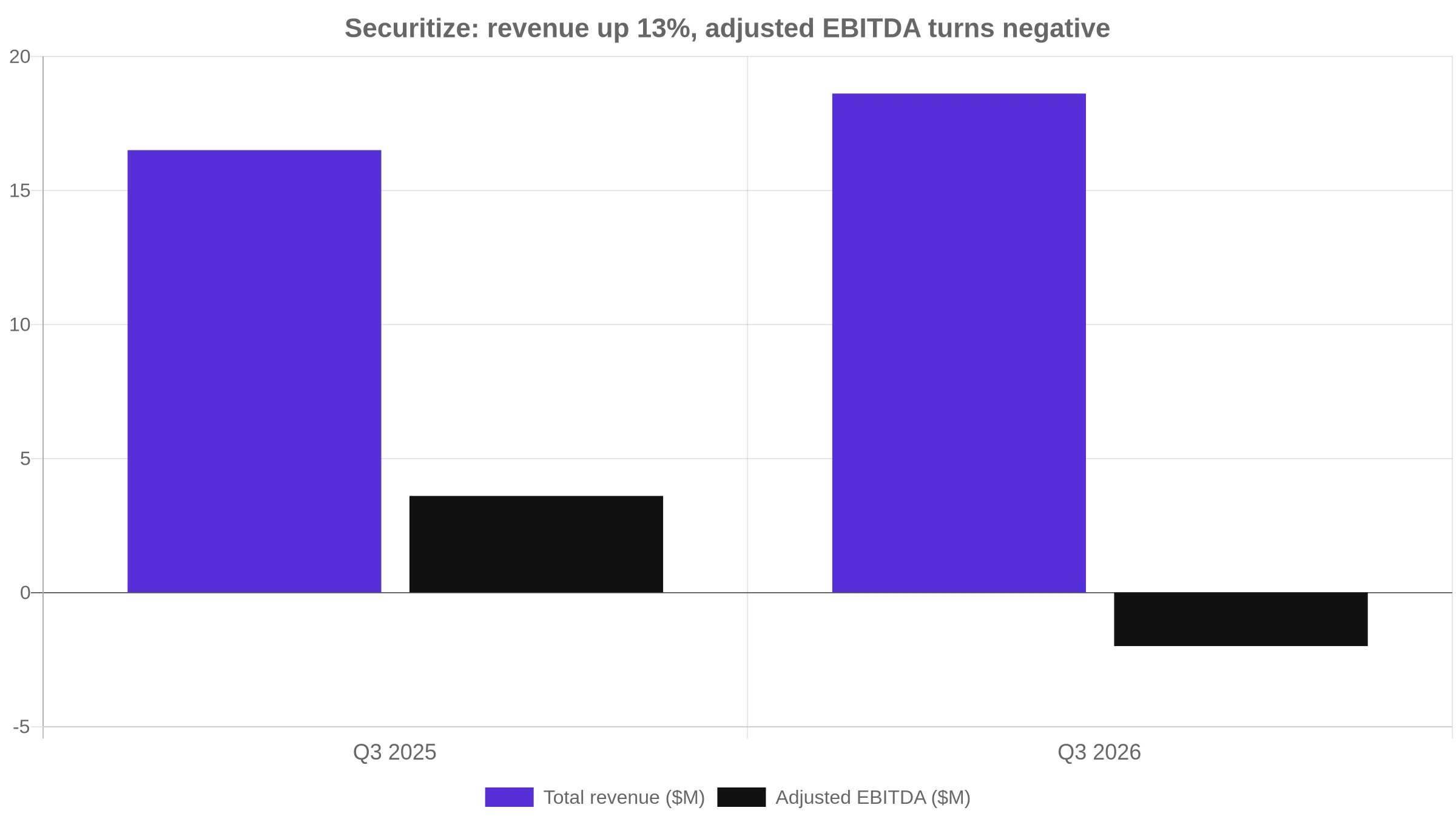
Securitize reported the acquisition and its third-quarter results on the same afternoon, and the results explain why the company is shopping for a second revenue line. Revenue was $18.6 million, up 13% from $16.5 million a year earlier and up 29% from the second quarter, the second-highest quarterly figure in its history. Aggregate transaction volume was $4.3 billion, up 20%.
The bottom line looks worse than the operating business. The company reported a net loss of $66.3 million, or $0.41 per diluted share, of which roughly $60 million, about 90%, came from largely non-cash expenses and accounting charges tied to the business combination, the NYSE listing and warrant-related items. Adjusted EBITDA was a loss of $2.0 million, against positive adjusted EBITDA of $3.6 million a year earlier and, according to management, a 64% improvement from the second quarter.
Securitize total revenue and adjusted EBITDA, Q3 2025 versus Q3 2026, in millions of dollars. Data: Securitize third-quarter 2026 results.
Fund services is the soft spot. Securitize Fund Services serviced 669 active funds at September 30, roughly flat year on year, with total assets under administration of $25.2 billion, down 29%. That decline sits next to a 39% increase in average tokenized assets, which tells you the two halves of the business are moving in opposite directions.
The balance sheet is the reason the company can buy rather than build. Securitize ended the quarter with about $300 million in cash and cash equivalents and no debt, and its board authorized a $50 million share repurchase program on November 6, open through December 31, 2027. “We ended the quarter with approximately $300 million in cash and cash equivalents and no debt, providing us with the financial flexibility to continue investing in our growth initiatives while opportunistically managing our capital structure,” chief financial officer Francisco Flores said in the release.
Two capital-allocation decisions in three days are worth flagging. The buyback equals about 17% of reported cash and roughly 2.7 times quarterly revenue, and the release says it will be funded from cash on hand. The acquisition is not priced in public, so the combined draw on that $300 million cannot be calculated yet. Companies that authorize buybacks and announce acquisitions in the same week usually expect the market to read confidence; the filings will eventually show the cash movement.
What the announcement does not say
Four omissions stand out for anyone trying to value the transaction.
There is no purchase price and no indication of the consideration mix, cash or stock. There is no earnout structure disclosed. River One’s own financials, loan volume, assets under management, capital providers and headcount are absent. And the conditions beyond “customary closing conditions” are not enumerated.
The regulatory paper trail reflects that. Securitize’s only Form 8-K on file for November 9 covers Item 2.02, results of operations and financial condition, together with Item 9.01 for exhibits, and its text describes only the earnings release attached to it. It does not include Item 1.01, the item companies use to disclose entry into a material definitive agreement. A separate filing carrying the terms would ordinarily follow; until it does, the deal has an announcement but not a disclosed price.
Timing is the other constraint. A fourth-quarter close gives the company until December 31, 2026, which is 52 days from the announcement. The release does not say whether any regulator must clear the transaction, though adding a lending platform to a broker-dealer, alternative trading system and transfer agent group enlarges the regulatory perimeter the combined company operates in.
Why credit is a different business from issuance
Tokenization revenue is largely fee-for-service: issuance, administration, transfer agency, and a slice of assets under management. It scales with assets on platform and carries modest balance-sheet risk. Asset-backed lending scales with credit decisions, and the failure mode is a loss given default, not a missed fee.
The release’s own risk language concedes the distance. It cites the “early-stage nature of River One’s business and technology” and the “ability to establish relationships with capital providers and borrowers” among the factors that could make results differ from expectations. River One is described as developing relationships with capital providers in the stablecoin ecosystem, not as having signed them.
Stablecoin-funded credit is a live market rather than a hypothetical one. Tether and Fasanara launched a $400 million stablecoin private credit fund in September 2026, and the structures that connect stablecoin liquidity to institutional borrowers are being built by several competing groups. Warehouse financing is the layer where that capital meets actual loan collateral, and it is the layer where underwriting discipline, not token design, decides the returns.
There is a second-order question about the tokenized securities business. Securitize expanded its onchain stock offering to 25 U.S. equities on November 2, days after launching the product with an initial slate that included Apple, Microsoft, Nvidia, Tesla and Amazon. Financing a portfolio of small-business loans and financing tokenized equities are different credit problems, and nothing in the release says River One’s technology will be applied to the equities book. The connection the companies are selling is distribution of capital, not a single unified collateral pool.
What to watch before the fourth quarter closes
The first item is a filing with a price. A Form 8-K under Item 1.01, or an amendment to the November 9 filing, would disclose the consideration and any earnout, which is what turns a strategic claim into a valuation.
The second is closing. The transaction is expected to complete in the fourth quarter, and any slip past December 31 is a signal about conditions the release does not describe.
The third is River One’s first named capital provider. The company’s model depends on lenders accepting its collateral monitoring and borrowing-base reporting; a signed facility from a regulated lender or a stablecoin issuer would do more for the thesis than any additional partnership announcement.
The fourth is the fourth-quarter report, the first to include a full period of Securitize Stocks and the last before the acquisition would consolidate. Revenue growth of 13% year on year, with fund services assets under administration down 29%, is a mix that needs a second engine. Whether River One becomes that engine depends on numbers the announcement has not supplied.
This article is for informational purposes only and is not investment advice. It reflects information published on November 9, 2026 and does not price the transaction described.

 blockchainreporter.net