Nvidia CEO Jensen Huang has admitted to an affair with a Chinese spy who was the founder of the largest buyer of Nvidia’s AI chips in Southeast Asia.
As reporting uncovers her role in assisting with smuggling Nvidia’s chips and/or IP into China — raising US national security concerns — some shareholders are already wondering how to fire Huang.
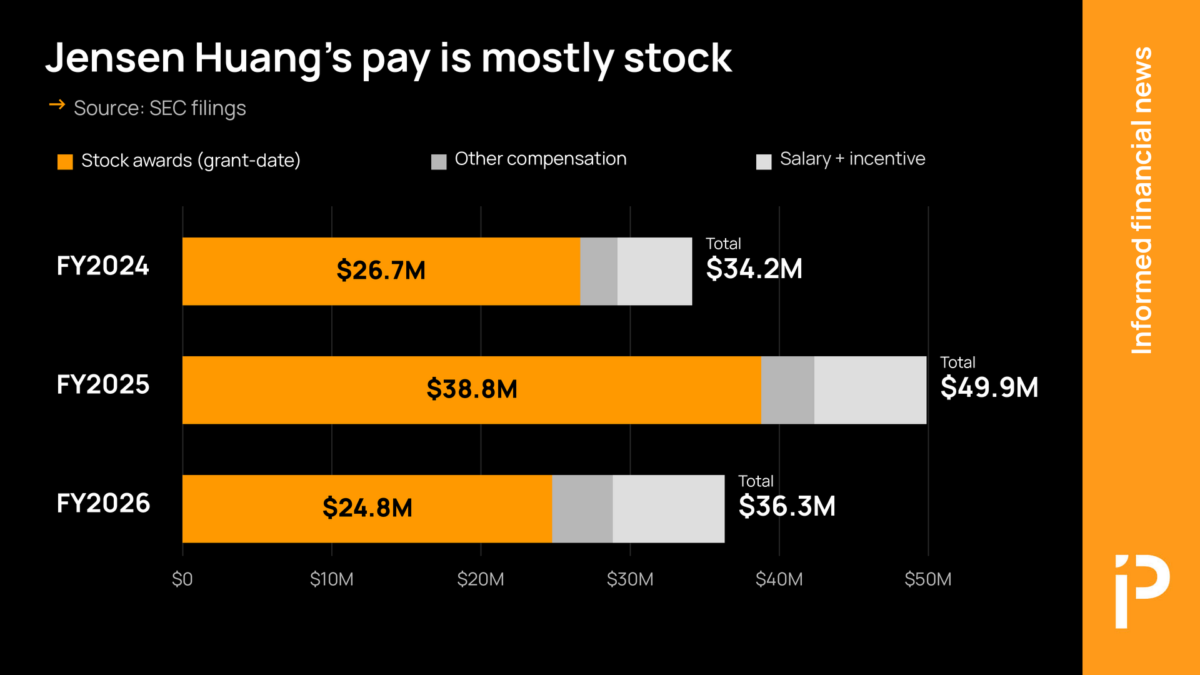
Huang is a billionaire almost entirely due to his equity in Nvidia, the world’s second-largest public company.
Know when your coins move
Alerts, real-time prices, and market news — all in one app
Point your phone camera to install
4.8 based on 40K reviews in the App Store and Google Play
Even if Nvidia fires him or relegates him to a non-executive role as chairman, his beneficial ownership above $150 billion today means he’ll comfortably remain a billionaire in almost any outcome.
Even if he leaves the company, Jensen Huang still has billions of dollars worth of Nvidia stock.
Huang admitted in writing to employees on Sunday, “I was unfaithful to my wife,” days after the New York Times reported US intelligence had concluded the woman involved was a Chinese intelligence recruit.
That same day, Nvidia’s board said its founder had reportedly been “the target of a foreign intelligence effort.”
Nvidia’s board of directors can fire Jensen Huang
Can Nvidia fire Huang as CEO? The answer is a simple yes.
In fact, it only takes six votes to fire him as CEO. Nvidia’s board of directors is already investigating the incident and has unilateral power to fire him as an officer of the company.
Separately, and especially if the board doesn’t enact a six-vote majority to fire Huang, shareholders may attempt to organize his removal as a director from the board “without cause” based on public outcry over his conduct.
Shareholders, as opposed to the simple majority required by the board, would need a supermajority vote to fire Huang without cause, according to the company’s bylaws.
The quickest and most likely removal — if any, of course — starts with the board of directors.
Donald Trump thinks Jensen Huang should remain CEO of Nvidia
Nvidia’s board has already told Bloomberg that it has “no reason to believe that either national security or Nvidia secrets were compromised.”
However, its self-described inquiry “will examine all available information.”
Although boards at public companies don’t generally fire workers for mere romantic involvements, the trail of evidence regarding smuggling of chips into China, possible IP theft, or other breaches of work duties or US regulations could be grounds for termination.
President Donald Trump, for his part, thinks Huang should remain on the job. Trump said of Huang, “I think he’s an honorable guy,” yet he conceded, “you never know what is going on.”
Nvidia’s bylaws state unambiguously, “Any officer may be removed from office at any time, either with or without cause, by the affirmative vote of a majority of the directors in office at the time.” It adds, “All officers shall hold office at the pleasure of the board of directors.”
A majority of the directors requires six votes. Nvidia’s board has 11 members.
Moreover, a potential separation agreement doesn’t necessarily include severance protections. Nvidia’s proxy states that Huang serves “at will,” and that Nvidia operates without “severance, or change-in-control agreements with our executive officers.”
Huang beneficially owned 870.6 million shares or 3.58% of Nvdia’s equity, which is worth approximately $150 billion.
Short-seller called Nvidia top by not trusting Jensen Huang
Voluntary (or coordinated) resignation
Of course, the final option is for Huang to simply resign. Indeed, many CEOs of public companies have resigned after romantic scandals.
For example, Intel CEO Brian Krzanich resigned in 2018 because of a relationship with an employee, violating a non-fraternization policy covering all managers.
Boeing pushed CEO Harry Stonecipher out in 2005 for conduct that a chairman said “reflected poorly on Harry’s judgment and would impair his ability to lead the company.”
HP CEO Mark Hurd resigned in 2010 after a harassment inquiry into his ties to a contractor found conduct violations.
Although no published Nvidia rule bans a CEO dating a customer expressly, its code of conduct generally flags “personal relationships” as a possible conflict of interest.
If the ongoing investigation finds Huang shared anything sensitive or concealed the relationship, the board might be able to justify “cause” for removal.
Nvidia reports earnings on November 17, and three House committee chairs have requested a closed-door briefing, tentatively scheduled for November 18.
Nvidia stock opened substantially lower today on news of Huang’s affair. Two hours into Monday’s Nasdaq trading session, the company remained 6% below Friday’s close.

 protos.com