The Fed’s rate freeze will mean nothing unless banks fix a repo market bottleneck
cryptoslate.com
29 October 2026 23:40, UTC
The Federal Reserve held its rate target range at 3.75%-4% on Oct. 28, with operating instructions effective the following day setting out how to implement that stance across bank reserves and overnight funding markets.
The Federal Open Market Committee's October decision passed 10-2, with Lisa D. Cook and Beth M. Hammack dissenting and preferring a quarter-percentage-point increase.
The Oct. 29 accompanying implementation note maintains interest on reserve balances (IORB) at 3.9%, with standing overnight repo at 4% and reverse repo offered at 3.75%.
Know when your coins move
Alerts, real-time prices, and market news — all in one app
Point your phone camera to install
4.8 based on 40K reviews in the App Store and Google Play
The 3.75%-4% range is the FOMC's policy target for the federal funds market, where banks and other eligible entities borrow and lend balances held at the Fed overnight without collateral.
As the New York Fed explains, administered rates help keep that market rate within the target range. An instruction to maintain the range differs from a report of where transactions cleared.
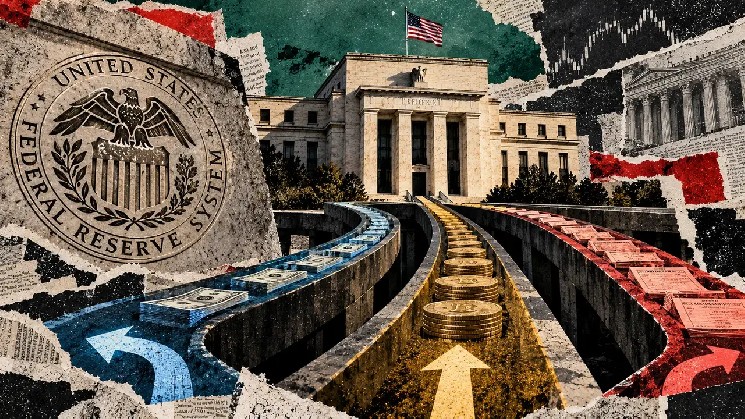
How the Fed holds a 3.75%–4% range
The October hold is implemented through three administered rates, with conditional asset purchases reserved for maintaining ample reserves.
The target range sets the stance; IORB, repo and reverse repo help keep overnight rates inside it. Conditional reserve purchases are not a quantified QE announcement.
The graphic maps instructions and facility terms, not actual transaction results, the effective federal funds rate, completed asset purchases or crypto-market transmission. The directive gives no purchase amount.
Sources and evidence
The Federal Reserve Board sets the interest paid on eligible institutions' reserve balances at the Fed. Its IORB guidance describes the payment as a tool for implementing monetary policy and controlling short-term rates.
At the directive's 4% rate, standing overnight repo offers secured overnight funding. In a repo, the New York Fed's trading desk buys securities with an agreement to resell them. The transaction temporarily adds reserves and helps limit upward pressure on money-market rates.
Overnight reverse repo works in the opposite direction, as the Desk sells securities with an agreement to buy them back, temporarily reducing reserves. The New York Fed's repo and reverse repo explanation describes the two tools as supporting rate control and smooth market functioning.
The reverse repo terms also include a $160 billion daily limit per counterparty.
Conditional purchases and the relation with rates
The directive permits the Desk, when appropriate, to increase the System Open Market Account's holdings through Treasury-bill purchases to maintain ample reserves. If needed, it can also buy other Treasury securities with no more than three years remaining to maturity.
The note also directs the Desk to roll over all principal payments from Treasury holdings at auction and reinvest all principal payments from agency securities into Treasury bills.
The practical lesson for crypto markets is to distinguish the chosen interest-rate stance from the operations that maintain it. The October package describes a hold implemented through an ample-reserves system.
Transaction results and purchase records would show how the instructions are executed. Separate evidence of crypto demand and transmission would be needed to connect those operations to Bitcoin.

 cryptoslate.com