The separate borrower survey also reported cost pressure. The ECB’s Oct. 26 enterprise-financing survey showed a net 46% reporting higher bank-loan interest rates, compared with 42% previously. The response base covers firms that applied for bank loans, credit lines or bank or credit-card overdrafts. The figure counts firms reporting increases minus those reporting decreases.
The borrower sample changed substantially, with first-time respondents forming a majority. Separately, about half of firms answered for July through September while the remainder covered April through September. Those differing windows complicate comparisons; the ECB’s explicit warning about the sample change particularly concerns numerical expectations.
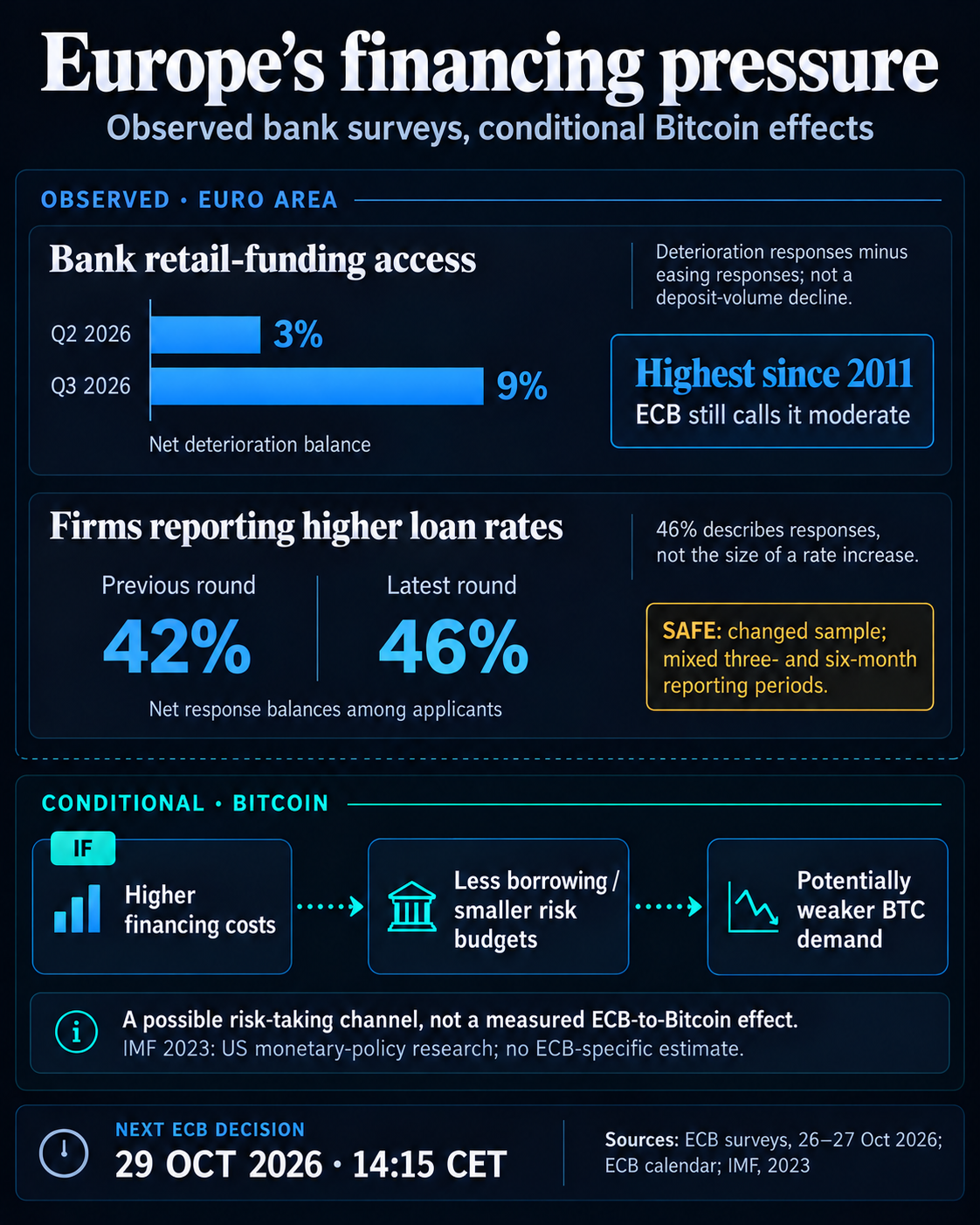
How financing costs could reach Bitcoin
The financing constraints coexist with continued money and loan growth. ECB data released Oct. 27 showed September annual growth of 3.5% in broad money, 4.2% in adjusted corporate loans and 3.1% in adjusted household loans, all unchanged from August. Those annual growth measures can remain positive while new borrowing becomes harder or more expensive.
A 2023 IMF working paper offers a possible mechanism: it found that US Federal Reserve tightening reduced a common crypto-price factor through investors’ risk taking. Applying that finding to European financing costs is an inference.
For Bitcoin, the potential pressure runs through the cost of financing and investors’ willingness to take risk. If more expensive credit prompts investors to borrow less or reduce the amount they are willing to risk, demand for Bitcoin could weaken.
Wider funding spreads, tighter dollar financing and actual deleveraging would strengthen the case that regional strain is reaching crypto investors. Stable dollar funding and sustained Bitcoin demand would weaken it.
The next policy checkpoint is the ECB decision scheduled for Oct. 29 at 14:15 CET.

 cryptoslate.com