coindesk.com

Happy Thursday, advisors!
In today’s newsletter, Dovile Silenskyte from WisdomTree on the two questions investors keep bundling together when they buy bitcoin.
Then, in “Ask an Expert,” Bryan Courchesne from DAiM answers questions about how the failure of the CLARITY Act vote could impact bitcoin as an investment.
Happy reading.
- Sarah Morton
Bitcoin exposure doesn't have to come with a second job
Bitcoin is becoming a more familiar portfolio allocation. But owning it directly can still demand the time, technical judgment and operational discipline of a second job.
The key point is that investors may have clear views on bitcoin’s role within their portfolios without wanting to become their own custodians, cybersecurity teams and protocol analysts.
Self-custody moves risk; it does not eliminate it
“Not your keys, not your coins” is a powerful slogan. It is also incomplete.
With self-custody, the investor must safeguard private keys and recovery phrases, maintain wallet software or hardware, execute transactions correctly and plan for inheritance or incapacity. There is no forgotten-password process, reversal mechanism or help desk when a recovery phrase is lost or a transaction is sent to the wrong address.
That control can be valuable. But it transfers custody risk from an institution to the individual.
Hardware wallets can reduce certain risks, but they do not make operational security foolproof. The attack surface also extends beyond the device itself: backup phrases, personal data, software updates and transaction hygiene all matter.
Self-custody can expose investors to multiple forms of security risk
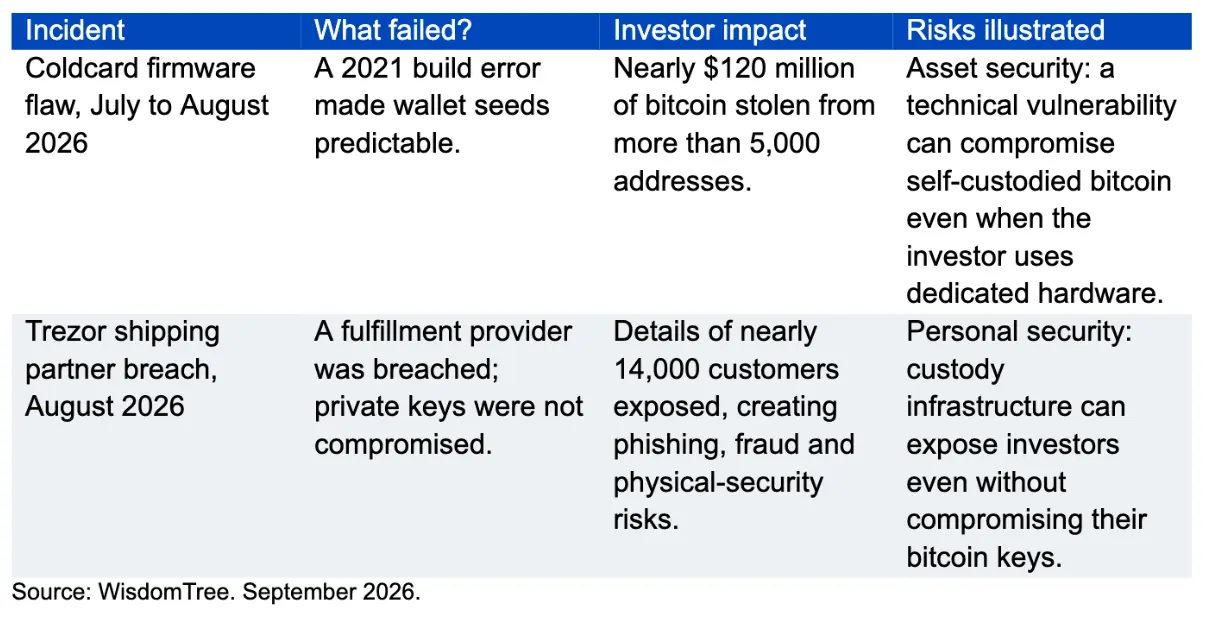
For an investor making a modest portfolio allocation, that is an uncomfortable mismatch. The operational burden does not improve bitcoin’s expected return. It is simply the cost of a direct bitcoin ownership model.
Bitcoin is not static
Bitcoin is built to resist arbitrary change, but it still evolves. Software upgrades, wallet compatibility issues and occasional chain splits can create decisions for direct holders.
A blockchain split can be particularly complex; it may create rights to assets on competing networks, leaving holders to decide whether to claim, hold, sell or ignore them. Security, liquidity, wallet support, transaction replay risk and tax treatment can all matter.
This is where the romantic version of self-custody collides with reality. Holding bitcoin directly means owning not only the asset, but also the operational consequences of its ecosystem.
Exposure and ownership are different decisions
Investors should separate two questions that are too often bundled together:
- Do I want bitcoin exposure?
- Do I want to manage bitcoin directly?