
 coindesk.com
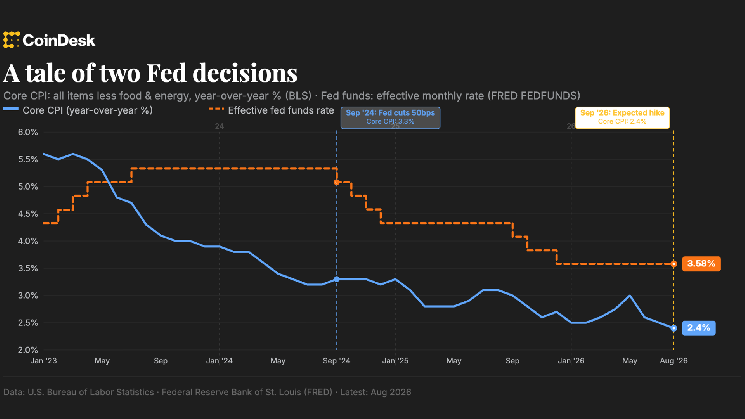
A Federal Reserve rate hike next Wednesday — likely 25 basis points — is essentially universally expected at this point.
One of the last holdouts on Wall Street, Goldman Sachs, late Friday, rescinded its forecast that the Fed would stay on hold next week.
“While today’s CPI report only raised our August core PCE forecast slightly to 0.26% and has not changed our fundamental inflation view, we think that the FOMC will want to avoid the market reaction that would likely follow from remaining on hold when the market is pricing a nearly 90% chance of a hike,” said the bank.
A tale of two Fed decisions
It was two years ago — in September 2024 — that the Fed embarked on a rate-cutting cycle with annual core CPI running at well over 3%. Not only that, but the central bank saw fit to slash its benchmark fed funds rate by 50 basis points that month, instead of the assumed 25.
Fast-forward two years, and markets are assuming the Fed has no choice but to embark on a rate-hike cycle next week, even as the core CPI has fallen to a five-year low of 2.4%.
Wall Street, not Main Street
“The Wall Street wall of mirrors,” said James Thorne, chief market strategist at Wellington-Altus, of the Goldman shift. “No material change in inflation outlook, but a hike to calm Wall Street.”
“Rate hikes cannot produce oil, expand refining capacity, or repair disrupted supply routes,” he continued. “They reduce demand, investment, employment, and household purchasing power.”
Thorne noted that wage growth has slowed to just 3.1% year-over-year. “There is no demonstrated wage price spiral, no verified second round inflation, and no evidence that the energy shock is becoming embedded.”
“If the Warsh Fed hikes simply to validate Wall Street’s futures market narrative, Warsh’s critique of the Wall of Mirrors and his promise to end forward guidance will not have been worth the paper his Jackson Hole speech was written on,” he concluded.
Inflation may be perkier than core CPI showed
Not all agree with Thorne, of course.
“The [core CPI] gain were heavily in services, said Diane Swonk, chief economist at KPMG. Super core services, she said, were up a particularly hot 0.5% and up 3% year-over-year.
Based on the CPI data, the PCE Index, which is the Fed’s preferred inflation gauge (not CPI), is likely to be higher by 0.4% in August, with core up 0.3%, said Swonk. That would put the annualized pace of core PCE at 3.4% — far more above the Fed’s 2% target than core CPI.
“We now expect three rate hikes by early 2027,” concluded Swonk. “The probability that the vote will be unanimous just rose. That would provide a much needed boost to the Fed’s inflation-fighting credibility, something the bond market is craving.”



