Memecoin degens are providing the spark for Wall Street to turn stock tokens into real capital
cryptoslate.com
10 September 2026 12:05, UTC
Pump.fun announced its new Custom Pairs feature on Sept. 9, letting new memecoins trade against tokenized stocks, major crypto assets, and other quote assets, expanding the familiar settlement menu beyond $SOL and stablecoins.
If a meme trades against a tokenized stock, traders must acquire or supply that stock token to enter the market. Launchpads can become distribution rails for assets that already exist on-chain but still need reasons for people to hold and transact with them.
Retail speculation could perform the first job in a longer adoption process by creating transactions and inventory. Separate lending markets, collateral systems, and managed vaults can perform the next one by giving that inventory uses beyond trading.
Know when your coins move
Alerts, real-time prices, and market news — all in one app
Point your phone camera to install
4.8 based on 40K reviews in the App Store and Google Play
Institutions could eventually interact with those products without touching the memecoin market that helped create the activity.
The causal bridge from meme trading to deeper lending liquidity or institutional use remains hypothetical, but moves such as Pump.fun's Custom Pairs makes that potential connection timely enough to test.
Platform / market
Date cited
What changed
Quote asset expansion
Evidence in article
Forward-looking implication
Pump.fun
Sept. 9
Announced Custom Pairs for new memecoins
Tokenized stocks, major crypto assets, and other quote assets
New memecoins no longer need to trade only against $SOL or stablecoins
Launchpads could become distribution rails for tokenized assets that need transactional demand
Raydium LaunchLab
Sept. 6
Enabled a newly issued token to pair with any supported quote token
Any supported quote token on Raydium
LaunchOnSF named as first integration
Custom quote assets may become a category-wide feature across Solana launch venues
Robinhood Chain memecoin pairs
Sept. 2
Memecoins traded against tokenized stock tokens
Tokenized stocks used as settlement assets
$217 million in trading volume on Sept. 2
Retail speculation can create stock-token activity before deeper financial utility emerges
Hyperliquid / xStocks
Aug. 10
Five tokenized stocks and ETFs launched as native spot markets
Tokenized stocks and ETFs
xStocks said future HyperEVM composability could include lending, collateral, and structured products
Tokenized assets may move from spot trading into programmable financial infrastructure
From a memecoin trade to tokenized-asset inventory
Tokenization turns exposure to an equity, exchange-traded fund, or another real-world asset into a transferable blockchain token. Issuance alone doesn't solve demand, market depth, or collateral utility.
In a market where a meme is quoted in a tokenized stock, the stock token becomes the settlement side of the trade. A buyer may want the meme rather than equity exposure, but entering the pair still creates transactional demand for the tokenized asset and puts more of it into wallets or pools.
Memecoin pairs using tokenized stock tokens on Robinhood Chain generated $217 million in trading volume on Sept. 2. That result shows activity but leaves persistence and migration into other financial products unresolved.
Raydium announced on Sept. 6 a newly issued token to pair with any supported quote token and named LaunchOnSF as the first integration.
The moves suggest custom quote assets are becoming a category feature, so a tokenized stock can become necessary inventory inside a market sought for an entirely different reason, broadening its route to users beyond deliberate equity exposure.
More transactions can spread that inventory across traders and pools, giving liquidity providers and market makers more opportunities to support the asset. Meanwhile, volume and wider distribution remain weak proxies for execution quality.
The next stage depends on whether protocols can safely use the token as collateral and whether borrowers and lenders show sustained demand.
In February, Ondo Finance said its $SPYon and $QQQon tokenized ETFs had entered Morpho lending markets on Ethereum.
A tokenized ETF begins as blockchain-based market exposure. Once accepted as collateral, it can support borrowing and other capital-efficient strategies without requiring the holder to sell that exposure.
Flowdesk, stablecoin issuer Agora, and xStocks announced a Morpho strategy that accepts the $AUSD stablecoin and allocates capital to a market using tokenized S&P 500 exposure (SPYx) as collateral.
The vault opened with an $18 million cap, while Flowdesk handles curation, liquidity, and ongoing risk monitoring.
Morpho's live interface listed over $6.3 million in deposits around Sept. 8 and Sept. 9 and identifies Limitless Frontier Corp. as the operator.
The balance shows real use while also noting the gap between available capacity and deposited capital.
Stage
What happens
Article example
Main user created
Metric to watch
Unresolved risk
1. Issuance
A tokenized stock, ETF, or other asset exists on-chain
Ondo tokenized ETFs; xStocks tokenized stocks and ETFs
Eligible holder
Minting and redemption activity
Asset exists but may lack organic demand
2. Custom pair trading
A memecoin trades against the tokenized asset instead of $SOL or stablecoins
Pump.fun Custom Pairs; Raydium LaunchLab
Retail trader
Pair volume, transaction count, wallet distribution
Volume may be temporary or speculative
3. Liquidity provision
LPs and market makers hold both the meme asset and the tokenized quote asset
Stock-token meme pools on Robinhood Chain
LP / market maker
Pool depth, slippage, fee revenue
Inventory can grow without reliable price discovery
4. Collateral market
The tokenized asset is accepted as collateral for borrowing
Ondo $SPYon and $QQQon entering Morpho lending markets
Borrower / lender
Borrow demand, loan-to-value ratios, liquidations
Oracle failure or thin exit liquidity can create lending losses
5. Managed vault
A vault uses tokenized-asset collateral markets to generate yield
Flowdesk, Agora, and xStocks $AUSD equity strategy vault on Morpho
Vault depositor
Deposits, cap utilization, risk parameters
Deposits may remain below capacity if demand is weak
6. Institutional access
Professional users interact with structured products, collateral systems, or managed exposure
Institutions may avoid assets without predictable entry and exit routes
Different users can deepen the same market
A meme trader may acquire a tokenized stock because it is the quote asset for a desired coin, while a liquidity provider may hold both sides of the pair to earn fees.
At the same time, a borrower may keep the stock token for its market exposure while using it as collateral, a vault depositor may care about the yield generated by borrowing demand, and a professional risk manager may focus on caps, oracles, and liquidation routes.
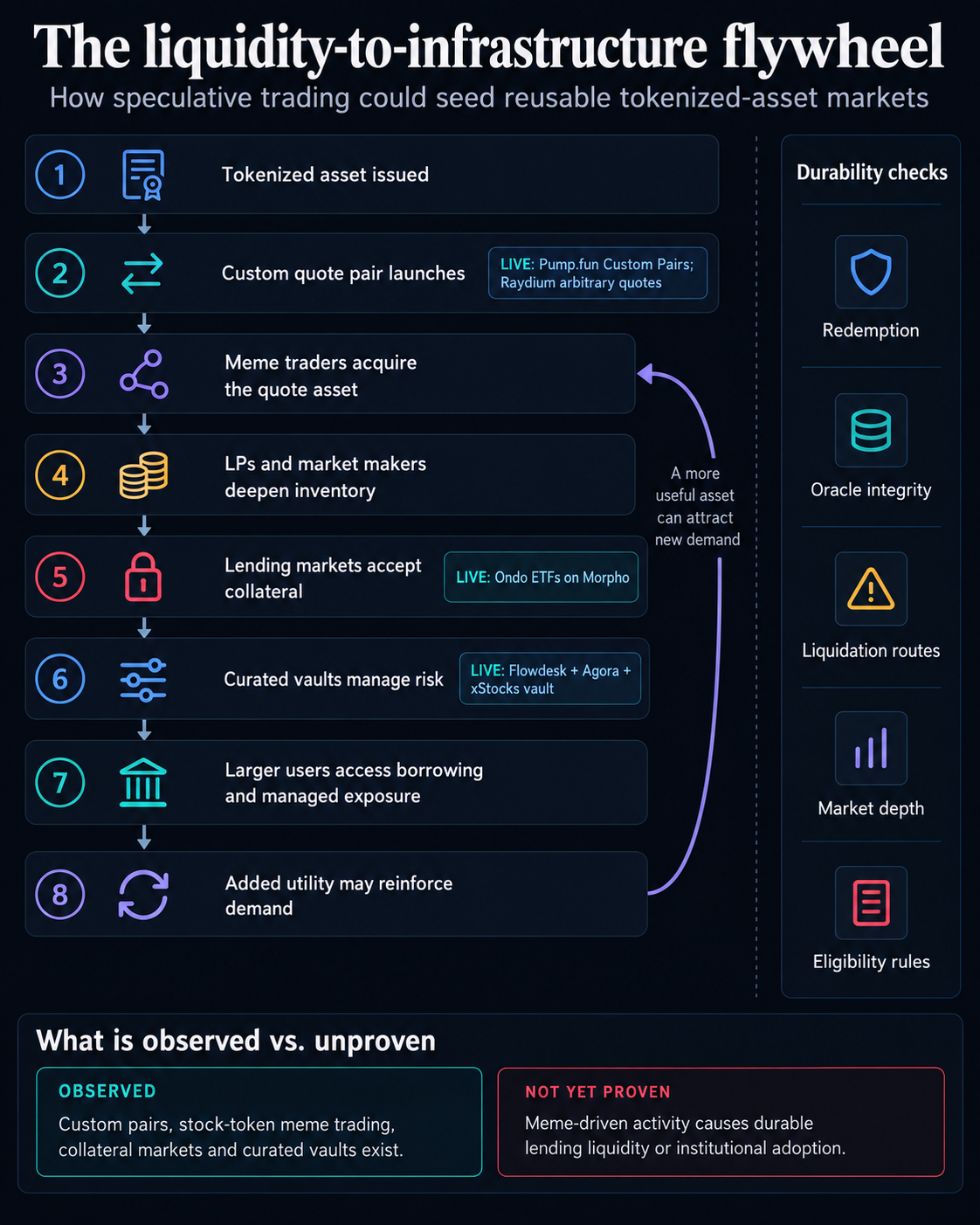
That progression explains how retail speculation could reach institutional infrastructure without requiring institutions to trade memes. Different groups can use the same underlying inventory through different products.
On Aug. 10, xStocks launched five tokenized stocks and ETFs as native spot markets on Hyperliquid's HyperCore order books. It said full composability on HyperEVM, Hyperliquid's smart-contract environment, would follow and could include lending, collateral, and structured-product integrations.
If custom pairs spread across launchpads and chains, they could repeatedly introduce tokenized assets to traders and liquidity providers. A broader base of transactions and inventory could make new lending markets, portfolio collateral, and managed strategies more attractive to build. Added utility could then create another reason to acquire the asset.
Diagram shows how tokenized-asset trading could progress from issuance and custom pairs to lending, risk-managed vaults and broader institutional access.
Transaction counts remain an incomplete measure of liquidity depth, pricing reliability, and holder stability. A tokenized asset also needs dependable minting and redemption, clear legal and eligibility rules, robust price feeds, predictable liquidation mechanics, and enough market depth for lenders to exit collateral without disorderly losses.
Ondo's tokenized-stock framework connects eligible users to minting and redemption against underlying market exposure, subject to geographic and onboarding restrictions. Gauntlet and Flowdesk add collateral parameters, caps, monitoring, and liquidation design around specific lending products.
If the quote asset is thin, a fast meme rally can produce inventory without producing trustworthy price discovery. If redemption is limited or an oracle fails during volatile trading, lenders face risks that no amount of trade count can offset.
Institutional users need predictable routes into and out of positions alongside visible activity.
Durability check
Why it matters
What strong evidence would look like
Failure mode
Article example
Persistent liquidity
Lending and vault products need more than one-day trading spikes
Sustained depth across pools, order books, and lending markets
Meme activity fades and liquidity disappears
Robinhood Chain stock-token meme pairs produced $217 million in volume on Sept. 2, but persistence remains unresolved
Redemption reliability
Holders and lenders need confidence that tokenized exposure can be exited
Clear minting and redemption routes for eligible users
Tokens trade at unreliable premiums or discounts
Ondo’s framework connects eligible users to minting and redemption
Legal and eligibility rules
Institutions need clarity on who can hold, redeem, or use the asset
Defined geographic, onboarding, and compliance restrictions
Activity grows in markets that larger capital pools cannot access
Ondo’s tokenized-stock framework is subject to geographic and onboarding restrictions
Oracle quality
Collateral markets depend on accurate pricing
Robust feeds that hold up during volatility
Bad prices trigger incorrect liquidations or unsafe borrowing
Article flags oracle failure as a key risk during volatile trading
Liquidation depth
Lenders need collateral that can be sold without disorderly losses
Liquid markets with predictable exit routes
Collateral cannot be liquidated cleanly in a downturn
Article notes lenders need enough market depth to exit collateral
Risk-managed lending design
Caps and parameters prevent early markets from scaling too aggressively
Conservative collateral factors, caps, monitoring, and liquidation design
Borrowing grows faster than the market can support
Flowdesk handles curation, liquidity, and ongoing risk monitoring for the $AUSD strategy
Use beyond trading
Infrastructure status depends on whether inventory has utility after speculation cools
Borrowing demand, vault deposits, structured products, and collateral integrations
Tokenized assets remain speculative settlement tokens only
Morpho lending markets and the $AUSD strategy vault show early non-trading use cases
Custom pairs would give users a reason to touch tokenized assets and seed the transactions and inventory from which deeper markets might grow. DeFi's role is to determine whether that activity can be transformed into borrowing capacity, managed exposure, and collateral that remains useful after speculative attention moves elsewhere.
Current evidence shows material stock-token meme trading on Robinhood Chain, a fresh custom-pairs push on Solana, and separate tokenized-equity lending products with real deposits and professional controls.
Memecoins may provide the spark, while redemption, risk management, collateral design, and persistent liquidity will decide whether the result becomes infrastructure.

 cryptoslate.com