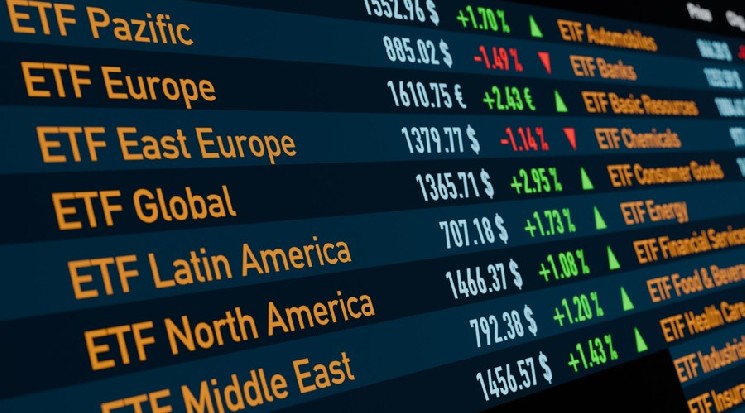
Total consolidated US ETF notional value traded in July reached $90.6 billion (up 45% year-over-year), with the proportion of automated intelligent execution transactions and notional volume amounting to 58% and 17%, respectively.
🚨 TRADEWEB REPORTS AUGUST 2026 TOTAL TRADING VOLUME OF $61.2 TRILLION, AVERAGE DAILY VOLUME OF $2.8 TRILLION - PRESS RELEASE
— Blockchain Daily News (@blckchaindaily) September 4, 2026
These figures are significant because ETFs were once primarily traded electronically on exchange, while large institutional orders were still often handled through dealers. The execution workflow is increasingly becoming fully electronic from price discovery through execution and post-trade analysis.
The institutional market isn't just trading more ETFs; it is using them for more sophisticated purposes. Tradeweb's July data shows fixed income ETFs accounted for 27% of trading, while equities accounted for 66%.
That reflects a broader shift towards using ETFs for a variety of strategies, including rapid asset allocation, duration management, credit exposure, liquidity management, hedging, tactical sector exposure, portfolio transitions, benchmark implementation, raising and deploying cash quickly.
Liquid Portfolio Building Blocks
In other words, institutional investors increasingly view ETFs as liquid portfolio building blocks, rather than merely funds that happen to trade intraday. This is particularly important in bonds, where ETFs can provide a more readily tradable instrument than the underlying bonds themselves.
The retail ETF investor of 2026 increasingly looks less like a traditional long-term fund investor and more like a tactical trader.
Citadel Securities’ market update for the first half of the year reveals that ETFs attracted $1.2 trillion in net inflows, 45% ahead of the figure for the same period in 2025. In six months, investors allocated approximately two and a half times what historically represented an entire year’s worth of ETF inflows.
As investors crowd into market leadership, leverage has become the preferred way to express that view. Options, leveraged ETFs and systematic strategies are increasingly amplifying moves in the underlying market.
For example, leveraged ETF assets reached a record $218 billion, more than four and a half times their levels from June 2020. In the second quarter alone, assets increased by roughly $82 billion, led by technology and semiconductor exposure.
Citadel’s first half data shows retail buying at exceptionally high levels. May and June shattered the previous monthly activity records, with average daily retail cash equity volumes running 65% above 2025 levels and more than double the 2024 average. Nine of the 10 most active trading days ever observed on the platform occurred during May and June, including seven during June alone.
Retail Traders' 3.5x $SPX Push
Retail investors purchased nearly three and a half times the average daily amount on $SPX down days during the first half of 2026, the strongest buy-the-dip behaviour in the firm’s dataset. Even on $SPX rallies, they continued to buy nearly one and a half times the daily average.
According to Citadel’s head of equity and equity derivatives strategy, unlike previous periods of elevated retail activity, today’s retail investor is increasingly concentrated in the same sectors driving benchmark performance, led by semiconductors and broad-based ETFs.
The firm estimates that retail traded about $1.9 billion of semiconductor options premium per day in June, roughly six times its historical average. This indicates that ETFs are increasingly being used by retail investors to make sector and thematic bets, rather than simply construct diversified portfolios.
As always, the divergence between retail and institutional trading is fascinating. For the former, ETFs are becoming tactical trading instruments, while execution is app- or broker-driven and increasingly options-like. Trading horizons are becoming increasingly short-term amid concerns over leverage, losses and product complexity.
ETFs are becoming portfolio implementation instruments for institutional traders, who are executing using RFQs and algos and aligning net asset value calculations with market-on-close order execution. They are adopting increasingly intraday/tactical trading horizons.
The institutional side of the business is particularly interesting because ETF trading is becoming infrastructure-like. Tradeweb's European ETF volume reached almost €240 billion in Q2 – its second-highest quarter on record – while automation is approaching near-total penetration of institutional tickets.
In broader terms, the ETF is increasingly becoming the interface between investors and markets. An institution can now use an ETF to rapidly move between equities, bonds, credit and commodities; hedge it with options; execute it algorithmically; trade at net asset value or market-on-close; and analyse execution quality electronically.
Retail investors can use the same wrapper to obtain two or three times exposure, inverse exposure, options exposure, thematic exposure or short-duration tactical exposure.
However, this convergence creates a potentially important market structure risk. As more investors express views through ETFs and ETF derivatives, price movements in the ETF can increasingly feed back into the underlying securities and options markets.

 financemagnates.com