
 cryptopolitan.com
ARK Investment Management requested the SEC to allow its ARK Venture Fund to offer a tokenized share class, which could pave the way for blockchain ownership and secondary trading for a registered interval fund.
However, ARK has no plans to introduce the new share class at this point. The company filed the Second Amended Application with the SEC on August 7, seeking to modify the order issued in 2025 prohibiting the fund from offering shares in the unlisted category without a secondary market.
Two new share classes, one on a blockchain
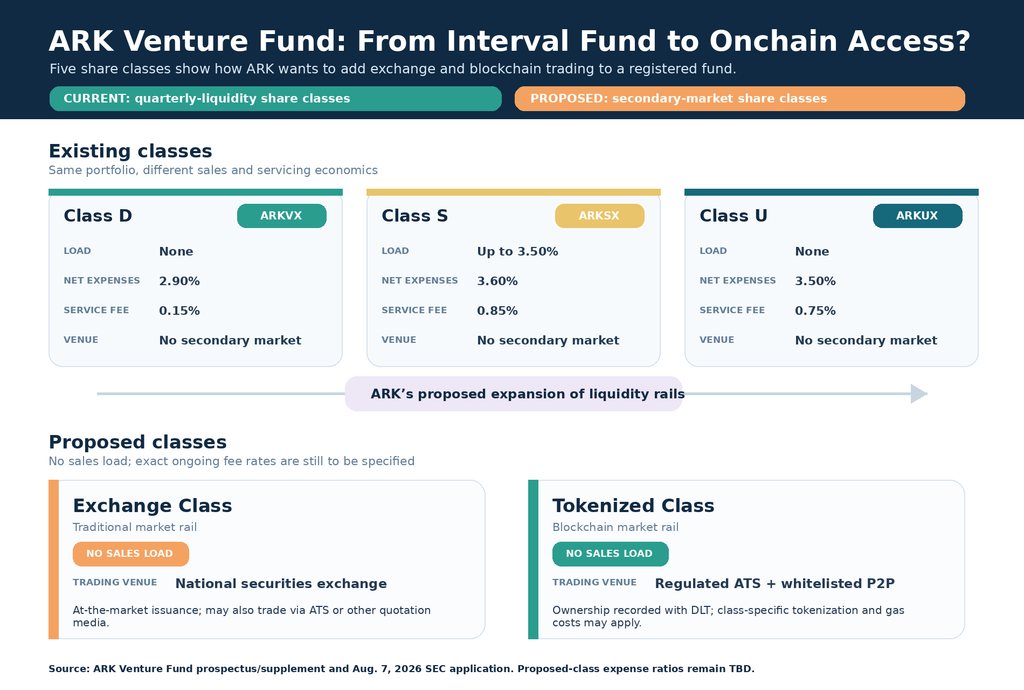
The ARK Venture Fund is a non-diversified closed-end interval fund functioning as a Delaware statutory trust and engaging in investments in both public and private entities utilizing disruptive innovations. Its offerings bear the names Class D (ARKVX), Class S (ARKSX), and Class U (ARKUX).
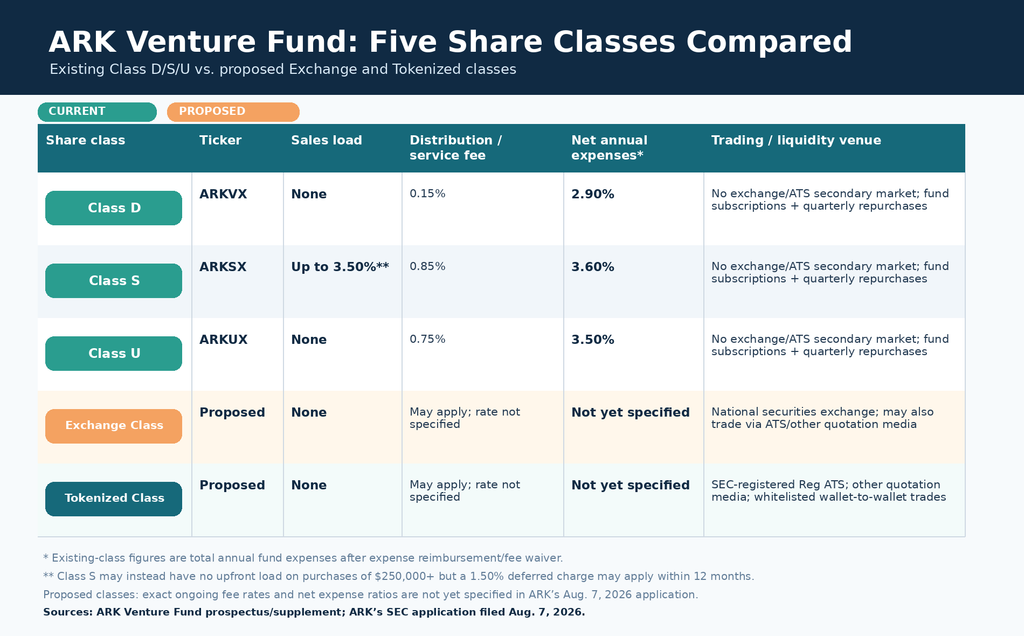
Those classes come with different costs. ARK’s prospectus lists net annual fund expenses after reimbursement of 2.90% for Class D, 3.60% for Class S and 3.50% for Class U. Class D and U have no sales load, while Class S may carry one of up to 3.50%. Their distribution and shareholder-services fees are 0.15%, 0.85% and 0.75%, respectively.
ARK now wants to add an Exchange Class and a Tokenized Class. Both would have no sales load, although the filing says either may carry distribution and shareholder-services fees and class-specific expenses. Exact ongoing fee rates and net expense ratios have not yet been specified.
The Exchange Class will be traded in a national securities exchange and issued via an at-the-market offering.
Where the tokenized shares could trade
The Tokenized Class has used distributed-ledger technologies to track ownership. Shares can be distributed through registered broker-dealers or directly by the fund’s transfer agent and may be traded on SEC-registered Regulation ATS systems, other quotation media, or on a peer-to-peer basis through “whitelisted” wallets.
According to ARK, some tokenized transactions may settle on a T+0 basis, while the Exchange Class transactions are expected to settle on a T+1 basis.
This is a major change from ARK’s November 2025 exemptive order in which it stated that the fund’s shares were not exchange-registered, quoted, or anticipated to have a secondary market. The proposed order will replace the prior order.
How the SEC approval process works
ARK submitted an initial application on May 20th, revised it on June 11th, and filed its second amendment on August 7th. The SEC released the notice concerning this issue on August 24th.
If there is no hearing held by the Commission, it is assumed that it will accept the requested appeal. Hearing requests are due by 5:30 p.m. ET on September 18th.
The wider regulatory direction is also becoming clearer. In January, three SEC departments actively dealt with tokenized securities stating that the law does not depend on the form in which it has been represented, saying:
The format in which a security is issued … does not affect application of the federal securities laws.
On September 1, SEC Chairman Paul Atkins stated that the new regulations concerning transfer agents will consider “electronic communications and blockchain technology” in securities offerings and share transfers.
A fund manager chasing a fast-growing market
ARK fund is entering a market that is relatively small, but growing rapidly. In fact, RWA.xyz reported that on September 8, some $2.35 billion of tokenized equity and venture capital has been distributed across 25 assets and 7,263 holders, with Blockchain Capital’s BCAP token alone making up $960 million of that amount.
According to earlier reports by Cryptopolitan, tokenized equity onchain trading was worth $9 billion as of July, compared to just $1 billion in January, with venture capital being one of the top-performing categories in the world of tokenized assets.
According to PwC’s forecasts, the total value of tokenized investment assets worldwide is predicted to increase by an average of 41% annually to reach an impressive $715 billion by 2030.
If the SEC approves ARK’s new arrangement, it is possible that its consequences will be more than just about one investment fund. It will give regulated investment managers a clearer understanding of how to combine traditional fund ownership with broker-dealer supervision and on-chain transfer mechanisms without treating tokenization as a way to circumvent the rules of securities legislation.