‘Dear God’: Japan’s borrowing costs hit 30-year high
protos.com
01 September 2026 21:42, UTC
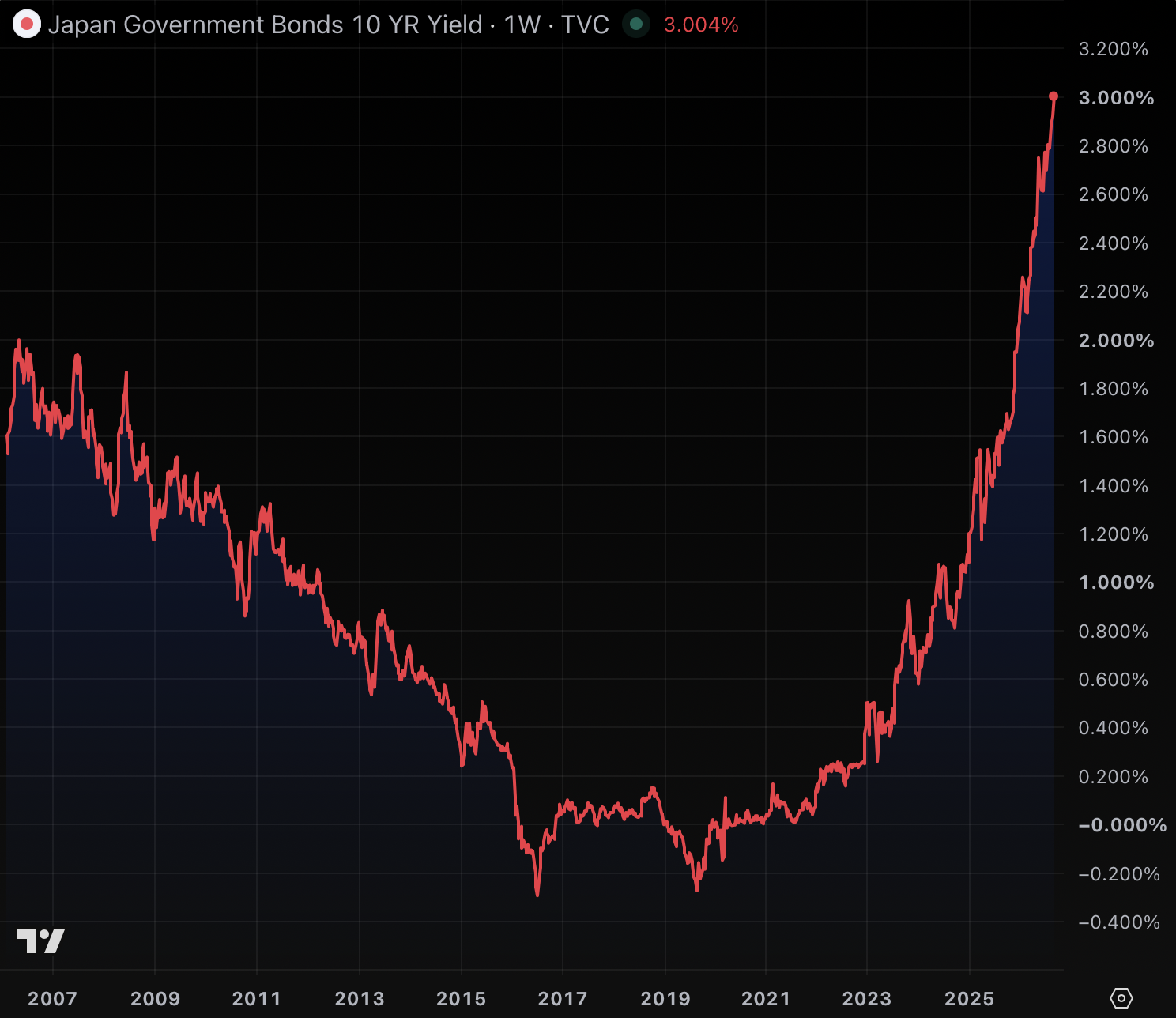
The yield that Japan pays for a 10-year loan reached 3% on Tuesday, its most expensive rate since September 1996.
The government’s borrowing cost has increased 2,900% in less than five years.
Originating a loan of the same duration in early 2022 cost the sovereign just 0.1%.
Know when your coins move
Alerts, real-time prices, and market news — all in one app
Point your phone camera to install
4.8 based on 40K reviews in the App Store and Google Play
Yield on 10-year Japan Government Bonds, 2006-present. Source: Tradingview
Japanese government bonds (JGBs) set multi-decade records across their yield curve. The country is paying a 1.81% yield to borrow for two years, 2.26% for five years, 3.8% for 20 years, and 4.18% for 30 years.
Only 40-year JGBs are below a multi-decade record, albeit only slightly: 4.28%. That duration set its recent record at 4.4% in May.
As the government pays up to bond investors, otherwise hesitant buyers are happy to continue attending auctions. Tuesday’s 10-year JGB auction attracted more than three bids per bond, keeping the rate of bidding in-line with the annual average.
Highest cost for Japan to borrow money since the 1990s
Today’s milestone for several durations of JGBs is a multi-decade record but not technically an all-time high. For example, Japanese ministry archives show JGBs offering higher yields in the 1990s.
Sensationally, market data vendor Barchart declared the 30-year print the highest in history, exclaiming: “Dear God!”
Technically, however, 30-year JGBs traded a couple basis points higher in May 2026, not to mention that its formal history runs only back to 1999 when investors would use other durations to construct de facto 30-year hold period.
In any case, JGB yields are certainly higher than it has paid over recent years.
BREAKING 🚨: Japan
Japan's 30-Year Yield just ripped above 4.18%, the highest level in history 🤯 👀 Dear God! pic.twitter.com/sW13NrSqgb
— Barchart (@Barchart) September 1, 2026
Debt servicing costs skyrocket in Japan
Japan stayed under the radar of bond traders for many years with a high level of domestic credit ownership, foreign exchange rate intervention, mandated bond purchases, and strong employment. For years, JGBs and the yen remained calm and seemingly under control.
Suddenly, however, the Bank of Japan (BOJ) raised its policy rate to 1% in June, the highest in 31 years. Worse, markets now expect a hike to an even more expensive 1.25% cost of borrowing this month.
In addition, inflation fears are rising among normally complacent yen currency traders. The bank’s own July outlook projects core consumer prices rising sharply above its target, pointing to catalysts like expensive crude oil. “The consumer price index is likely to accelerate to a level clearly above 2% from the second half of fiscal 2026,” BOJ guided.
On July 31, with the yen near a 40 year low relative to the US dollar, US and Japan’s governments bought yen together for the first time since 1998. Scott Bessent’s US Treasury paid with euros from its Exchange Stabilization Fund. Japan, the largest foreign holder of US debt, said it would tap a Federal Reserve facility to borrow dollars against its $1.1 trillion US Treasury stockpile.
Tokyo’s finance ministry said, “This joint action countered excessive volatility and disorderly movements in the Japanese yen in recent months.” Bessent hailed the “coordinated foreign exchange actions” against “disorderly yen movements.”
Despite the historic intervention, the yen did not hold the line, and Japanese borrowing costs continued to rise. Eleven days later, the yen was fading again relative to the dollar, and this week it traded back near 160 per dollar.
Debt servicing is set to cost the Japanese government a record 36.6 trillion yen ($230 billion) next year, up 17% in one year.

 protos.com