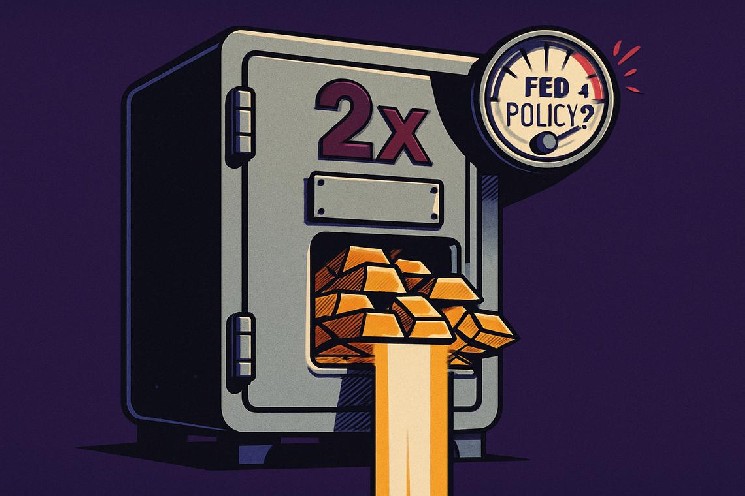
A Strategic Move Driven by Fed Policy Concerns
The expansion of Fidelity’s gold holdings lines up closely with the tone struck in the most recent FOMC minutes, which highlighted inflation as a persistent and unresolved problem. That kind of language tends to unsettle fixed-income investors more than equity traders, and it’s precisely the environment in which gold has historically found support. With the federal funds rate currently sitting between 3.50% and 3.75%, there’s little room for the Fed to maneuver without risking either reigniting price pressures or choking growth — a bind that pushes cautious allocators toward hard assets.
Impact on Gold Market Sensitivity
Why does this matter beyond Fidelity’s own balance sheet? Because large institutional shifts like this one tend to ripple through market sentiment, reinforcing the idea that gold is being treated less as a speculative trade and more as a hedge against policy missteps. The gold market’s sensitivity to real-rate expectations and Federal Reserve signaling appears increasingly aligned with the metal’s current price strength, suggesting that Fidelity’s move isn’t happening in isolation.
Current Gold Price Environment and Market Outlook
Gold is trading near some of its strongest levels in months, with spot and futures markets ranging between $4,650 and $4,690 per ounce. That pricing environment gives Fididelity’s repositioning added context — the firm isn’t buying into weakness, it’s adding exposure while the metal is already commanding a premium.
Gold Prices at Multi-Month Highs
The rally has been reinforced by wider structural pressures reported by CNBC, including a weaker dollar, renewed concern over ballooning U.S. government debt — which recently topped $40 trillion for the first time — and a Treasury Department plan to expand liquidity-support buybacks for longer-dated government debt. Those dynamics initially pushed Treasury yields lower and the dollar softer, both of which tend to favor non-yielding assets like gold. UBS commodity analyst Giovanni Staunovo told CNBC that rising global debt levels combined with sustained dollar weakness could lift gold toward $5,400 an ounce over the next 12 months.
Key Price Thresholds and Market Predictions
Even so, not every signal points in the same direction. Market odds currently assign only a 2% probability to gold reaching $15,000 by the end of December — a reminder that the most dramatic price targets circulating in trading circles remain firmly speculative rather than mainstream expectations. A more grounded marker for traders watching gold price trends is the $5,200-per-ounce level; a sustained move above that threshold would be consistent with scenarios that support stronger bullish momentum heading into year-end. On the downside, Trade Nation senior market analyst David Morrison noted that even a pullback to around $4,400 could be read as a healthy, supportive base for gold bulls, particularly if the dollar keeps sliding.
Factors Influencing Gold Price Movements
Several forces beyond Fidelity’s own positioning will shape where gold goes from here, and most of them trace back to the same source of tension: uncertainty over how the Federal Reserve balances inflation control against economic growth.
Persistent Inflation and the Federal Funds Rate
The FOMC inflation concerns flagged in recent minutes remain central to the story. As long as the federal funds rate stays anchored between 3.50% and 3.75% without clear direction on future cuts or hikes, gold is likely to keep benefiting from investors seeking protection against policy ambiguity. This is precisely the kind of Federal Reserve policy uncertainty that has historically pushed institutional money toward bullion.
Central Bank Purchases and Geopolitical Tensions
Institutional demand isn’t limited to asset managers like Fidelity. The World Gold Council’s annual Central Bank Gold Reserves Survey, cited by CNBC, found that 89% of central bank respondents expect global gold reserves to increase over the coming year, with a record 45% expecting their own institution’s holdings to rise and just 1% anticipating a decline. Diane Garrett, executive chairman and CEO of Hycroft Mining, described this as tracking directly with why central banks keep “rotating reserves out of Treasuries and into gold.” Geopolitical tensions in the Middle East add another layer of volatility, with Theo Botoulas, CEO of Neo Energy Metals, noting that annual gold consumption is running near record levels of almost 5,000 metric tons a year, while supply grows by little more than 1.5% annually — a structural imbalance that continues to favor higher prices even as short-term swings persist.
Market participants will now be watching upcoming Fed announcements, inflation data releases, and any fresh geopolitical flashpoints for clues on whether Fidelity’s bet on gold proves to be early positioning ahead of a broader institutional shift — or simply one large player hedging against a policy path that, for now, remains anything but settled.
FAQ
Why did Fidelity International increase its gold holdings?
Fidelity increased its gold holdings due to uncertainty over Federal Reserve policy and concerns about persistent inflation, according to Bloomberg Markets.
What are the current gold price levels?
Gold prices are near multi-month highs, trading between $4,650 and $4,690 per ounce across spot and futures markets.
What factors could influence future gold price movements?
Future Federal Reserve announcements, inflation data, central bank purchases, and geopolitical tensions could all influence where gold prices head next.
Article produced with the assistance of artificial intelligence and reviewed by the editorial team.

 en.cryptonomist.ch