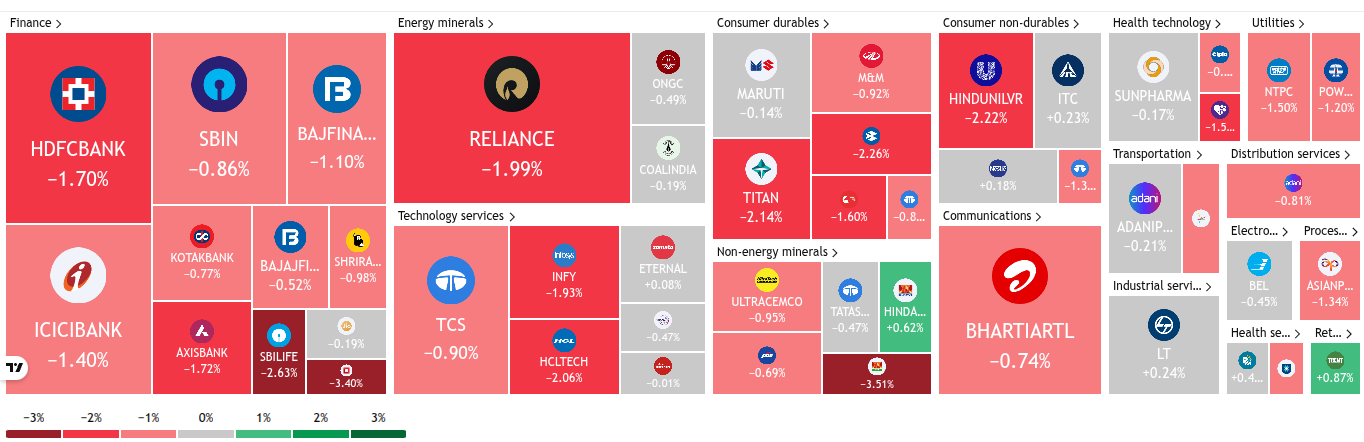
Source: TradingView
The divergence extended to the Sensex, which rose only about 0.7%, far less than the Nifty’s 1.6% gain. Market participants attributed the unusual move to low participation during the inaugural auction, limited arbitrage activity, and concentrated buying in heavyweight stocks such as Reliance Industries, ICICI Bank, HDFC Bank, Infosys and Bharti Airtel.
How the New Closing Auction Works
Until now, Indian exchanges determined closing prices using the Volume Weighted Average Price (VWAP) during the final 30 minutes of trading.
Under SEBI’s new framework, continuous trading for F&O stocks ends at 3:15 pm, followed by a 20-minute auction session. During this period, buy and sell orders are collected without immediate execution before an algorithm matches them at a single equilibrium price where the maximum number of trades can occur.
The goal is to reduce end-of-day price manipulation, improve execution for large institutional investors and create a more transparent benchmark for ETFs, index funds and derivatives settlement.
Although the first session produced unexpected volatility, regulators and market participants expect price discovery to improve as participation increases.
Why Crypto Still Has a Price Discovery Problem
Unlike regulated equity markets, cryptocurrencies trade 24 hours a day across hundreds of independent exchanges, each operating its own order book.
As a result, Bitcoin, Ethereum and other digital assets often report different closing prices depending on the exchange. Liquidity, trading volume, regional demand, fees and local regulations all contribute to those discrepancies.
For retail traders, the differences may appear small. For institutions settling derivatives, valuing ETFs or calculating fund performance, they can create meaningful pricing inconsistencies.
Could Crypto Adopt a Similar System?
A closing auction could help solve part of that problem.
Instead of relying on the last trade from individual exchanges, participating platforms could aggregate liquidity into a single settlement window to establish one equilibrium price. Such a mechanism could make benchmarks harder to manipulate, reduce ETF tracking errors and improve confidence among institutional investors.
Implementing that model would be considerably more complex than in equities because crypto lacks a central exchange and operates continuously across global markets.
Related: Why Does India Need an INR Stablecoin? Top Crypto Heads Explains
Related: How SEBI’s SM REIT Framework Validates India’s On-Chain RWA Revolution

 coinedition.com