Public equities lead growth as RWA tokenization takes off on crypto exchanges
cryptopolitan.com
21 July 2026 12:17, UTC
Public equities are leading the growth of RWA markets. While RWA started out with bonds and money funds, tokenizing stocks has started to find a use case in the category.
Public equities are coming on-chain at a higher rate, becoming a key type of RWA. The ability to trade some of the hottest trending stocks is also changing the entire crypto ecosystem, offering new life to otherwise less active exchanges.
While institutions are still interested in BTC, ETH, and some tokens, equities are taking the attention of retail, as well as whale-sized traders.
Know when your coins move
Alerts, real-time prices, and market news — all in one app
4.8 based on 40K reviews in the App Store and Google Play
Public equities spark a new wave of trading
According to Cryptorank data, public equities have 411 active markets, with over $2B in open interest as of July 2026. The weight of public equities has grown to 46% of the market, already breaking above $2.4B in daily trading volumes.
The recent trend shows the idea of RWA is mostly used for access to leveraged trading and permissionless stock positions. RWA is not widely used for less liquid assets, and trading is still the key use case of tokenization.
While tokenization continues even without trading, the bulk of open interest and daily activity comes from a handful of leading US equities.
RWA holders are also a growing group of crypto natives and equity traders. In the past month, the total number of holders is up by 30%, to 1.2M wallets. The recent wave of on-chain equities arrives after years of ad-hoc attempts to issue stocks on a blockchain. Only the latest wave of tokenization, especially on Robinhood Chain and Solana, has caught on with traders.
The inflow of new traders also means RWA assets will find the missing piece to the puzzle, ensuring new inflows of liquidity.
Hyperliquid and HIP-3 remain some of the leading venues for trading, though Binance and specialized exchanges are catching up with new equity pairs. Kraken is now the source of 100 US-based stocks and ETFs, while the S&P500 index takes up around 1% of the exchange’s daily volumes.
Bybit is also a key RWA hub, giving access to XYZStocks to international traders, with 24/7 activity.
Tokenized equities and perpetual futures markets are still unregulated, with questions of jurisdiction, custody, ownership laws, and more still to be applied. For now, the market is a mix of permissionless platforms and some regulated centralized exchanges.
Whale opens earnings season on Hyperliquid
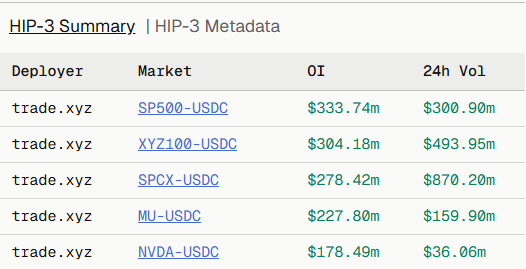
Equity perpetual futures have also replaced gold and oil as the leading contracts on HIP-3. As of July, stock indexes are the most actively traded contracts, followed by individual stocks.
Equities are the most active perpetual futures contracts on HIP-3. | Source: Dune Analytics
As Q2 earnings season opens, equities expect more market-moving news. On HIP-3, Nvidia (Nasdaq: NVIDA) and Micron Technology Inc. (Nasdaq: MU) are among the top 5 trending assets.
Recently, a whale opened a position on MU, after depositing over $14M in USDC to Hyperliqid. MU is among the actively traded contracts, attracting over 40 whale positions. Of those whales, 16 are long on MU, while the rest attempt to short the perpetual futures.
On-chain equity markets are also watched for signs of narratives forming, as in the case of stronger confidence in semiconductor stocks and AI growth.

 cryptopolitan.com