Michael Saylor spent Monday morning boasting about a bigger pile of cash to support dividends, yet the dividend-paying shares of STRC he intended to reassure barely budged.
The problem seems to be confidence, not cash.
Strategy (formerly MicroStrategy), the largest publicly-traded holder of $BTC, diluted its common stockholders last week to increase its dollar stockpile by $450 million.
Know when your coins move
Alerts, real-time prices, and market news — all in one app
Point your phone camera to install
4.8 based on 40K reviews in the App Store and Google Play
Now holding $3 billion, MSTR shareholders paid for 17% more cash than the $2.55 billion balance it last disclosed as of July 5.
Strategy has increased its USD Reserve by $450 million. As of 7/12/2026, we hodl ₿843,775 in our $BTC Reserves and $3.0 billion in our USD Reserves. $MSTR $STRC https://t.co/OdFbjLuCTP
— Michael Saylor (@saylor) July 13, 2026
More cash should mean more comfort. However, investors in STRC, the dividend-yielding preferred stock that requires cash for semi-monthly payouts, don’t seem to agree.
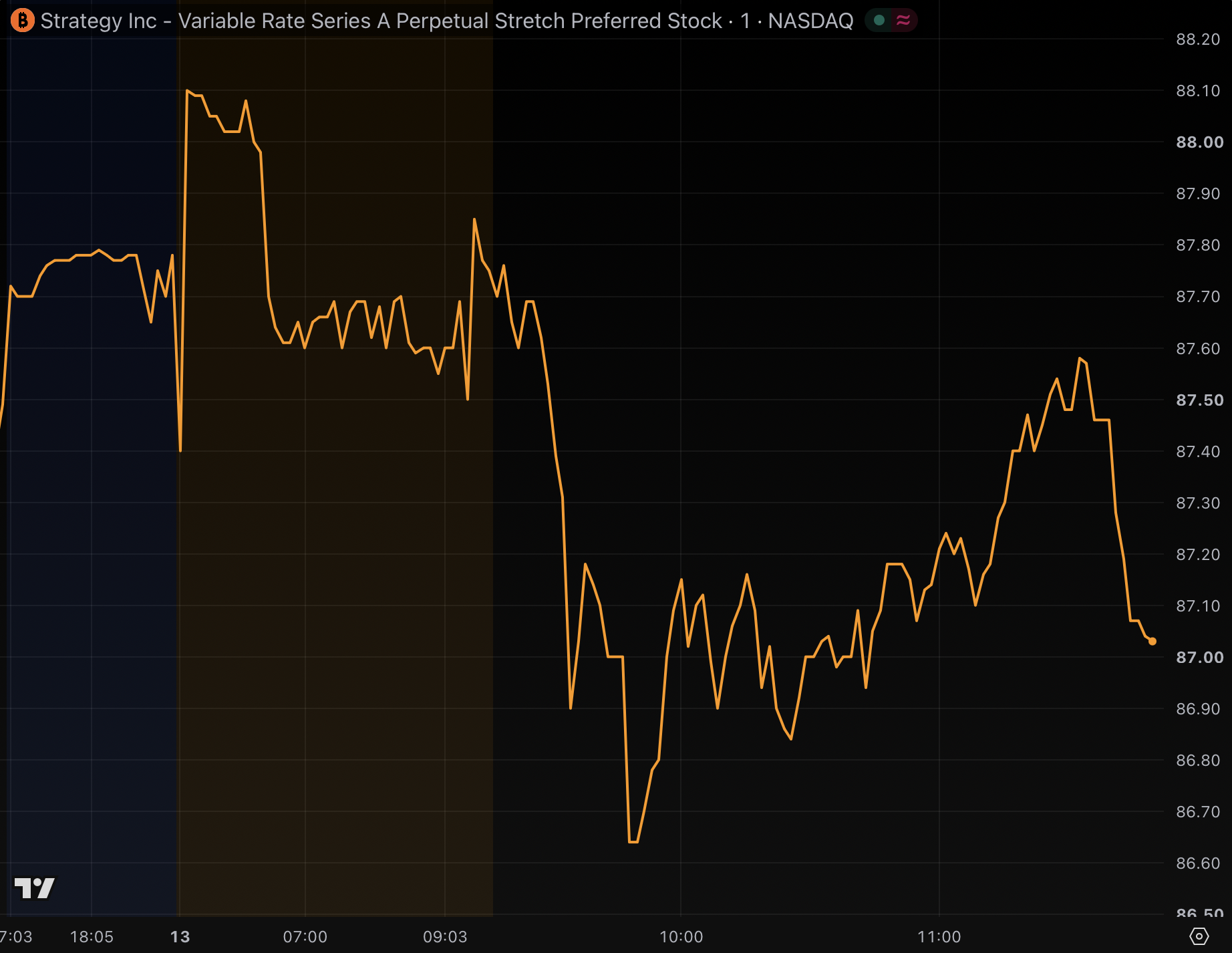
By this morning, STRC had actually dropped to $86.60, a decline of 1% versus Friday’s closing price.
Even though Strategy’s larger cash reserve should pay for more months of STRC dividends — the kind of news that should boost confidence in any other security — it didn’t boost STRC.
There seems to be another problem at Strategy that cash can’t solve.
The market shrugged
Strategy was supposed to keep the price of STRC boring. Instead, its wild fluctuations are generating daily headlines.
The company adjusts the dividend regularly with a stated objective to keep the stock trading between $99 and $100. It hasn’t.
When the price sags, Strategy raises dividend payouts to lure buyers back toward its $100 par. When the price is higher, Strategy sells shares to cap the price.
Unfortunately, STRC has actually declined in value since its dividend rate has climbed from 9% at launch to 12% currently.
Moreover, even with 20 months of cash providing so-called “dividend coverage” and a yield far richer than most junk bonds, STRC was trading 13% below par today.
Chart of STRC from Friday close through Monday at noon. Source: TradingView
The price of STRC is actually lower today than before Strategy increased its cash by 17%.
So, what gives?
The mechanism driving the price of STRC lower is far simpler than the quantity of cash or the mathematics of Strategy’s dilution or leverage ratios.
The problem appears to be confidence. Without a rally in $BTC to boost the value of Strategy’s massive treasury, investors have only one reason to bid up STRC back to par: Belief in management’s resolve to fund long-term dividends.
Sadly, there are plenty of reasons to doubt their resolve.
A preferred share is a promise to pay dividends, honor terms, and perform what the prospectus says. In addition, investors base their decisions on guidance and forward-looking statements from management.
Investors aren’t discounting STRC because they doubt the existence of $3 billion in cash or the mathematics of how many months that quantity could service in dividend payouts. They’re discounting the man making the promises about those payouts.
Buy STRC and make 28%? Traders say no thanks
Michael Saylor’s shifting promises
Strategy founder Saylor has a long record of forecasts he later abandoned. Each reversal teaches the market to price his assurances below face value.
For example, last summer, Strategy told investors it wouldn’t issue new MSTR shares below 2.5 times its $BTC multiple-to-net asset value (mNAV), except to pay interest and preferred dividends.
Days later, it quietly rewrote that promise, adding a third exception for whenever it deemed issuances advantageous. It then sold hundreds of millions of dollars of stock below 2.5x mNAV anyway.
Consider another, egregious example.
For years, Saylor preached about never selling $BTC, a mantra Protos has catalogued across his interviews and posts.
However, over late June and early July, Strategy sold 3,588 $BTC and authorized over $1 billion in additional sales. The examples continue.
Saylor spent early 2026 assuring markets that debt, not $BTC sales, would carry the company through any $BTC bear market.
He told CNBC the company would simply refinance and extend its obligations during a $BTC bear market. A few months later, he wasn’t refinancing but instead selling $BTC to fund dividend payments.
Saylor has also slashed his own earnings forecast, which makes trusting his future forecasts difficult. In December, Strategy cut its fiscal year 2025 earnings per share guidance from a target of $80 per share to a revised range to less than $19.
That erased hopes of more than 76% of the profit it had projected.
STRC at all-time low as Strategy loses 40 years of dividend coverage
Despite promises, STRC is nothing like a bank account
Saylor has also likened STRC to a high-yield bank account or money market.
Nevertheless, STRC sank to an all-time low of $71.25 in June, losing many savers one-third of their savings, unlike any insured bank account or money market.
After Saylor’s guidance about STRC’s $100 stability confronted the reality of $71.25 and everybody had lost money, it became difficult to maintain confidence in his ability to forecast future stability for STRC.
STRC isn’t any kind of bank account or money market, isn’t backed by segregated $BTC, and carries no ordinary redemption right. In order for investors to sell STRC for $100, they must find other traders who are willing to buy it from them at $100.
Strategy won’t be bidding.
The pattern of shifting promises is older than Strategy’s $BTC era. In 2000, the SEC charged Saylor and two other executives.
The company had allegedly inflated its reported sales and profit in breach of accounting rules. Saylor paid more than $8 million to settle that civil action.
Decades later, the market re-learning to be wary of the same man. Strategy just added 17% more cash to a reserve meant to keep STRC pinned at $100. Despite this, STRC failed to rally, staying 13% below par this morning and actually declining relative to Friday.

 protos.com