coindesk.com
Welcome to our institutional newsletter, Crypto Long & Short. This week:
- $BTC is reaching a market bottom and is poised for a turnaround, writes Martin Gaspar.
- Top headlines institutions should pay attention to by Francisco Rodrigues.
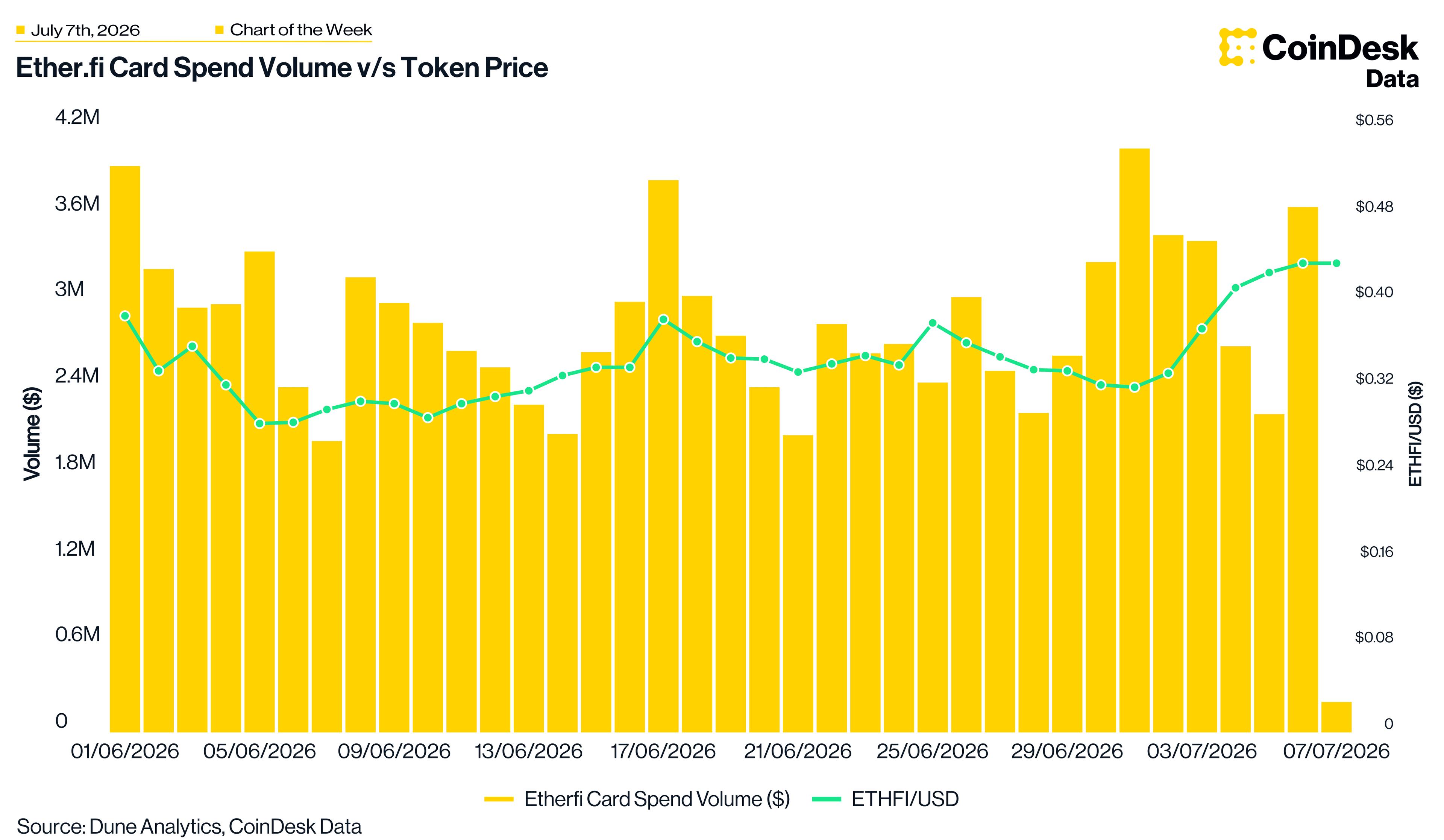
- “Ether.Fi Continues to Lead the Neobank Meta” in Chart of the Week.
Thanks for joining us!
-Alexandra Levis
With MSTR concerns assuaged, look to traditional signals around $BTC
By Martin Gaspar, senior crypto market strategist, FalconX
In bitcoin $BTC$61,650.24’s 4-year cycles, there has always been a distinct driver of selling pressure. In 2018, we saw the promise of crypto running ahead of its skis; the market drove up valuations of crypto projects far beyond their nascent stages of development that led to selling once participants understood the reality. In 2022, leveraged blow ups brought several forced sellers, such as Celsius and FTX, which pressured crypto prices. The most recent overhang on the market has been Strategy (MSTR), whose evolving capital structure drove concerns of potential $BTC sales to meet dividend obligations. The good news is that MSTR took concrete steps to placate said concerns, shoring up its USD reserve and updating its capital allocation strategy, buying time for $BTC to recover. The market can now look past this and evaluate $BTC on its own merits.
The $BTC story remains relevant as ever
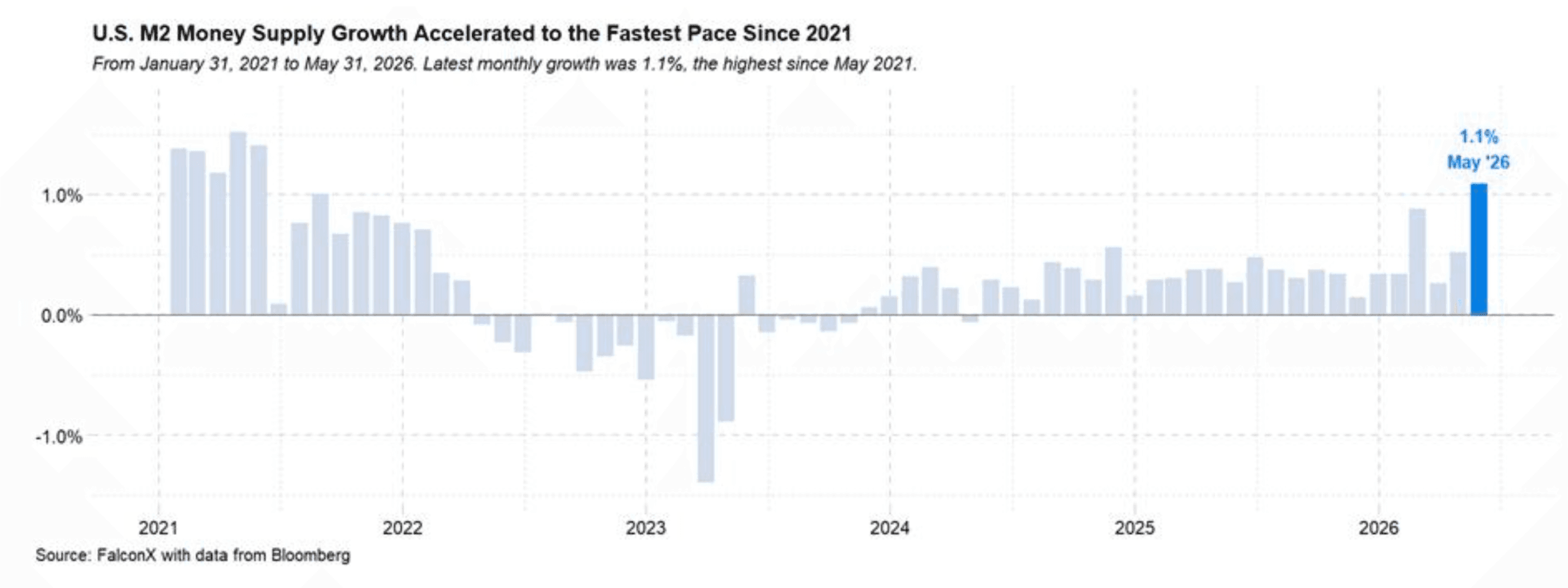
$BTC’s role as sound money resonates as the money supply continues to increase, surpassing $23 trillion for the first time in May. What’s notable is that the month-over-month jump was over 1% and the highest since 2021, a marked acceleration from prior months. Bitcoin remains a solution to rapid expansion of the money supply. While attention has drifted away from this to the Iran conflict and AI, $BTC is poised to swing back to this dynamic.
Unlike its peer store of value asset, gold, $BTC was designed to be easily divisible and portable. And its fixed supply of 21 million $BTC still holds. There is value in this kind of neutral asset and allocators should continue to take note.
The situation today
$BTC has been in a down market since October, fighting a rotating set of headwinds largely unrelated to bitcoin’s underlying attributes. The question now is what happens when those headwinds change to tailwinds. With growth in money supply accelerating, sentiment and momentum could soon turn around.
Headlines of the week
By Francisco Rodrigues
This week’s headlines show Strategy (MSTR) has become an active capital manager rather than a passive bitcoin holder, while Circle and Tether are facing new competition from a giant stablecoin-focused initiative. Meanwhile, U.S. President Donald Trump has faced significant backlash over his family’s crypto earnings.
- Strategy authorizes $1.25 billion in bitcoin sales, lifts STRC dividend to 12%: The firm’s new Digital Credit Capital Framework introduced a series of initiatives to perverse long term bitcoin exposure. It includes a $2.55 billion cash reserve and cleared $1 billion each in preferred and common equity buybacks, along with a Bitcoin Monetization Program allowing it to sell $BTC.
- Stripe, Coinbase and BlackRock back new Open USD stablecoin network: More than 140 firms launched $OUSD, a dollar stablecoin with no minting or redemption fees that returns most reserve earnings to partners, inverting the economics that built leading stablecoin firms Circle and Tether.
- UK's bold new crypto rules promise to unlock global trading, but huge compliance hurdles still threaten the rollout: The framework and covers exchanges, custodians, stablecoin issuers, staking providers and DeFi operators with an identifiable controlling entity, giving institutions the legal certainty to deploy capital in the UK.
- New York Life makes tokenization debut with $807 billion behind it: The firm's first tokenized fund, HYB, lets investors subscribe and redeem in USDC while New York Life keeps the underlying portfolio.
- Trump pocketed more than $1 billion from crypto ties as industry headed toward slump: The sum was the largest portion of a $2.2 billion disclosure, outstripping his real estate and resort earnings, and drew renewed conflict-of-interest criticism the White House denied.