Stanislav Lazarev, Deputy General Director for Sales at A7, believes that the cross-border payments ecosystem will shift toward independent solutions, including digital assets, as participants seek to complete these disbursements while avoiding secondary sanctions imposed by Western countries.
-
Key Takeaways:
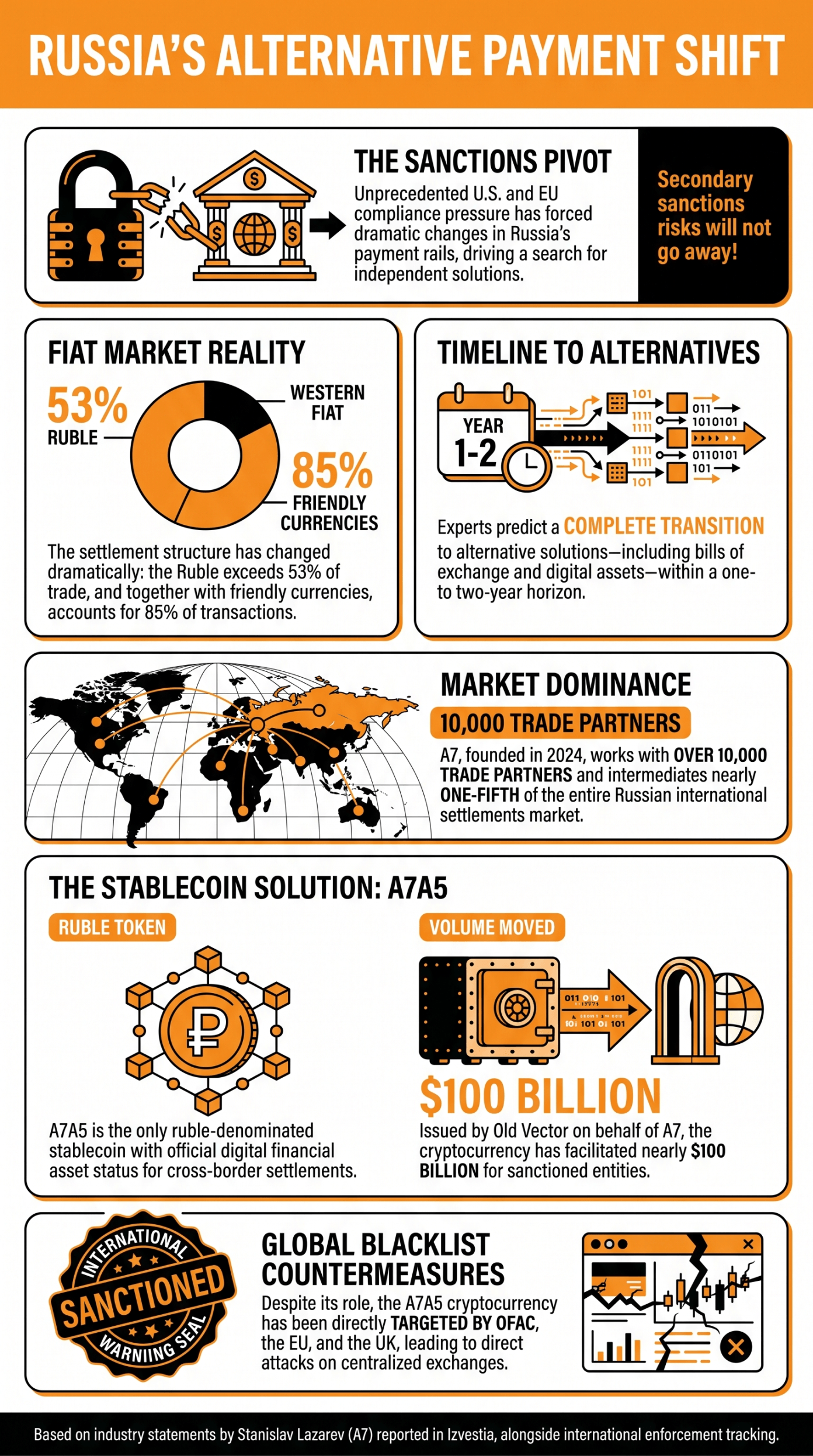
- To bypass sanctions, A7 says 85% of trades use friendly currencies, pushing independent rails in 2 years.
- With 10,000 partners, A7 handles 20% of Russian settlements and has developed alternative digital assets.
- Despite challenges, the A7A5 token moved $100B for sanctioned groups, driving digital cross-border trades.
A7: Cross-Border Settlements Ecosystem To Change Due To Western Pressure
The sheer number of sanctions Russia is facing from both the U.S. and the EU has led to changes in its payment rails and structures, helping Russian companies navigate the newfound intricacies of a limited cross-border settlement ecosystem.

Stanislav Lazarev, First Deputy General Director for Sales at A7, stressed that he believes that this new state of the standard fiat payment system will force a change to implement independent solutions in the next two years.

“The settlement structure has changed dramatically: the share of the ruble in importers’ foreign trade transactions has exceeded 53%, and together with the currencies of friendly countries, it now accounts for 85%,” he told Izvestia.
Lazarev expects this new structure to shift from the default system toward alternatives, which might include bills of exchange and more modern solutions like digital assets.
“If we look at a one- to two-year horizon, we’ll see a complete transition to alternative and independent payment solutions. Western compliance pressure and the risk of secondary sanctions won’t go away.” Furthermore, he stressed that digital solutions, including stablecoins, will develop.
“Our A7A5 is currently the only ruble-denominated stablecoin to have received digital financial asset status for cross-border settlements,” Lazarev declared.
A7, founded in 2024, has over 10,000 trade partners that rely on its services to expedite payments, and according to estimates, it intermediates nearly a fifth of the Russian international settlements market.
The A7A5 token, a Russian ruble stablecoin issued by Old Vector on behalf of A7, has facilitated the movement of nearly $100 billion from sanctioned entities. Nonetheless, it has been the target of sanctions by the U.S. Office of Foreign Assets Control (OFAC), the EU, and the UK, and centralized exchanges where it could be traded were targeted and even attacked directly.
news.bitcoin.com