
 coindesk.com
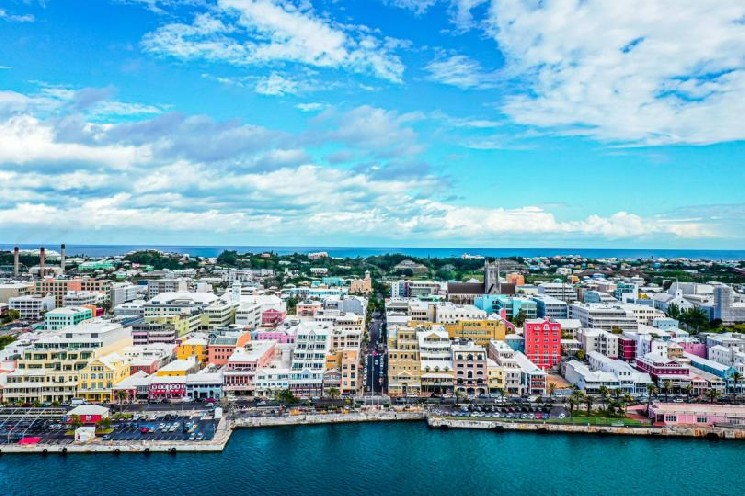
Craig Swan’s eyes light up, and his smile widens when he speaks of Bermuda's ambitions to become the world’s first economy to go fully onchain, a move he is certain will create amazing new opportunities for the country's citizens.
In an interview with CoinDesk in London, Swan, the CEO of Bermuda’s Money Authority (BMA), spoke of his tiny island nation’s huge plans.
“We carried out a huge event in Bermuda to educate our citizens on how to set up their crypto wallet, and we airdropped $100 in Circle’s stablecoin USDC, and showed them how to use it for purchases, transfer or send it to friends and family or convert it and even offramp it into fiat if they chose to,” Swan said.
The experiment was designed to onboard local vendors and the public simultaneously, Swan added. Attendees were able to immediately test the ecosystem at an on-site marketplace, using their newly minted stablecoins to purchase goods, while payment processors like MoneyGram provided immediate conversion back into paper currency.
Driving demand at the DMV
While the pop-up marketplace served as a sandbox, the BMA and the government of Bermuda are already scaling the infrastructure to prepare it for the blockchain. The island nation has amended its legislation to officially accept digital assets for public taxes, starting with its highest-volume public sector.
“We are starting at a high-volume area," Swan explained. "Starting with the Department of Motor Vehicles, because most people have a car or licenses. We are going to cast that across the government itself."
The financial migration represents the real-world execution of a roadmap first unveiled at the World Economic Forum in Davos, where the Bermudan government announced a partnership with Circle and Coinbase to build out the infrastructure for the world's first fully onchain economy. Circle deployed its Circle Mint infrastructure to power the government’s digital treasury accounts, while Coinbase pledged its engineering rails to streamline institutional and consumer onboarding.
Bermuda also recently announced a third major partnership. This time with Stellar for the upcoming rollout of its official Bermuda digital dollar, a sovereign-grade stablecoin. Rather than compete with the traditional financial sector, Swan said he expects the onchain rails to coexist with legacy banks, which will continue to hold the fiat reserves backing the digital tokens and provide localized custody.
"The reliance on legacy payments infrastructure has left Bermudians paying high fees and hindered additional economic growth," Premier E. David Burt noted following the Stellar announcement. By leveraging blockchain rails, Bermuda is attempting to bypass the expensive intermediary banking loops that chew up thin merchant margins, keeping capital circulating natively on-island.
However, moving a national economy onto a blockchain requires rewriting more than just banking rules, said Swan, noting that it requires changing the definition of property.
“When you look at contract law, and if you look at securities, in some cases, it's not clear whether or not a smart contract satisfies a legal transfer of ownership," Swan observed. "We have to look at the legislation to make sure that it's aligned. I think there are a few tweaks the island needs to make around shares—the way legislation records a share register needs to be clear that it can exist in a digital form.”
Regulating the AI agent wave
Bermuda’s testing programs have historically yielded massive macroeconomic results, Swan said. The island currently ranks among the world's top three largest reinsurance centers. The government is betting that its regulatory framework, the Digital Asset Business Act (DABA), can achieve the same global footprint for tokenized real-world assets (RWAs) and decentralized finance (DeFi).
To prove it, Swan said the BMA recently concluded a pilot program focused on embedding compliance directly inside smart contracts. The trial successfully demonstrated that protocols could automatically freeze a transaction if underlying collateral reserves fell below a specific threshold or block and exchange entirely if an address violated real-time anti-money laundering or sanctions screening.
To address these risks, Swan said the BMA is already looking beyond human traders to digital liquidity generated by automated machines. With that, he said, the BMA plans to roll out an AI payments hub to research and supervise transactional flows initiated entirely by autonomous software.
For larger G20 nations, scaling such an ambitious ledger remains a multi-year regulatory bottleneck. For Bermuda, its small population is its primary geopolitical advantage.
“Smaller jurisdictions with the resources will be able to follow us," Swan concluded, offering advice to other sovereign states looking to digitize their financial architecture. "Larger jurisdictions would have to take a different train. But to attract companies that are serious, it's best not to race to the bottom."