Rwa.xyz data identified U.S. Treasury debt as the largest tokenized asset category, with Treasury-linked products climbing to roughly $16 billion by May 2026. Commodities approached $6 billion, while asset-backed credit exceeded $3 billion. Other expanding sectors included tokenized equities, diversified credit, specialty finance, private equity, venture capital, and real estate. The platform also showed $335.17 billion in represented asset value, 815,297 total asset holders, and 256.95 million stablecoin holders.
A16z crypto wrote:
“The tokenized asset market crossed $30 billion last month and has stayed there. Roughly the size of an elite university endowment. As recently as mid-2024, it was below $3 billion. 10x in under two years.”
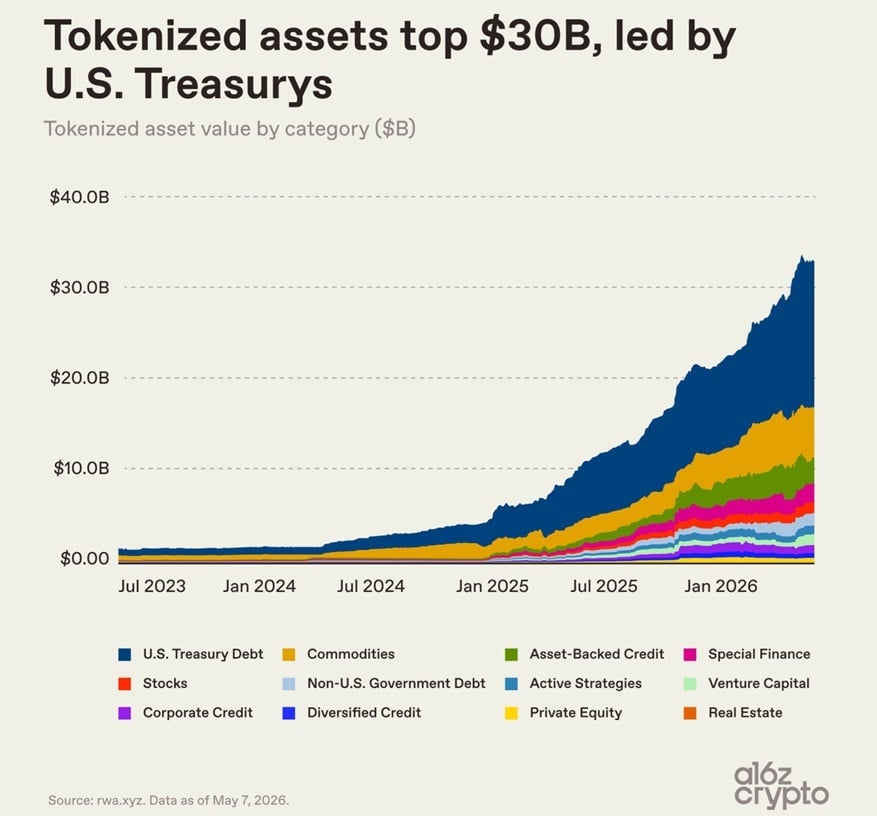
Institutional participation accelerated as financial firms shifted blockchain initiatives from testing environments into operational systems. A16z crypto linked the expansion to the $GENIUS Act, mature settlement infrastructure, and broader adoption among traditional financial institutions.
The Guiding and Establishing National Innovation for U.S. Stablecoins Act became law on July 18, 2025, creating a federal framework for payment stablecoins in the United States. Asset-backed credit products reached $1 billion in market capitalization in just 185 days, while specialty finance products crossed the same threshold in under two years, reflecting faster adoption for simpler yield-oriented structures. Venture capital tokenization took more than seven years to reach $1 billion, while active strategy products required nearly the same timeline.
$GENIUS Act Spurs Institutional Blockchain Deployments
Regulated stablecoin frameworks strengthened demand for short-duration Treasury products because issuers must maintain highly liquid reserves. The $GENIUS Act requires one-to-one reserve backing using assets such as U.S. dollars, deposits, and short-term Treasury bills. Analysts across banking and crypto markets have linked those requirements to increased Treasury demand from digital asset issuers. Bank of America estimated stablecoin growth could generate substantial additional purchases of Treasury bills as regulated digital dollar products expand.
Several financial institutions and asset managers have introduced tokenized Treasury products over the past year to support collateral management, payments, and yield-bearing settlement systems. Industry participants increasingly use blockchain rails for near-instant transfers and programmable asset servicing. The Federal Reserve Bank of Richmond noted that tokenized deposits remain distinct from payment stablecoins and that the $GENIUS Act preserves banks’ authority to issue tokenized deposits. Stablecoin issuers also continue increasing Treasury exposure as reserve requirements tighten. A16z crypto stated:
“What changed: the $GENIUS Act, mature institutional onchain infrastructure, and a wave of financial institutions moving from pilots to production — all at roughly the same time.”
Market composition has also diversified beyond its earlier concentration in Treasurys and commodities. A16z crypto noted those two sectors represented nearly the entire tokenized asset market in early 2024, but now account for roughly two-thirds of total value as additional asset classes gain traction. The tokenized commodity sector remains dominated by gold-backed products, particularly Tether Gold (XAUt) and Pax Gold (PAXG), which convert vault-held bullion ownership into blockchain-based tokens. Tokenized oil, agricultural assets, energy exposure, and compute-linked products remain at earlier development stages with smaller market share.

 news.bitcoin.com