In today’s newsletter, Andy Baehr from GSR examines how, beneath the stalled market, advisors are quietly building durable crypto allocations, moving beyond $BTC and gaining more comfort in this asset class.
Then, in “Ask an Expert,” Patrick Velleman of Valdora offers commentary on how financial advisors can navigate the growing trend of durable crypto allocations.
- Sarah Morton
Know when your coins move
Alerts, real-time prices, and market news — all in one app
Point your phone camera to install
4.8 based on 40K reviews in the App Store and Google Play
Summer is coming. Build your core.
Crypto markets feel low-energy and ambivalent. But, beneath the surface, investors are searching for the right long-term home in crypto. It's time to position for the next change of the season.
The question finds every crypto person, eventually. A friend, a relative, a client asks: ”I want to add some crypto. What should I actually own?”
Before answering, let's be honest about the current environment.
Rallies with no booster rocket
The good news: crypto prices are drifting higher. The less-good news: they’re only drifting. Bitcoin has moved from the mid-$60,000s to the high $70,000s, ether ($ETH) from around $1,800 toward $2,300, and Solana ($SOL) in the mid-$80s. Movement without momentum. Progress without pulse — and more than a few sad-trombone rallies that faded before they could build on themselves.
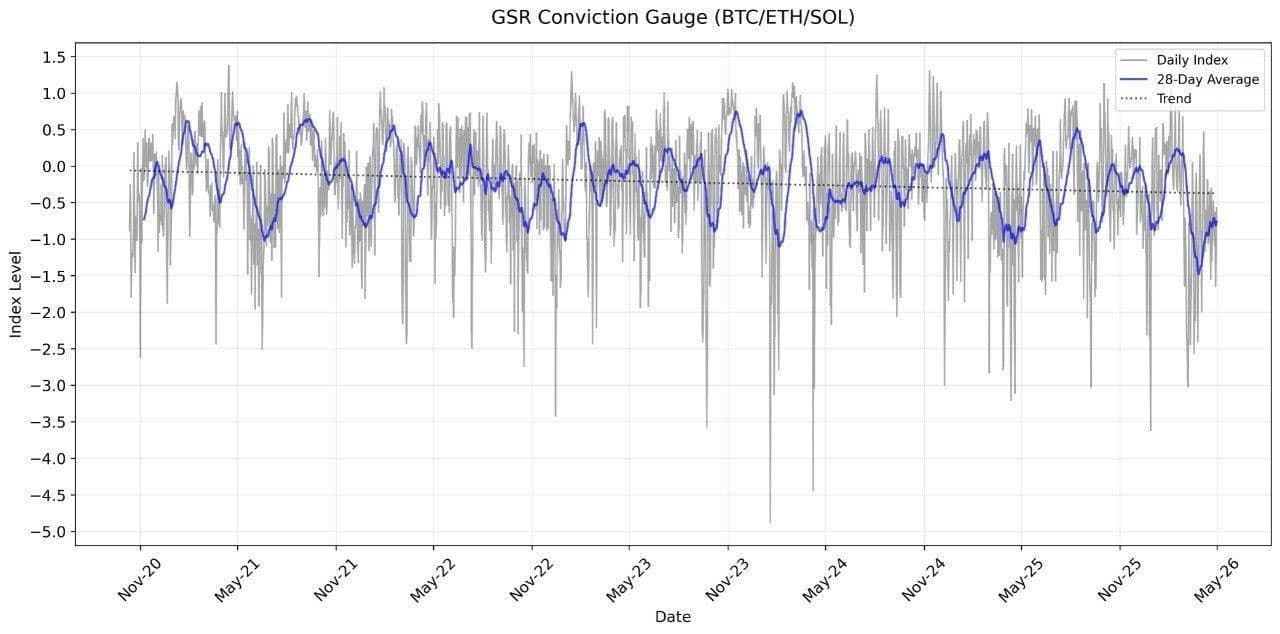
The feeling of … ambivalence ... was so palpable, we developed a Conviction/Ambivalence gauge. In Q1 2026, we hit maximum ambivalence. Other signals point the same way. Funding rates on perpetual futures, a clean read on leveraged appetite, have been persistently low or negative. DeFi borrow rates on Aave drifted toward 3% ahead of a recent exploit, versus 20%+ in the weeks after the 2024 election and 5–7% in more typical conditions. The fast money is elsewhere: oil, equities, prediction markets. Volatility is both a magnet and a product of hot markets, and right now, crypto has a shortage of both.
The Conviction Gauge measures an average ratio of weekly returns to daily returns. Source: GSR
That stands in stark contrast to last year's Q2 and Q3 rally, which had velocity, power, and breadth. $ETH led. $SOL pushed hard in August and September. The GENIUS Act added fuel. That was a market with real conviction.
The slower shift that matters more
And yet beneath the surface, something more durable is happening: longer-term investors and their advisors are quietly getting more comfortable allocating to crypto. That shift doesn't flood X the way a funding rate spike does. Nobody is posting charts about advisors quietly building allocations, but it's the iceberg that matters. Over time, the effects will be felt, and they will be durable.
And for those allocators, $BTC alone is no longer the answer. Its role has been clarified as the macro asset, something that may even behave defensively when markets contract. But advisors are being asked to go further. Clients want exposure to the blockchain growth story: tokenization, stablecoins, the layer-one infrastructure that's now top-of-fold business news.
So what should the core actually be?
Our answer is straightforward: $BTC, $ETH and $SOL. The power trio. The cycle survivors. Two distinct themes across three assets: $BTC as the major macro asset, with $ETH and $SOL as the layer-ones on which blockchain's growth story settles. Neck and neck, genuinely competing and we believe, likely to both win.
A solid core holding though, should do more than just sit there. Proof-of-stake assets like $ETH and $SOL can generate yield through staking, a return stream that passive holders often leave on the table. And you want a product that tilts toward the market: one that reads different environments and adjusts weights to seek excess return, rather than holding fixed weights through every regime.
That's a lot to ask. So we launched an ETF to make it easy.
The GSR Crypto Core3 ETF (BESO) packages the core $BTC, $ETH and $SOL, with staking rewards on $ETH and $SOL, and active, research-driven weekly rebalancing. Over time, investors will seek satellite holdings — sectors, themes and factors. But Core3 is designed to do the first job well: core crypto market beta, with staking and active management built in.
gsretps.io/etf/beso
- Andy Baehr, managing director, Asset Management at GSR *
Ask an Expert
Q. How is digital asset investing and trading different from traditional assets?
The biggest practical difference is that everything happens on the blockchain. Holdings, transactions, strategies, even the behaviour of a protocol over time, all of it is visible. Anyone with a wallet address and a block explorer can see what you own and what you have done. That is a level of transparency traditional markets simply do not offer. This changes the information environment clients/users are operating in.
The second difference is that price discovery runs 24/7, which means volatility never takes a break either. Then there is self-custody. In traditional finance, custody is someone else's problem and quite often insured. In digital assets, it’s going to be your problem whether you want it or not. That is empowering, because you genuinely own the asset and no intermediary can gate your access to it. It is also more dangerous because the responsibility for keys, backup and operational security falls on the holder. A lost phrase is a permanent loss and it’s one of the reasons people like CZ (Changpeng Zhao, former CEO of Binance) vouch for storing assets on centralized exchanges.
For advisors this means the conversation with clients is broader than allocation because it also covers custody setup, key management and operational risk in a way it never has before.
Q. How do vaults and onchain finance change the investing vs trading debate?
It is no longer a question of invest versus trade, what I see the market actually debating is which yields are real and which are not. After a few cycles of degen farming, triple-digit APYs and protocols that collapsed, most serious participants have moved on from the question of “how much can I earn” to “how durable is this.”
This is why vaults have been increasing in popularity. A well-designed vault lets capital stay in the market with less manual rotation. So if you deposit into a strategy, and the strategy runs, there is less movement, less clicking, less emotional decision-making. For someone who does not want to trade, that is a clear improvement over what was previously available on-chain, which was mostly either passive holding or active yield farming.
The other important piece is liquidity. A lot of traditional yield products lock your capital up. Private credit funds for example, have redemption windows that run anywhere from a week to a quarter. A vault that issues a liquid token against your deposit gives you something different. Your capital is earning, but you can still move if you need to. That is a real change in how long-term allocations can be structured.
The path this sets up is yield that is perhaps a bit more boring than what crypto has historically offered, but more sustainable. But at least boring doesn’t get you REKT.
Q. As automated vaults handle the technical ‘trading’ (rebalancing, compounding, liquidating), does an advisor’s value-add shift from ‘picking winners’ to ‘curating risk profiles’?
Yes, and a good one at that.
When the mechanics of a strategy are handled by a smart contract, the execution work is no longer where the advisor adds value. Rebalancing happens automatically and compounding happens automatically. Liquidation triggers run on their own logic where none of it needs a human in the loop.
What it does need is a human in the loop as the judgment layer on top. Someone has to look at what is actually available in the market, vet it and decide what is worth putting client capital into. That is more of a due diligence question. Who built this vault? What is the strategy doing underneath? What are the custody arrangements? How has it performed in stress? Is the team credible? Is the audit credible? What happens if a dependency breaks?
You then take the risk appetite of the client and adapt it to the risks the available vaults actually carry. A conservative client might want a tokenized Treasury vault and a stablecoin yield vault. A more adventurous client might accept a DeFi yield vault or an FX strategy vault. Curating risk is human in the loop work.
- Patrick Velleman, chief marketing officer, Valdora CMO
Keep Reading
Andreessen Horowitz raises $2.2 billion in a new fund, saying crypto fundamentals are at an 'all-time high'.
Morgan Stanley crypto trading pilot is live on E*Trade with access expected for all 8.6 million E*Trade clients later this year, per Bloomberg.
Canada approves first CAD backed stablecoin.
* Risk Disclosure
Investors should consider the investment objectives, risks, charges and expenses carefully before investing. For a prospectus or summary prospectus with this and other information about the Fund, please call 888-999-5958 or visit our website at gsretps.io/etf/beso. Read the prospectus or summary prospectus carefully before investing.Investments involve risk. Principal loss is possible.
Crypto Currency Risk (Bitcoin (“$BTC”), Ether (“$ETH”), and Solana (“$SOL”) (together, the “Reference Assets”)). The Reference Assets are relatively new innovations and are subject to unique and substantial risks. Crypto currencies are a subset of digital assets, representing blockchain-based tokens that function primarily as mediums of exchange, stores of value, or units of account, whereas digital assets more broadly include any electronically represented asset with economic value, such as tokens, stablecoins, and other distributed-ledger-based instruments.Digital Assets/Cryptocurrency Market Volatility Risk. The prices of the Reference Assets have historically been highly volatile. The value of the Fund’s exposure to the Reference Assets—and therefore the value of an investment in the Fund—could decline significantly and without warning, including to zero.
Market Beta Risk. The Fund seeks to provide core exposure to the cryptocurrency market (‘market beta’) through allocations to $BTC, $ETH, and $SOL. As a result, the Fund’s performance may be significantly influenced by overall digital asset market movements, and the Fund may decline in value when the broader cryptocurrency market declines. The cryptocurrency market is highly volatile and subject to rapid changes.Staking and Validator Risk. When the Fund stakes Reference Assets that utilize proof-of-stake consensus (currently, Ethereum and Solana), the assets are subject to risks attendant to staking generally, such as illiquidity, reliance on third-party service providers, slashing, missed rewards, validator problems, and errors. Staking is the process of putting digital assets to work on a blockchain network to receive rewards and enhance protocol security. By helping the blockchain run more smoothly and securely, rewards are earned in the native blockchain token. Potential staking rewards are earned by the Trust and not issued directly to investors. Liquidity Risk. Unbonding periods for staked Reference Assets may range from several days to several weeks depending on network conditions. Concentration Risk. The Fund’s assets will be concentrated in the sector or sectors or industry or group of industries that are assigned to the Reference Assets, which will subject the Fund to the risk that economic, political or other conditions that have a negative effect on those sectors and/or industries may negatively impact the Fund to a greater extent than if the Fund’s assets were invested in a wider variety of sectors or industries. Foreign Securities Risk. To the extent the Fund invests in foreign securities they may be subject to additional risks not typically associated with investments in domestic securities.Indirect Investment Risk. None of the Reference ETFs or the Reference Assets are affiliated with the Trust, the Adviser, or any affiliates thereof and is not involved with this offering in any way, and has no obligation to consider the Fund in taking any corporate actions that might affect the value of the Fund.New Fund Risk. The Fund is a recently organized management investment company with no operating history. As a result, prospective investors do not have a track record or history on which to base their investment decisions.Non-Diversification Risk. Because the Fund is non-diversified, it may invest a greater percentage of its assets in the securities of a single issuer or a smaller number of issuers than if it was a diversified fund.

 coindesk.com