Is Google stock a Buy ahead of this week’s earnings?
finbold.com
27 April 2026 16:25, UTC
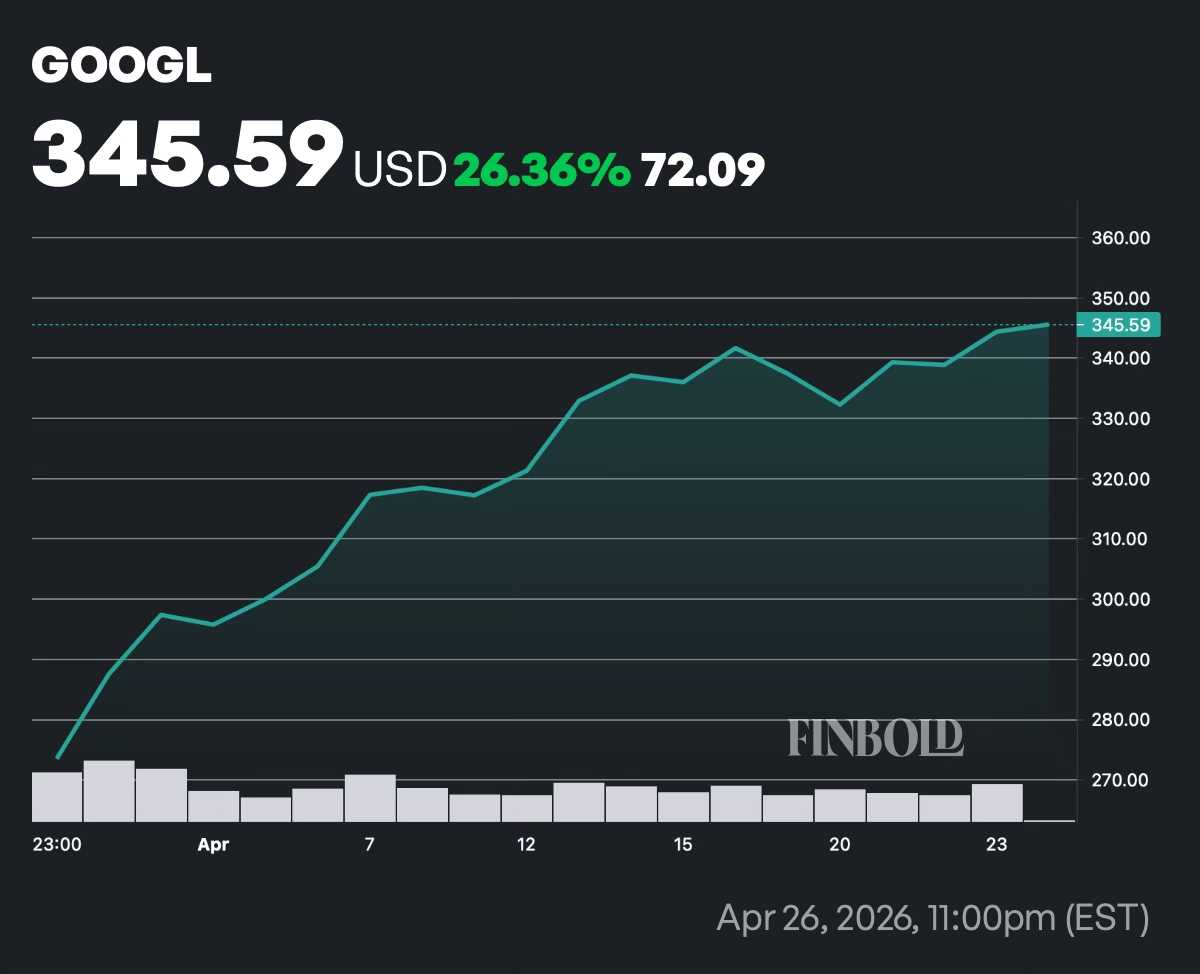
Google (NASDAQ: GOOGL) has had a strong run this month, its stock climbing more than 26% as one of the market’s best-performing equities.
The rally has also outpaced the broader S&P 500, keeping Google at the center of investor attention. Now, further momentum is building ahead of Alphabet’s upcoming earnings report on April 29.
Investors are primarily focused on whether the company’s artificial intelligence (AI) efforts have translated into growth. Accordingly, all eyes are on Google Cloud and Gemini.
Know when your coins move
Alerts, real-time prices, and market news — all in one app
Point your phone camera to install
4.8 based on 40K reviews in the App Store and Google Play
Google stock price. Source: Finbold
Gemini and Google Cloud drive investor sentiment
Indeed, investor sentiment has primarily hinged on these two aspects of Alphabet’s business. As a result, a strong earnings performance could reinforce bullish sentiment further.
For example, Citi recently raised its price target on Alphabet to $405 from $390, citing user engagement with Gemini features, trends in advertising revenue, and continued momentum in Google Cloud.
Similarly, Evercore ISI analyst Mark Mahaney has assigned the stock a $400 price target due to demand across core segments and ongoing strength in the cloud division. In addition, analysts noted a solid backlog as signaling sustained enterprise demand.
In general, Wall Street sentiment remains broadly positive, with adjusted earnings per share expected at around $2.62 and revenue estimates in the range of $106 billion to $107 billion. The figure represents a roughly 18% to 20% year over year.
Cloud momentum accelerates, but there’s a catch
Notably, in the fourth quarter of 2025, Google Cloud revenue jumped 48% year-over-year (YOY) to $17.7 billion, a notable jump from the 34% growth recorded in the prior quarter. CEO Sundar Pichai also highlighted a 55% sequential increase in cloud backlog ($240 billion).
The segment’s strength has been fueled by enterprise adoption of AI products, including Tensor Processing Units (TPUs), alongside solutions tied to models such as Gemini 3.
Naturally, to sustain this momentum, Alphabet will significantly increase its spending. For example, the company expects capital expenditures to reach between $175 billion and $185 billion in 2026, nearly double the amount spent in 2025.
While these investments could deliver substantial long-term returns if AI demand remains strong, they also introduce greater risk. Specifically, depreciation expenses have increased 38% to $21.1 billion in 2025.
Rising investment in AI infrastructure and data centers is also expected to weigh on margins, as higher operating costs partially offset growth. Therefore, even if Google Cloud continues to post strong growth, profitability could suffer due to rising costs.
Google fundamentals remain strong
From a longer-term perspective, Alphabet’s fundamentals remain compelling. The company continues to dominate in internet search, operates a powerful YouTube platform, and is scaling its cloud businesses.
The company also ended 2025 with $127 billion in cash and cash equivalents, outweighing its $46 billion in debt. Its core advertising segment likewise continues to generate free cash flow, while YouTube subscriptions are also emerging as a meaningful contribution.
Moreover, Google’s deep intangible assets and entrenched network effects should help defend its search leadership. Of course, the aforementioned investment in AI, now present in nearly all of Alphabet’s products, offers long-term upside.
Thus, while the valuation is not cheap, trading at more than 30 times earnings, it could be argued it remains reasonable, given the company’s competitive advantages and growth profile.
Is Google stock a Buy? Wall Street Google consensus
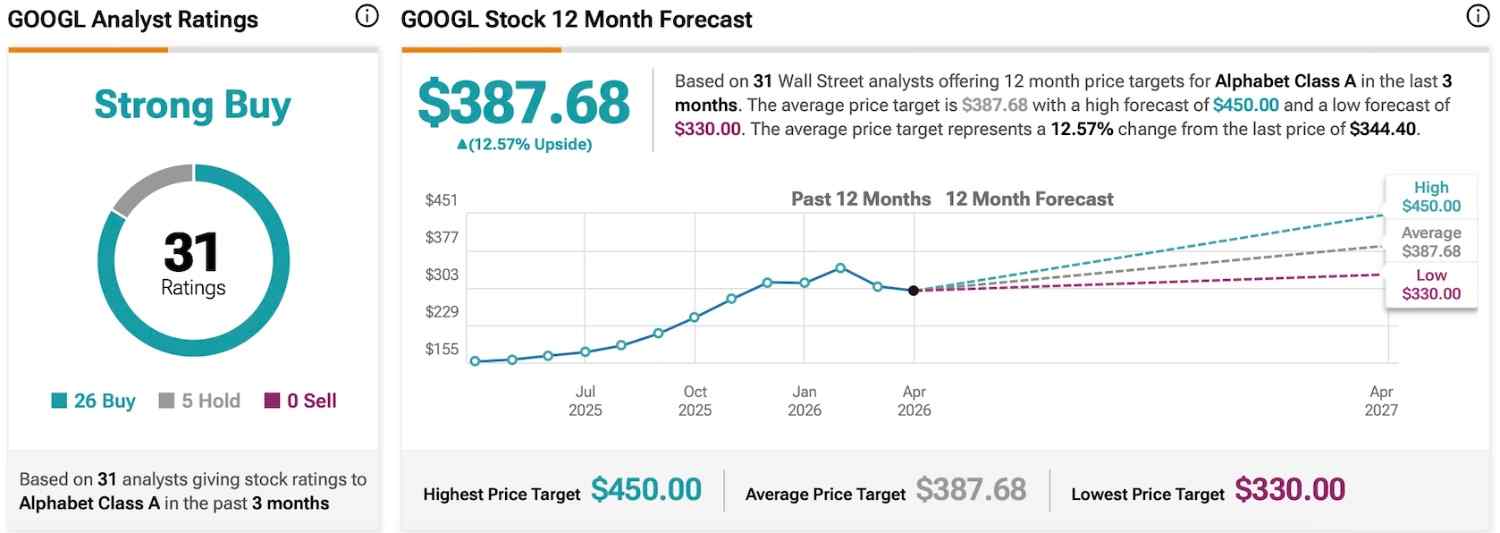
Two days ahead of earnings, Google enjoys a ‘Strong Buy’ Wall Street consensus, based on 31 analyst reports available aggregated over the past three months on TipRanks. The average GOOGL share price itself sits at $387.68, meaning the market expects a 12.57% rally in the next 12 months.
Google stock price target. Source: TipRanks
Overall, Google shares appear to be an attractive long-term investment. However, given the scale of its spending plans, careful positioning and close attention to upcoming Google Cloud growth, as well as earnings per share (EPS) figures, may be wise ahead of and after the upcoming earnings report.

 finbold.com