
 crypto.news

Circle (CRCL) sank about 22%, its worst drop since June 2025, after a tougher CLARITY Act draft threatened to ban stablecoin yield, clashing with booming $USDC growth.
- Circle Internet Group (CRCL) stock is trading around $98.71, down about 22% on the day and roughly 18% below Monday’s close, its steepest slide since June 2025.
- The sell-off follows reports that the latest draft of the U.S. CLARITY Act would sharply limit or ban yield and rewards on stablecoins, directly hitting Circle’s $USDC-centric business model.
- The move wipes billions from Circle’s market value even as $USDC circulation and on-chain usage climb, highlighting the tension between regulatory risk and underlying product growth.
Circle Internet Group shares plunged on Tuesday after fresh reports that U.S. lawmakers are tightening a key stablecoin bill to restrict yield and rewards, triggering an aggressive sell-off in one of the market’s highest-beta crypto stocks.
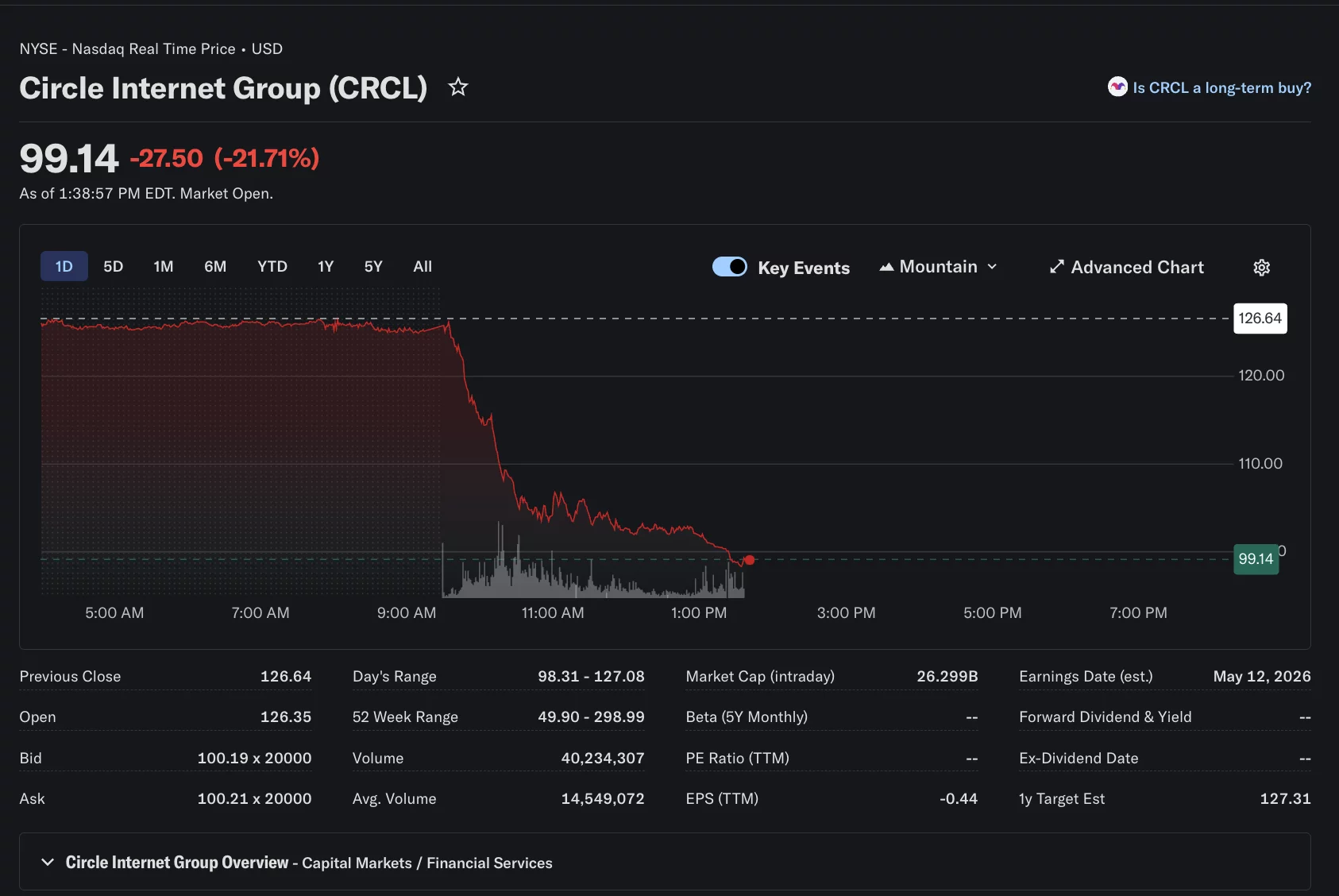
Real-time data shows Circle trading at about $98.71 on the NYSE under ticker CRCL, down $27.93 or 22.05% on the day, with intraday lows near $98.31 after opening at $126.35 and closing Monday at $126.64. Intellectia.ai and other market trackers said the drop reached roughly 18% by midday, marking Circle’s largest one-day percentage decline since June 2025.
Circle’s slump came alongside a broader crypto-equities sell-off, with Coinbase (COIN) down more than 7% to roughly $178.10 and Robinhood (HOOD) off 4.7%, after a draft of the CLARITY Act circulated in Washington. According to summary of the draft, the latest language would “ban yield on stablecoins across exchanges,” effectively prohibiting interest-style rewards on tokens like $USDC, a core revenue lever for both Circle and Coinbase. The bill is being viewed as a direct threat to Circle’s stablecoin-payments and rewards infrastructure, calling the proposed limits on yield “critical” to its platform economics and a key driver of Tuesday’s 22% intraday fall.
Circle shares sink as CLARITY Act hits stablecoin rewards
The price action is striking because it collides with still-strong fundamentals for $USDC. Yahoo Finance recently noted that Circle’s stock nearly tripled from its $31 IPO price on June 5, 2025 and at one point almost touched $299, buoyed by optimism around U.S. stablecoin legislation. Circle’s own “Internet Financial System in 2026” report highlighted that $USDC in circulation has expanded sharply alongside rising reserve income, while Intellectia.ai cited Baird as telling clients that $USDC outstanding averaged $75.2 billion through March 15, up 6% since the firm’s last earnings report. Baird raised its price target on Circle to $138 from $110 and reiterated an Outperform rating, arguing there is a “real path” to new revenue via products like Circle Payments Network and Arc Blockchain.
Reuters reported in February that Circle beat Wall Street expectations for fourth-quarter revenue on the back of stronger stablecoin circulation and higher interest income on reserves, sending the stock up nearly 30% in a single session at the time. Yet CRCL now trades below $100, roughly 35% below last week’s peak near $150 and more than 20% off the intraday highs it set earlier in March, even as $USDC leads 2026 stablecoin flows and on-chain usage has jumped 600% year-to-date. That disconnect between booming token metrics and a stock that has just erased nearly a fifth of its value in one day captures the core investor dilemma: as long as U.S. lawmakers treat stablecoin rewards as quasi-banking, Circle’s equity seems to know be trading as much on the Hill’s mood as on $USDC’s growth curve.