
 cointelegraph.com

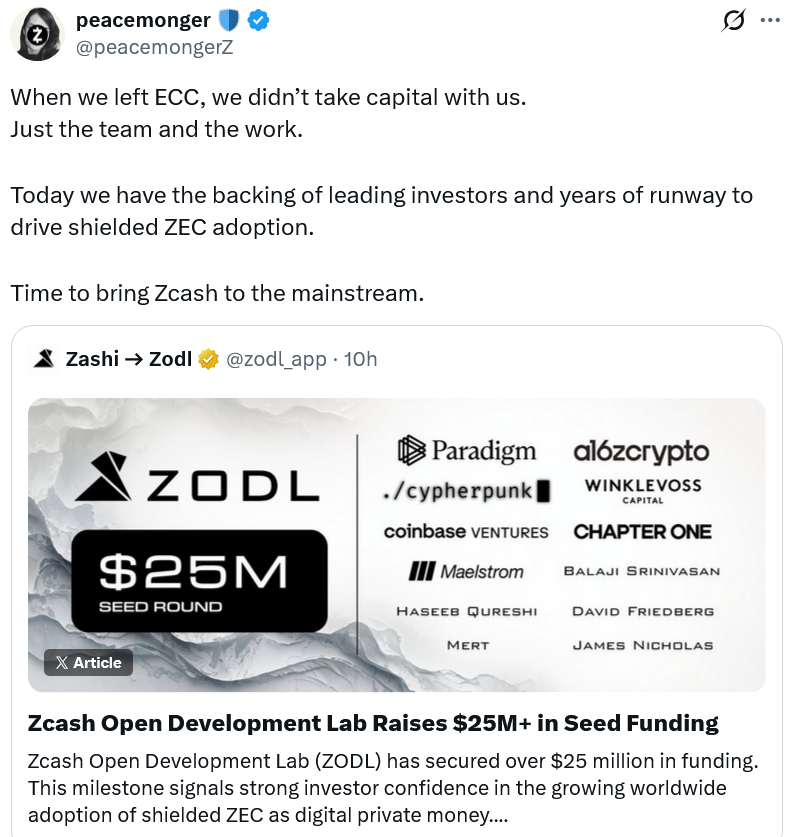
The development team that left Electric Coin Company in January to launch Zcash Open Development Lab (ZODL) has raised over $25 million from the likes of a16z Crypto and Coinbase Ventures to continue building the privacy-focused, self-custodial Zodl wallet.
ZODL was founded by former ECC CEO Josh Swihart and includes the entire engineering and product team that previously worked on the Zodl wallet at ECC. They resigned due to disputes with Bootstrap, the nonprofit that oversees ECC, over how Zcash should function as a privacy protocol.
ZODL said in an X post on Monday that crypto-focused investment firms Paradigm, Winklevoss Capital, Cypherpunk Technologies, Maelstrom, and Chapter One were among the other participants in the $25 million funding round.
Former Coinbase chief technology officer Balaji Srinivasan, Silicon Valley investor David Friedberg and Dragonfly managing partner Haseeb Qureshi also contributed.
ZODL said the widespread backing “reflects strong conviction from some of the most respected investors in crypto, not only in privacy as a principle, but in the continued growth of the Zcash ecosystem,” adding it would use the funds to expand its engineering team.
The open-source Zodl wallet is one of the main infrastructures powering the Zcash ecosystem.
Zodl wallet was initially launched by ECC under Swihart’s leadership as Zashi before ZODL renamed it to Zodl wallet in February.
Zcash jumps nearly 10% over 24 hours
Zcash ($ZEC) was one of the better-performing privacy tokens last year, rising nearly tenfold from $55.86 to $527.84 amid renewed interest in privacy-focused protocols.
While $ZEC has been impacted by the broader crypto market pullback to start 2026, it increased 4.1% to $217.80 on news of the latest funding round, CoinGecko data shows.
ZODL said the Zodl wallet facilitated more than $600 million in $ZEC swaps since October 2025, while noting that the Zcash shielded pool has grown by over 400% since its launch in 2024.
The Zcash shielded pool is the protocol’s main feature to mix transactions so details of the sender, receiver and amount remain hidden and untraceable.