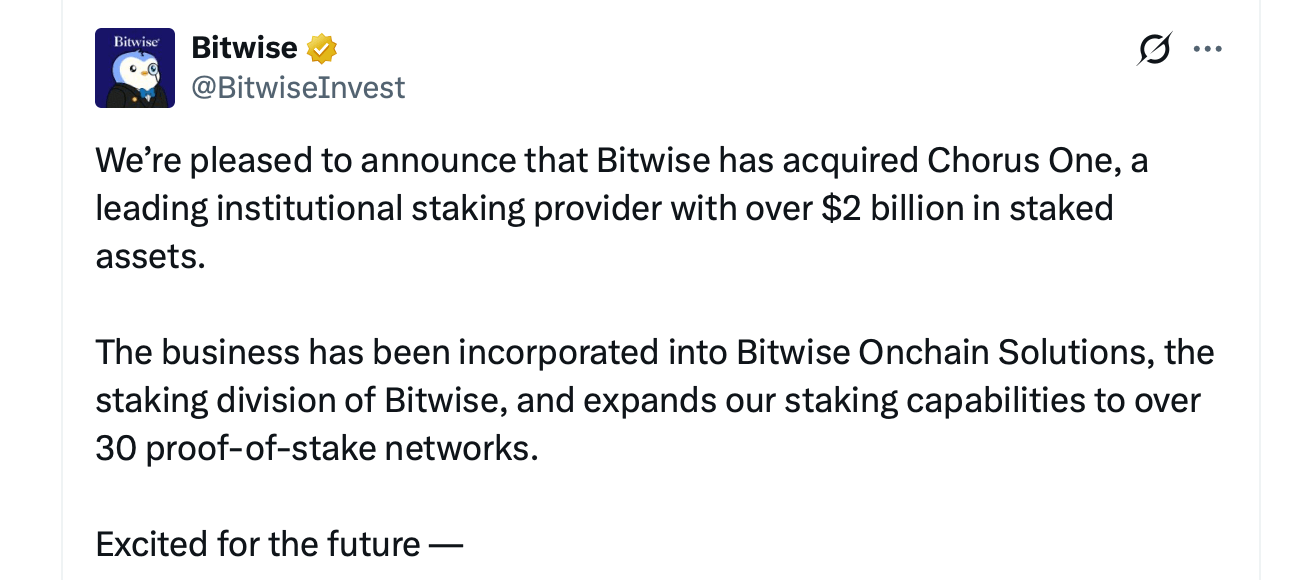
The acquisition expands Bitwise’s staking capabilities across more than 30 proof-of-stake ( PoS) networks, including Solana, Avalanche, Sui, and Aptos, among others. It also adds roughly 50 technology professionals to the firm’s ranks, increasing its validator and research capacity.
Staking, once a niche function handled by crypto-native operators, has become increasingly institutional. Large investors holding spot crypto often seek compliant, secure ways to earn staking rewards without running infrastructure themselves. Bitwise CEO Hunter Horsley described staking as “one of the most compelling growth opportunities” for clients who hold digital assets.
Chorus One, founded in 2018, built its reputation as a validator operator and research-driven staking firm serving family offices, funds, exchanges, and decentralized protocols. The company has focused on PoS infrastructure, governance participation and protocol research — areas that increasingly matter as networks evolve and tokenholders vote on upgrades.
Under the terms of the deal, the core Chorus One team will join Bitwise, while co-founder and CEO Brian Crain will move into an advisory role. The combined firm will have nearly 200 employees worldwide, signaling Bitwise’s intent to scale beyond asset management and deeper into crypto’s operational layer.
The move reflects a broader trend: asset managers are no longer content to simply package tokens into funds. They are building, or buying, the infrastructure that underpins them. In crypto, custody was the first battleground. Staking may be the next. Moreover, many digital asset managers operating ETFs are adding staking features to the prospectuses.
For institutional investors, the pitch is straightforward: one firm to manage exposure and help generate yield. Whether consolidation leads to greater efficiency — or concentrates too much influence among large validators — will likely be debated as staking continues to mature.

 news.bitcoin.com