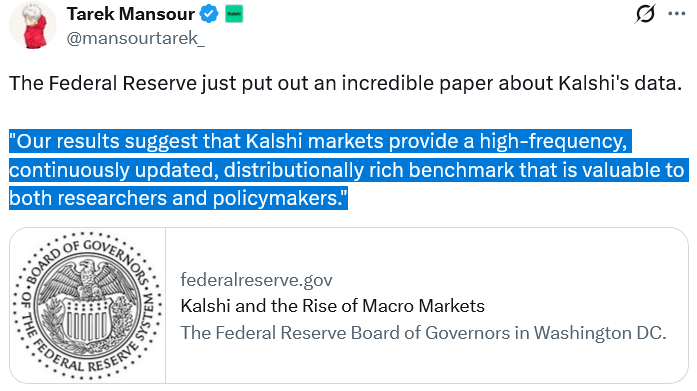
Source: Tarek Mansour
“Managing expectations is central to modern macroeconomic policy. Yet the tools that are often relied upon — surveys and financial derivatives — have many drawbacks,” the researchers said, adding that Kalshi can capture the market’s “beliefs directly and in real time.”
“Kalshi markets provide a high-frequency, continuously updated, distributionally rich benchmark that is valuable to both researchers and policymakers.”
Kalshi traders can bet on a range of markets tied to the Federal Reserve’s decision-making, including the consumer price index, payroll data, and other macroeconomic outcomes such as gross domestic product growth and gas prices.
The Fed researchers said Kalshi data should be used to construct a risk-neutral probability density function that shows all possible outcomes of Fed interest rate decisions and their likelihoods.
“Overall, we argue that Kalshi should be used to provide risk-neutral [probability density functions] concerning FOMC decisions at specific meetings,” they wrote, adding that the current benchmark is “too far removed from the monetary policy interest rate decision.”
However, Fed research papers are only “preliminary materials circulated to stimulate discussion” and do not impact the central bank’s decision-making.
Prediction markets became one of the hottest use cases in crypto last year and have consistently surpassed $10 billion in monthly trading volume. Kalshi and competitor platform Polymarket have been aggressively marketing their products to retail users in recent months despite some state regulators seeking to restrict the industry.
Kalshi is more reactive than existing expectations tools
The Federal Reserve noted one advantage Kalshi has in examining macroeconomic expectations is its “rich intraday dynamics.”
“These probabilities respond sharply and sensibly to major developments,” the researchers said, pointing out an example where the implied probability of a rate cut in July rose to 25% following remarks from Federal Reserve Governors Christopher Waller and Michelle Bowman before falling after a stronger-than-expected June employment report.
“Kalshi provides the fastest-updating distributions currently available for many key macroeconomic indicators,” the researchers added.

 cointelegraph.com