
 decrypt.co
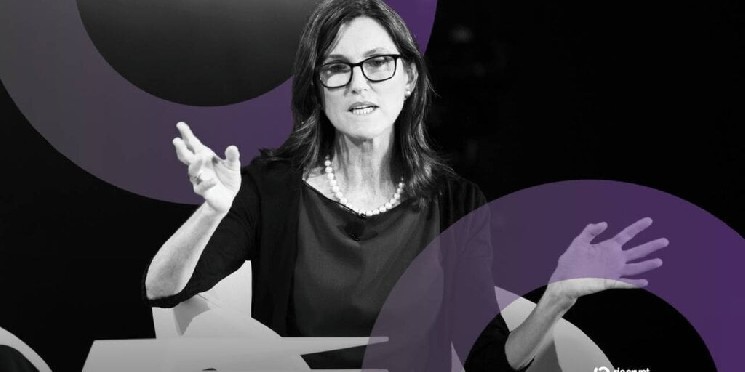
Cathie Wood’s $ARK Investment Management posits the world is at the beginning of a multi-year capital expenditure boom—driven not by traditional infrastructure but by artificial intelligence.
In a report on Monday, the firm outlined a trifecta of accelerating trends, including the release of more powerful AI models, a strategy retreat by legacy automakers from electric vehicles, and a breakthrough convergence of AI, robotics, and biology.
That optimism is increasingly echoed by Wall Street heavyweights, including Goldman Sachs, which boosted its 2026 AI CapEx forecast to $527 billion, noting that hyperscale spending is significantly outpacing previous consensus expectations.
Hyperscalers—Google Cloud, AWS, and Microsoft Azure—are large-scale cloud service providers that help with scaling high-volume computing, storage, and other AI-related services.
The report frames the massive capital outlays announced by tech giants like Amazon and Google not as a threat to short-term profits, but as the fuel for a coming wave of productivity that could reshape entire industries.
BlackRock’s 2026 Global Outlook reinforces this, describing a shift where the massive balance sheets of a few tech titans are now large enough to drive national GDP and broader market liquidity.
“Scaling the AI frontier will require enormous investment in infrastructure,” $ARK analysts wrote in their report. The firm noted that last week’s capital spending forecasts from Google and Amazon were “significantly ahead of consensus expectations.”
“The acceleration of investment reflects both preparation for the future and the risk of overcommitting capital to uncertain outcomes,” Ryan Yoon, senior analyst at Seoul-based Tiger Research, told Decrypt. “After the dot-com bubble, Google became the first major technology company to issue a 100-year bond… An increase in debt effectively pulls future expectations into the present. That dynamic requires sustained proof of earnings visibility. In this cycle, the critical issue is whether AI agents and autonomous systems can translate investment into tangible revenue contribution.”
Innovation advances
The research points to a flurry of activity last week that underscores the pace of change, including OpenAI’s release of GPT-5.3-Codex, which it claims is the first model that helped train itself, alongside a new enterprise platform called Frontier and Anthropic’s open-source plugins for its Claude Cowork agent.
$ARK analysts noted that the collapsing cost of coding, driven by these advanced models, triggered a roughly $300 billion drop in the market value of U.S. software stocks, as investors feared traditional software moats were eroding.
“AI continues to pull in more capital as investors hold a bullish view for further growth despite warning signs of crowded investment and market developments,” Nick Ruck, Director at LVRG Research, told Decrypt. “We remain optimistic in the long term as institutions continue to integrate more within the industry, while a pullback might be expected at some point in the future.”
Market analysts have dubbed this the "SaaS-pocalypse," as the "moats" of traditional enterprise software are eroded by AI-native tools that can build and iterate at near-zero marginal costs.
While AI CapEx continues to surge, $ARK highlighted a divergence in the automotive sector, with multiple EV-related write-downs totaling $59 billion from the likes of Stellantis, Volkswagen, General Motors, and Ford.
The retreat comes amid global markets facing "higher-for-longer" rate friction amid worsening macroeconomic and geopolitical outlooks. Some of those include Japan’s bond crisis, the U.S. dollar’s 12-month slump, the war between Russia and Ukraine, China’s aggressive stance toward Taiwan, and the U.S.’s recent attack on Venezuela.
Biotech: the next frontier?
JP Morgan’s 2026 analysis suggests that while legacy firms are cutting costs to protect dividends, AI-integrated leaders are using the downturn to widen their competitive lead through vertical integration.
The most forward-looking convergence, according to $ARK, is unfolding in biotechnology.
The firm spotlighted a new collaboration between OpenAI and Ginkgo Bioworks to create an autonomous robotic lab for drug discovery.
The system uses AI to design experiments, robots to run them, and then feeds the data back into the AI models—a closed loop that operates without human intervention.
$ARK's overarching thesis, as laid out in its Big Ideas 2026 report, is that the “hundreds of billions of dollars invested in AI infrastructure is likely to generate meaningful long-term returns thanks to the massive productivity gains we believe AI will deliver across every industry.”
The firm positions current cap-ex not as a cost, but as the down payment on that transformed future.