
 decrypt.co
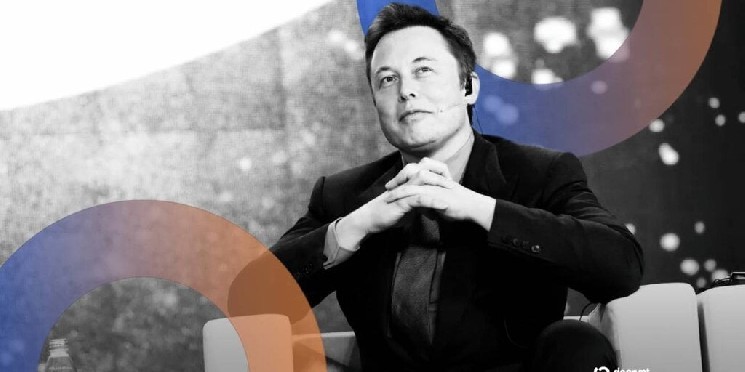
Elon Musk said Thursday that artificial intelligence could surpass human intelligence as soon as this year, arguing that progress toward artificial general intelligence is accelerating faster than humanity is prepared for.
The comments by the Tesla, SpaceX, and xAI CEO came during a wide-ranging conversation with BlackRock CEO Larry Fink at the World Economic Forum in Davos on Thursday.
“I think we might have AI that is smarter than any human by the end of this year,” Musk said. “No later than next year.” He added that by around 2030 or 2031, AI could become “smarter than all of humanity collectively.”
Musk’s comments place him among a growing group of tech CEOs who say AGI will arrive within years, not decades, raising concerns about labor disruption, governance, and economic concentration. He said the economic impact of AI will depend less on software alone, and more on the deployment of humanoid robots capable of performing physical work at scale.
“If you have ubiquitous AI that is essentially free or close to it, and ubiquitous robotics, then you will have an explosion in the global economy,” he said.
Musk also repeated his view that humanoid robots will eventually outnumber humans.
“My prediction, in the benign scenario of the future, is that we will make so many robots and AI that they will saturate all human needs,” Musk said.
Tesla, Musk added, has already begun using early versions of its Optimus humanoid robot in factories, where they are performing simple tasks, with more complex tasks planned by the end of 2026. The company also plans to sell humanoid robots to the public by the end of next year, Musk said, once safety and reliability targets are met.
Some researchers have previously questioned Musk’s timelines, citing unresolved safety, cost, and engineering challenges.
“Elon has a track record of overoptimistic predictions about AI,” Gary Marcus, a cognitive scientist and professor emeritus of psychology and neural science at New York University, previously told Decrypt. “It’s just fantasy to imagine selling 200 times as many humanoid robots in the nearish term when nobody knows how to build a single safe, reliable, generally useful humanoid right now, at any price.”
Musk acknowledged the risks posed by a proliferation of humanoid robots, but said progress in AI and robotics is compounding. The main constraint in deployment is power, he explained, highlighting the need to shift to solar power.
“Solar is by far the biggest source of energy. When you look beyond Earth, the sun rounds up to 100% of all energy. The sun is 99.8% of the mass of the solar system. Jupiter is about 0.1%, and everything else is miscellaneous,” he said. “Even if you were to burn Jupiter in a thermonuclear reactor, the amount of energy produced by the sun would still round up to 100%.”
He argued that large-scale solar deployment will determine how quickly AI systems can expand; however, Musk said advanced AI and robotics must be developed carefully.
“We need to be very careful with AI. We need to be very careful with robotics,” he said. “We don’t want to find ourselves in a James Cameron movie…'Terminator.'”
Despite these concerns, Musk closed by encouraging optimism about the future of AI and humanoid robotics.
“For quality of life, it is actually better to err on the side of being an optimist and wrong,” he said, “rather than a pessimist and right.”