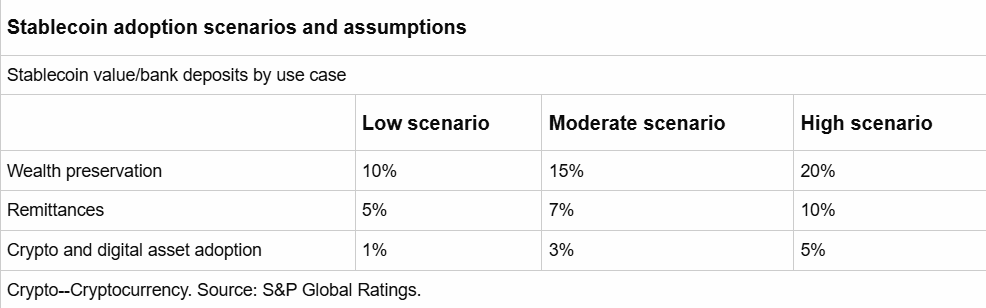
Stablecoin adoption simulation. Source: S&P Global Ratings
The New York-headquartered ratings firm bases its projections on three main forces: pressure on local currencies, cross-border remittance demand and broader digital-asset use.
“Adoption will be driven by, in order of importance, wealth protection, remittances and international trade, and general enthusiasm for digital assets,” the report reads.
Key Markets for Stablecoin Adoption
As S&P Global argues, countries with high inflation show the biggest potential for stablecoin adoption. In its most aggressive scenario, the firm projects stablecoins could reach a meaningful share of the value of traditional bank deposits in select markets, namely those where stablecoins are being used to preserve wealth — in countries where logical currency purchasing power is eroding.
“We assume stablecoin adoption could reach 10-20% of bank deposits in the top 15 countries where wealth preservation (purchasing power) is the most important factor,” the report notes.
The projections are based on bank deposit data from late 2024, with Argentina and Turkey leading the list by average inflation rate in the past two years.
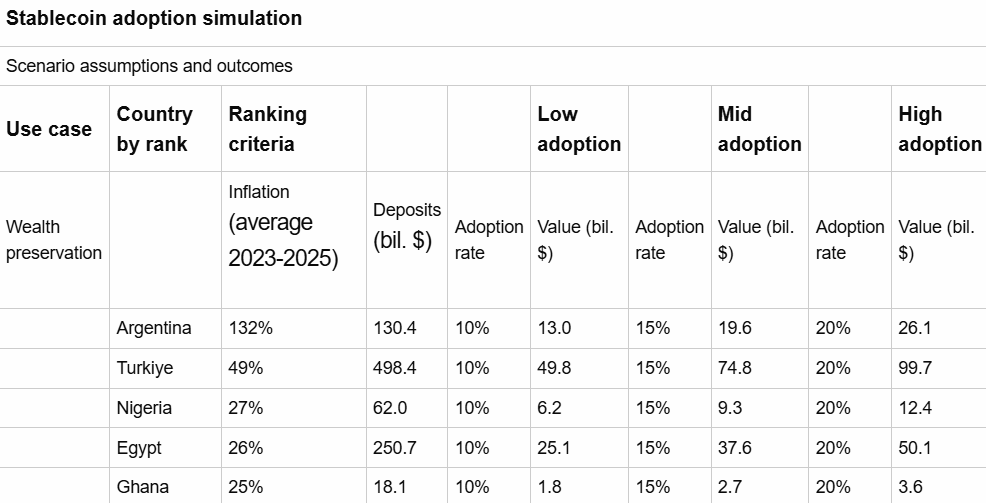
Stablecoin adoption simulation. Source: S&P Global Ratings
Earlier in January, blockchain analytics firm Artemis estimated that stablecoin-linked Visa card spending reached a $3.5 billion annualized run rate in late 2025, growing about 460% year-over-year.
A geographic breakdown of stablecoin usage showed India and Argentina as “true global outliers,” where USDC accounts for 47.4% and 46.6% of usage, respectively. By comparison, USDT dominates stablecoin activity across most other markets, including Turkey, China and Japan, according to the data.

 thedefiant.io