
 coindesk.com
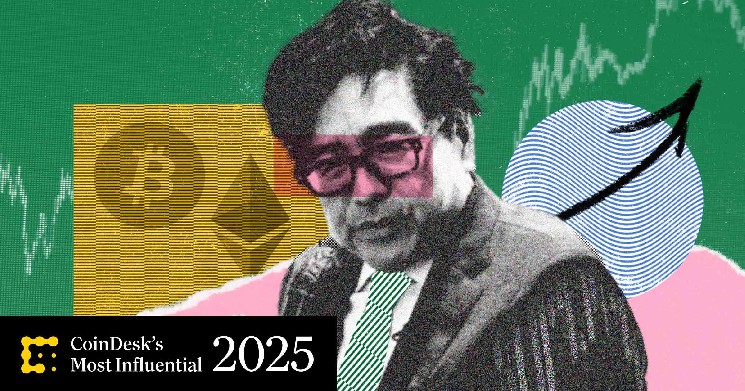
Thomas “Tom” Lee has been a fixture on Wall Street for some time, and his recent pivot into crypto signals he’s not content to remain on the sidelines.
This feature is a part of CoinDesk's Most Influential 2025 list.
Lee co-founded Fundstrat Global Advisors, an independent financial research firm, in 2014. He currently serves as head of research at Fundstrat and FSInsight, and as chief investment officer at asset management firm Fundstrat Capital.He has built a reputation over the last two decades as a bullish, media-savvy equity strategist. Now, as Chairman of the Board at Ethereum treasury BitMine Immersion Technologies (BMNR), he’s in a corporate role that places him at the crossroads of traditional finance and digital-asset innovation.
The strategist began his career in finance as a research associate at Kidder Peabody in the early nineties. Lee also worked at Oppenheimer and Salomon Smith Barney, before later joining Wall Street giant JPMorgan (JPM).
Lee was ranked among top analysts for many years during his 15-year tenure at the leading investment bank. In 2014 he left JPMorgan to co-found Fundstrat, where he was one of the first well-known strategists to give research coverage to cryptocurrencies.
That experience now bolsters his new role at BitMine, which announced Lee’s appointment as Chairman in June this year. Alongside Lee’s appointment, the company also announced that it had pivoted from its roots in bitcoin mining to a treasury strategy focused on staking and holding ether as its primary reserve asset. The company launched a $250 million private placement to implement the new strategy.
“Stablecoins have proven to be the ‘chatGPT’ of crypto, leading to rapid adoption by consumers, merchants and financial services. U.S. Treasury Secretary Scott Bessent, recently stated the stablecoin market could reasonably reach $2 trillion compared to the current $250 billion,” Lee said in a press release at the time. “Ethereum is the blockchain where the majority of stablecoin payments are transacted and thus, $ETH should benefit from this growth.”
BitMine has adopted “$ETH per share” as a key performance metric, a nod to the playbook of other crypto treasury companies. Lee framed the strategy as part of the broader convergence of traditional finance and crypto, highlighted by the booming stablecoin market and Ethereum’s dominance in smart contracts and tokenized assets.
Lee recently said on a post on X that ether is “embarking on that same supercycle" that produced a 100x gain in bitcoin $BTC$91,196.43 since his 2017 client recommendation. He noted that $BTC has suffered six drawdowns of more than 50% and three of more than 75% over the past eight and half years, arguing the volatility reflects markets “discounting a massive future,” and that investors have had to endure repeated “existential moments.”
He did not provide a timeline or price targets for his ether thesis, other than cautioning that the cryptocurrency’s path higher wouldn’t be in a straight line. The digital asset is down about 10% year-to-date, despite two major code changes designed to improve the blockchain rolling out in 2025.
BitMine is currently the largest corporate holder of ether. The company has a stack of around 3.9 million tokens, or more than 3% of the second-largest cryptocurrency’s supply. The digital asset treasury firm acquired 138,452 tokens last week, in its largest weekly acquisition in at least a month. It also increased its cash holdings to $1 billion, and currently holds a total of $13.2 billion in crypto and cash assets.
Lee said the firm had stepped up its buying of the crypto following the Ethereum blockchain’s Fusaka upgrade on Dec. 3. The upgrade is expected to boost throughput, keep validators efficient and strengthen the blockchain’s value capture by putting a floor under blob fees. If history is a guide, updates don’t reliably move ether’s price, but they reinforce the network’s institutional edge.
He cited macro factors, including an expected Federal Reserve rate cut this month, and the end of quantitative tightening, as catalysts for a stronger ether market in early 2026. Lee attributed the recent weakness in crypto markets to a sharp drop in liquidity, which may have been caused by a market maker shrinking operations following the Oct. 10 flash crash.
The Wall Street veteran is able to bridge the institutional-investor world with the crypto ecosystem. At Fundstrat Lee built a reputation for strong forecasts and transparent bullishness, now he is translating that voice into corporate strategy and board governance.
The shift to his new role at BitMine reflects the evolution of the crypto-treasury model and shows that seasoned traditional finance figures are increasingly willing to take operational responsibility for digital-asset exposures.