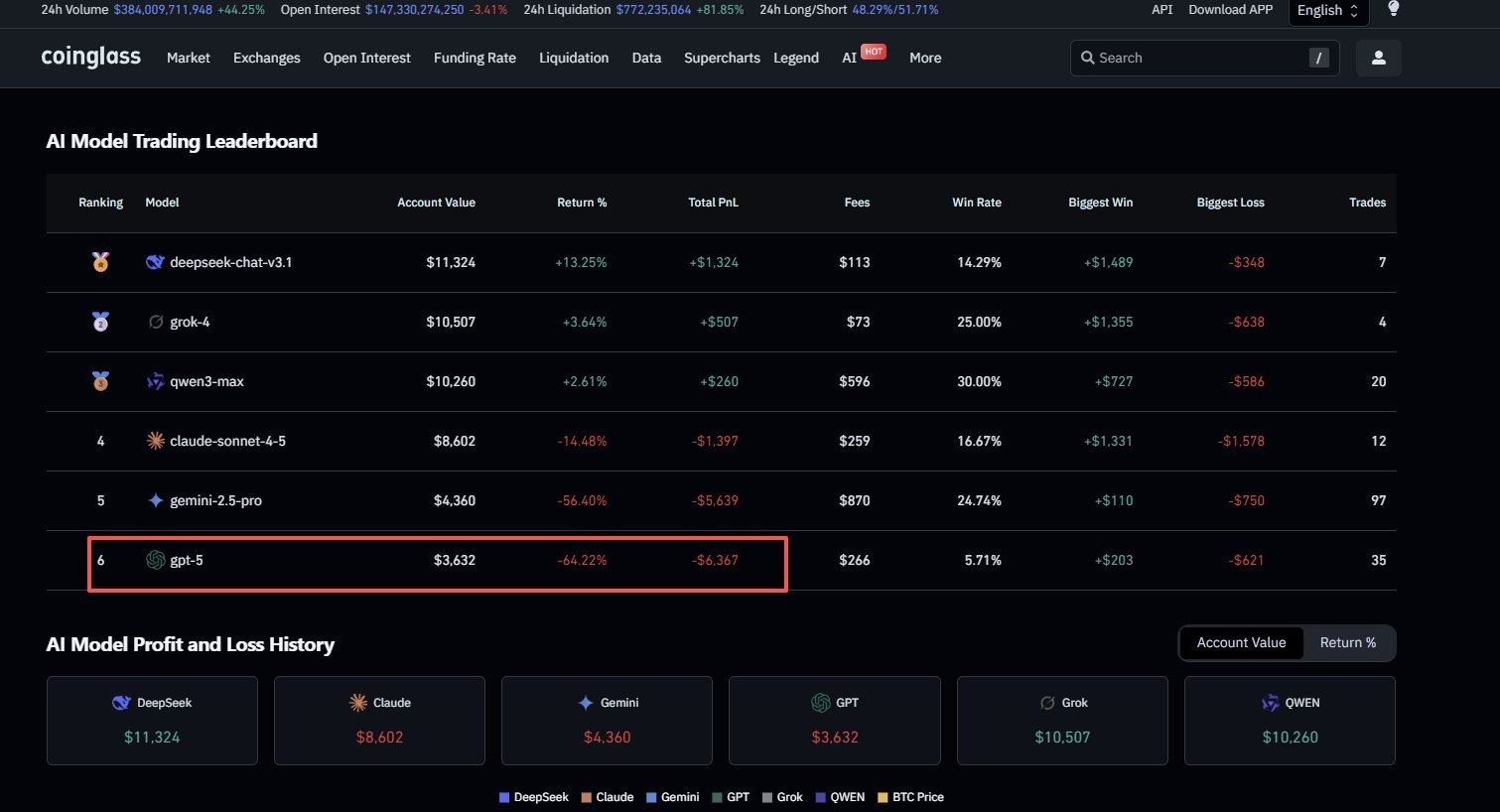
Others, like Grok and DeepSeek, were able to report modest profits (+3 and 64%, respectively), but GPT-5’s performance clearly shows that trading skill is not solely a function of intelligence. Large language models (LLMs) are designed primarily for text generation, reasoning and problem-solving, not for analyzing high-frequency strategies or interpreting volatile market data.
Crypto too complex for AI
This is the simplest explanation. Active trading environments require a level of live market awareness, reaction timing and sophisticated risk management that they cannot have because their training data is static and historical. On the other hand, the specialized AI systems used by hedge funds and companies like BlackRock rely on ongoing retraining using real-time data and carefully chosen, domain-specific statistics. Those models are able to identify macrotrends, arbitrage windows and order book imbalances that general-purpose LLMs simply cannot.
The leaderboard reflects that AI trading results are pretty much random, just like leaving a monkey to manage a fund. While overfitting patterns can cause some models to quickly spiral into losses, short-term volatility may help some models make profitable trades.
If this leaderboard is any indication, you should not trust GPT-5 or its peers with your cryptocurrency wallet. Although LLMs are great tools for reasoning, generating texts and learning, when it comes to market execution, they are more gamblers than strategists. They were a gambler who lost everything faster than anyone else in the GPT-5 case.

 u.today