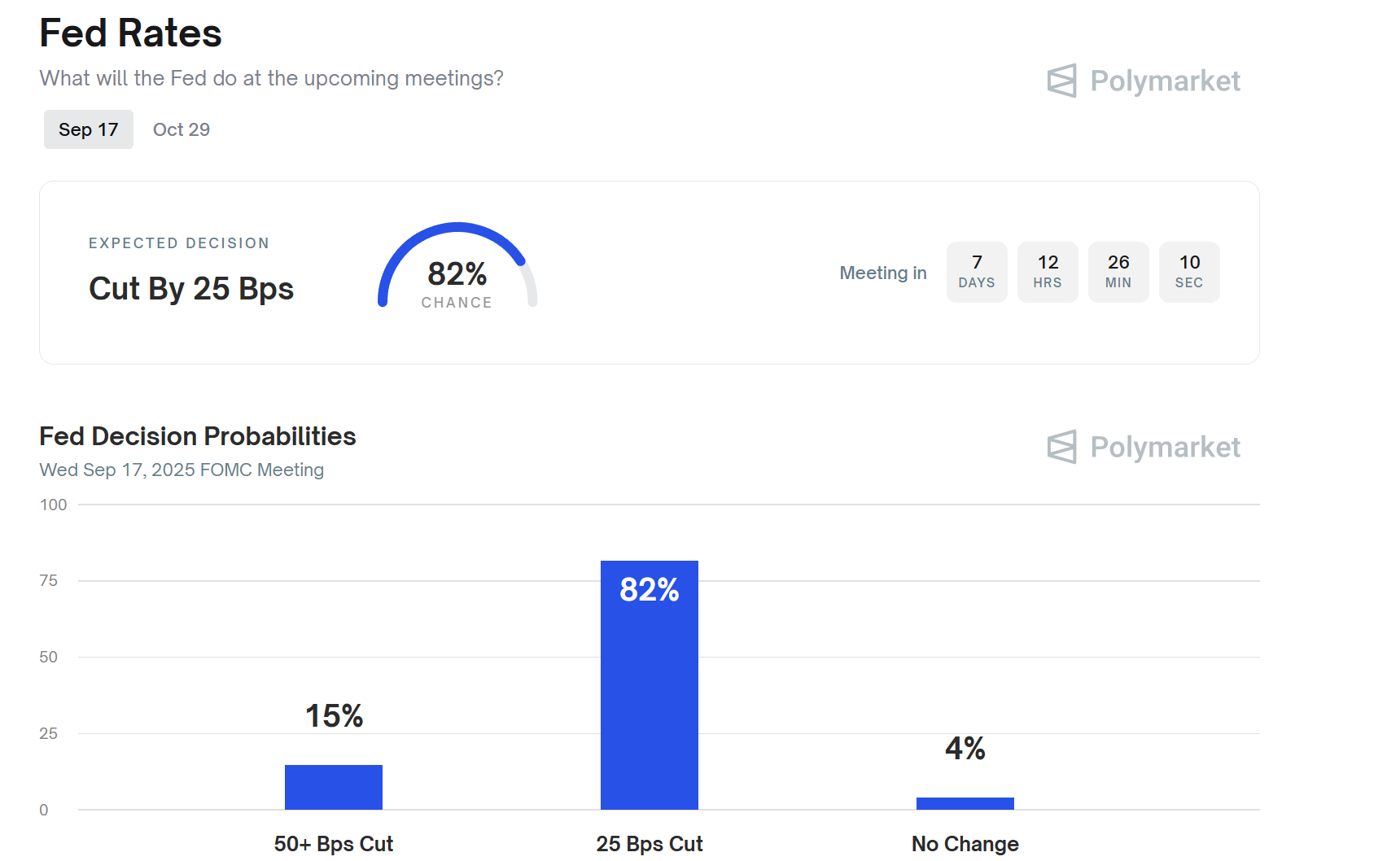
“Markets often look calm just before they move. Bitcoin is trading in one of its tightest ranges in months, and volatility across crypto has compressed to multi-month lows,” said Gracie Lin, OKX Singapore CEO. “With U.S. inflation data like Core CPI out on Sept. 11 and the Fed’s much-anticipated rate decision just ahead, this quiet period is setting the stage for the next decisive move. Whether the catalyst is an upside inflation surprise or a dovish signal from the Fed, what’s clear is that the absence of volatility is rarely permanent in digital assets; history shows the market will find its next direction soon enough.”
If a cut pulls money-market returns lower, the opportunity cost of sitting in cash rises, which is the pivot market maker Enflux says could send flows toward crypto.
“The real debate now is not if cuts come, but whether liquidity deployment shifts into $BTC, $ETH, and even riskier assets,” the firm told CoinDesk.
In other words, the Fed’s cut may grab headlines, but the real trade is whether sidelined cash rotates into digital assets — a shift that could fuel the return of volatility.
Market Movement
$BTC: Bitcoin has dipped slightly intraday, trading between approximately $110,812 and $113,237, reflecting short-term volatility amid shifting investor sentiment and broader crypto market dynamics.
$ETH: $ETH is modestly up intraday, with a range between roughly $4,279 and $4,379, signaling steady demand and some renewed investor interest. Range, however, is limited with modest ETF flows and traders awaiting the Fed's next move.
Gold: Gold is rallying to record highs, fueled by mounting expectations of U.S. Federal Reserve interest rate cuts, a weakening U.S. dollar, and renewed safe-haven demand.
Nikkei 225: Asia-Pacific stocks opened mostly higher Wednesday, with Japan’s Nikkei 225 up 0.2%, as investors awaited China’s August inflation data showing an expected 0.2% CPI drop and a smaller 2.9% PPI decline.
S&P 500: U.S. stocks closed at record highs Tuesday, with the S&P 500 up 0.27% to 6,512.61, as investors looked past a record payroll revision that cut 911,000 jobs from prior figures.

 coindesk.com