The findings reiterate a big challenge with traditional banks, where a lot of business money just sits there earning nothing. Stablecoins, on the other hand, give companies a faster, more profitable way to use their cash.
Currently, about 21% of U.S. business bank deposits (around $3.85 trillion) don’t earn any interest, the report revealed, and it can take up to five days for companies to move this money. As stablecoins grow in popularity, more of these funds are likely to be put into stablecoins that can earn yield. So far, over $600 million has already been paid out through yield-bearing stablecoins.
It is worth noting, however, that under the recently passed regulations for stablecoins in the U.S., issuers are prohibited from offering yield or interest on stablecoins directly.
“There’s an ongoing perception that stablecoins are at an early stage, or somehow waiting for mass buy-in. That’s not what we’re seeing on the ground,” Kevin de Patoul, CEO of Keyrock, told The Defiant:
“The infrastructure is here: wallets, custody, and compliance rails all exist today, and large institutions are already using them.”
De Patoul explained that the reason more people aren’t talking about the trend is because it isn’t loud. “It’s just working. The opportunity now is to scale it, and for institutions, that starts with understanding what’s already in place,” he added.
Stablecoins are rapidly evolving to become core components of the global financial system. As of August 2025, the total stablecoin market capitalization exceeds $271 billion, up from approximately $5 billion in 2020, per DefiLlama.
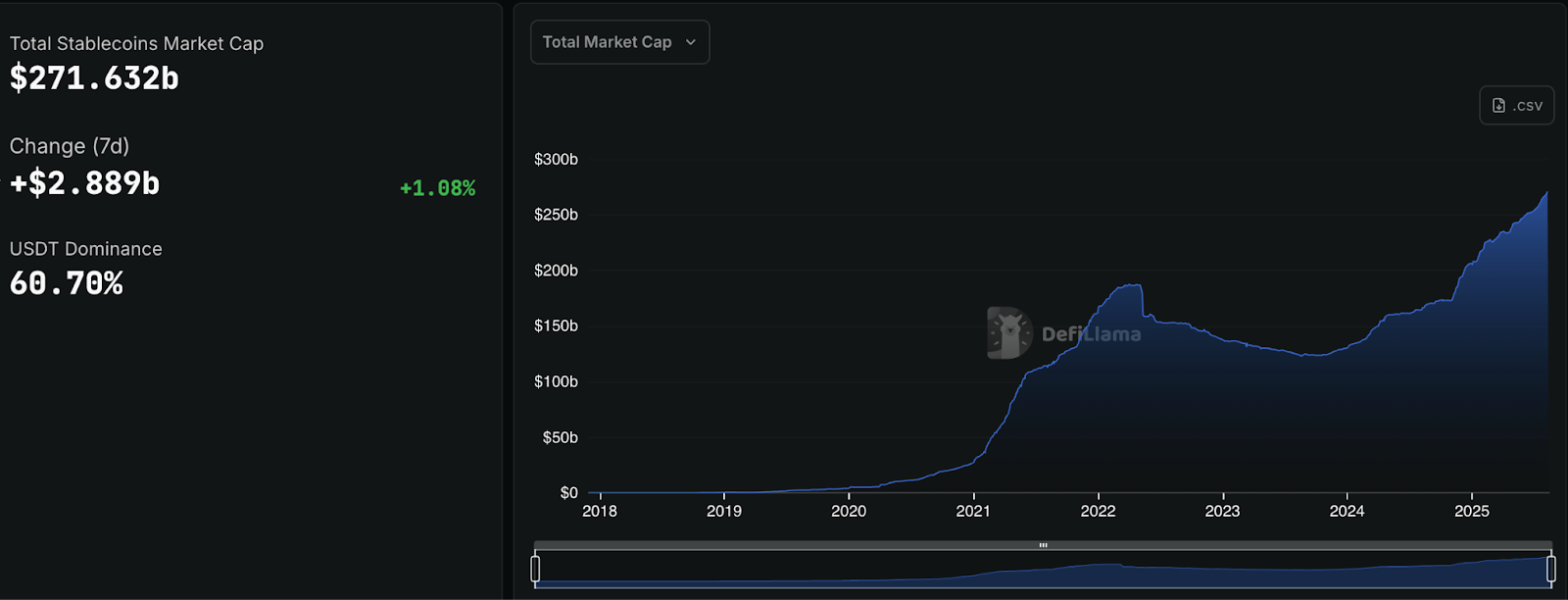
Total stablecoin market cap. Source: DefiLlama
Regulation is also catching up, providing a clearer framework for stablecoin use. Recent landmarks for stablecoin legislation include the GENIUS Act in the U.S. and a stablecoin framework in Hong Kong coming into effect this month.

 thedefiant.io