Ethereum price is rising, so why is Wall Street running for the exits?
invezz.com
3 h
Ethereum ($ETH) stays below $1,700 despite adding 3% to its value in the last 24 hours as persistent ETF withdrawals, weakening US investor demand, and hotter-than-expected inflation weigh on market sentiment.
The second-largest cryptocurrency has failed to establish a sustainable recovery despite approaching oversold territory.
Institutional investment products continue to experience significant redemptions, while on-chain market indicators suggest that US-linked buying demand remains subdued.
Know when your coins move
Alerts, real-time prices, and market news — all in one app
Point your phone camera to install
4.8 based on 40K reviews in the App Store and Google Play
Meanwhile, expectations of further Federal Reserve interest rate increases are adding pressure to an already fragile cryptocurrency market.
Ethereum ETF outflows reach $1.22 billion in November
Institutional demand for Ethereum continues to deteriorate as investors reduce their exposure to regulated $ETH investment products.
According to SoSoValue, US spot Ethereum ETFs recorded approximately $68.5 million in net outflows on Wednesday, extending their withdrawal streak to nine consecutive trading sessions.
BlackRock's iShares Ethereum Trust (ETHA) accounted for the entire withdrawals, with other funds recording no flows yesterday.
The latest redemptions brought cumulative November outflows to approximately $1.23 billion, indicating persistent institutional caution amid unfavorable market conditions.
Continued withdrawals could make it increasingly difficult for Ethereum to establish a meaningful recovery, particularly as broader cryptocurrency demand remains weak.
Further evidence of weakening demand comes from Ethereum's Coinbase Premium Index, which has remained negative for 80 consecutive days.
The indicator measures the difference between Ethereum's trading price on Coinbase and Binance.
Negative readings suggest weaker relative buying demand or stronger selling pressure on the US-based exchange.
According to CryptoQuant, the indicator's 30-day moving average has reached its lowest level since the collapse of the Terra LUNA-UST ecosystem in 2022.
This suggests that US-linked spot demand has yet to recover meaningfully despite Ethereum's substantial price correction.
Hotter US inflation strengthens Fed rate-hike expectations
Finally, Ethereum also faces additional macroeconomic pressure following the release of October's US Personal Consumption Expenditures (PCE) inflation data.
Annual headline PCE inflation accelerated to 3.8%, while core inflation, which excludes volatile food and energy prices, climbed to 3.3% from 3.1% in September.
The core reading exceeded economists' expectations of 3.2%, while both headline and core inflation increased by 0.3% on a monthly basis.
The stronger-than-expected figures reinforced expectations that the Federal Reserve will raise interest rates by another 25 basis points at its December meeting.
Persistent inflation and tighter monetary policy could continue to discourage investment in risk-sensitive assets, including Ethereum.
Despite $ETH's price weakness, the Ethereum Foundation continues to advance efforts to strengthen the network against emerging technological threats.
The Foundation has selected Keccak-256 as the primary hash function for Ethereum's planned hash-based cryptography as developers prepare for potential risks associated with quantum computing.
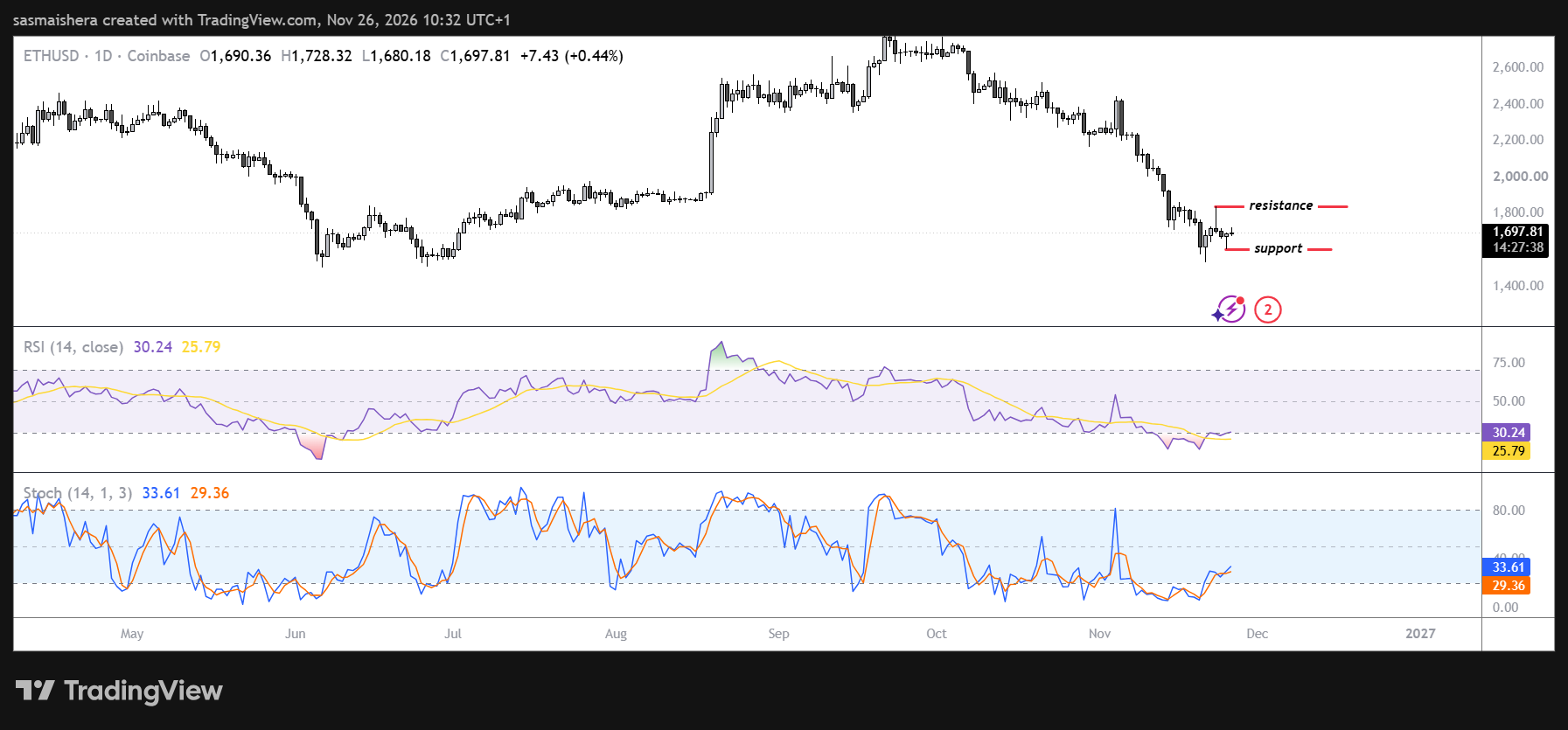
Ethereum's daily technical structure remains bearish as the cryptocurrency trades below its major Exponential Moving Averages (EMAs).
The 20-day EMA stands at $1,868, while the 50-day and 100-day EMAs are positioned at $2,096 and $2,192.
Meanwhile, the Relative Strength Index (RSI) stands at 30, indicating oversold conditions. The Stochastic Oscillator also remains subdued at 29, reflecting weak momentum.
On the downside, immediate support stands at $1,603. A decisive breakdown below this level could expose Ethereum to further losses toward $1,512 and $1,444.
$ETH/USD Daily Chart
On the upside, Ethereum would need to reclaim $1,706 to ease immediate selling pressure, followed by resistance at $1,827 and $1,868.
A sustained breakout above the broader $2,100–$2,200 resistance zone, followed by $2,355, would provide stronger evidence of a potential trend reversal.
For now, persistent ETF withdrawals, weak US spot demand, and hawkish Federal Reserve expectations leave Ethereum vulnerable to further downside despite oversold technical conditions.
AI disclosure: AI tools assisted with research and drafting of this piece. An Invezz editor reviewed the facts, sources and wording before publication. Any opinions or analysis are Invezz’s, not those of an automated system.

 invezz.com