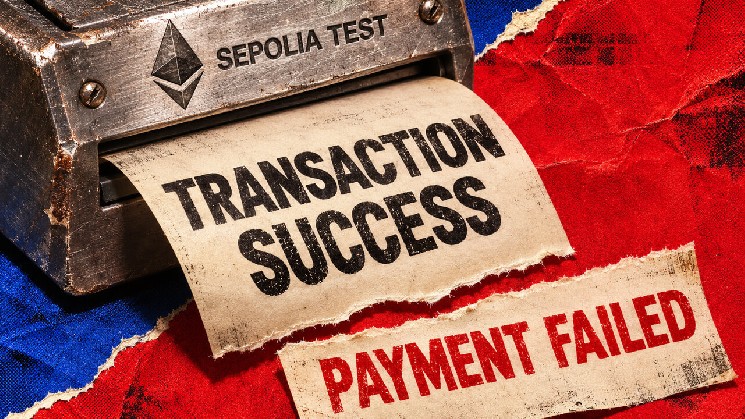
A successful Ethereum receipt can miss a payment
The developer mejango says the tests use deployed contract code through eth_simulateV1. A fresh project is launched and funded inside each simulation, then a payment path is tested across different transaction gas limits. Each scenario is pinned to a blockchain block.
The V6 payout test reports successful transactions that skip a split to another project, leaving that money in the paying project. A reserved-token distribution also completes despite a failed cross-project payment, with the beneficiary receiving raw tokens instead.
In the cash-out test, sampled gas limits in the reported 679,622-to-817,622 band let the withdrawal complete without paying the fee.
The mainnet comparison runs show only transaction failures or complete delivery across the sampled ranges for all four paths.
The distinction comes from which operation runs out of gas first, according to the developer's explanation. Under the tested Glamsterdam rules, an internal payment that writes fresh storage can fail before the outer transaction does.
The contract's try/catch error handling absorbs that failure and lets the surrounding operation finish.
EIP-8037 proposes higher costs for creating persistent blockchain data and separate accounting for state creation and execution, while EIP-8038 updates the costs of accessing and writing state. Those changes aim to support more throughput while controlling resource demands.
Ethereum's Nov. 16 testing-call agenda explicitly lists Juicebox's compatibility concerns and proofs of concept within the EIP-8037/8038 investigations. The findings are intended to inform Thursday's execution-layer discussion.
In a Nov. 13 comment on that agenda, mejango asked whether the impacts fall within the Ethereum Foundation's tolerance for breaking changes, linking the answer to confidence in building immutable applications whose deployed code cannot be changed in place.
The tests advance the broader compatibility warning from early November, with specific payment outcomes from deployed contract code. They leave developers weighing whether proposed protocol rules preserve the guarantees those applications were built to deliver.
In its earlier Nov. 9 update, the Foundation recommended reviewing public audit findings before deciding on specification changes or the Hoodi testnet schedule. It lists Nov. 19 for discussion of findings and possible next steps, with no decision precommitted.

 cryptoslate.com