
 coindesk.com

Pay someone from an ordinary Ethereum wallet and they can follow its public transaction history. Fortunately, users have a growing list of options to hide their data.
The latest alternative comes from Privacy developer Aztec Labs. The firm says it is bringing back zk.money, a wallet that hides payment amounts and recipients while letting people send money by name or payment link.
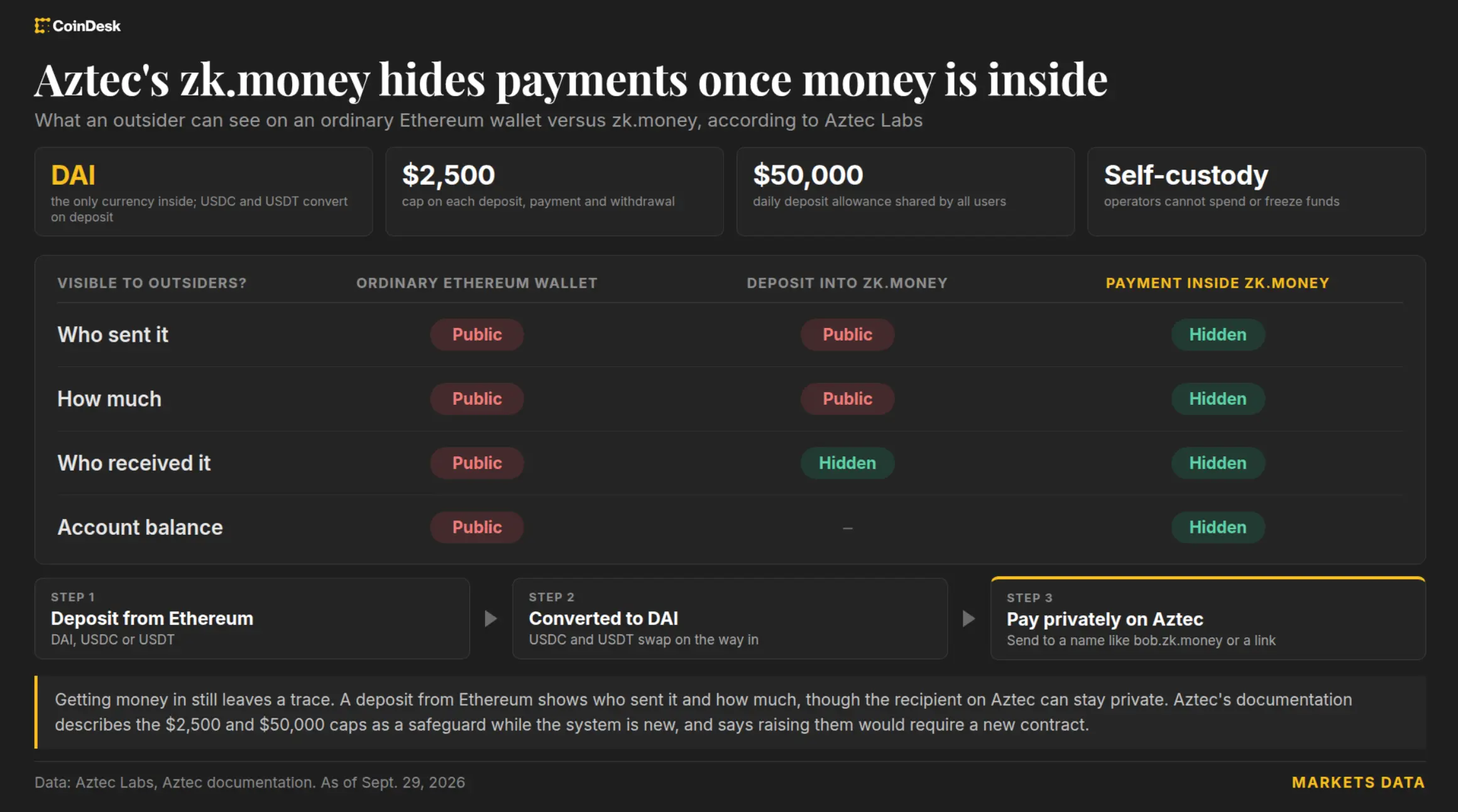
The firm told CoinDesk that users will be able to deposit the dollar-pegged stablecoins $DAI, $USDC and $USDT from Ethereum. $USDC and $USDT are converted into $DAI on the way in, leaving $DAI as the only currency used inside zk.money.
On Ethereum, anyone who knows a person’s wallet address can see its balance and trace past transfers. That can expose a business’s payments to suppliers or an individual’s spending history. zk.money moves payments onto the Aztec Network, which is connected to Ethereum but hides balances, amounts and the people involved in transfers.
People can request a payment by sharing a link or send one to a readable name such as bob.zk.money, rather than copying a long wallet address. Aztec Labs says the wallet is self-custodial, so its operators cannot spend or freeze the funds held in it.
“Onchain transactions between two individuals shouldn't mean publishing your financial history to the world,” Joe Andrews, CEO of Aztec Labs, said in a statement.
Andrews added that Aztec Labs chose $DAI because it considers it “the most decentralized of the mass-market stablecoins used today on Ethereum.” He said the wallet could support other assets later.
Ethereum already has apps that hide payments, though transfers from an ordinary wallet remain public. Its developers are weighing changes for the planned 2027 Hegotá upgrade that could let privacy apps handle transaction approvals and fees with less help from outside services. Those proposals are still under consideration, while Aztec Labs is bringing back a wallet people can use on its own network.
Read More: Ethereum’s next big upgrade has 66 proposals, including a major privacy fix
What zk.money can and cannot hide
Moving money into the system still leaves a public trace, however. Aztec’s documentation says a deposit from Ethereum reveals the sender and amount, even though the recipient on Aztec can remain private.
The relaunch comes with limits, however. Each deposit, payment and withdrawal must be below $2,500. All users share a $50,000 daily deposit allowance, which replenishes over time. The documentation describes those caps as a safeguard while the system is new and says raising them would require a new contract.



