Ethereum staking hits record high – Will EIP-8363 slow ETH issuance?
ambcrypto.com
12 August 2026 02:06, UTC
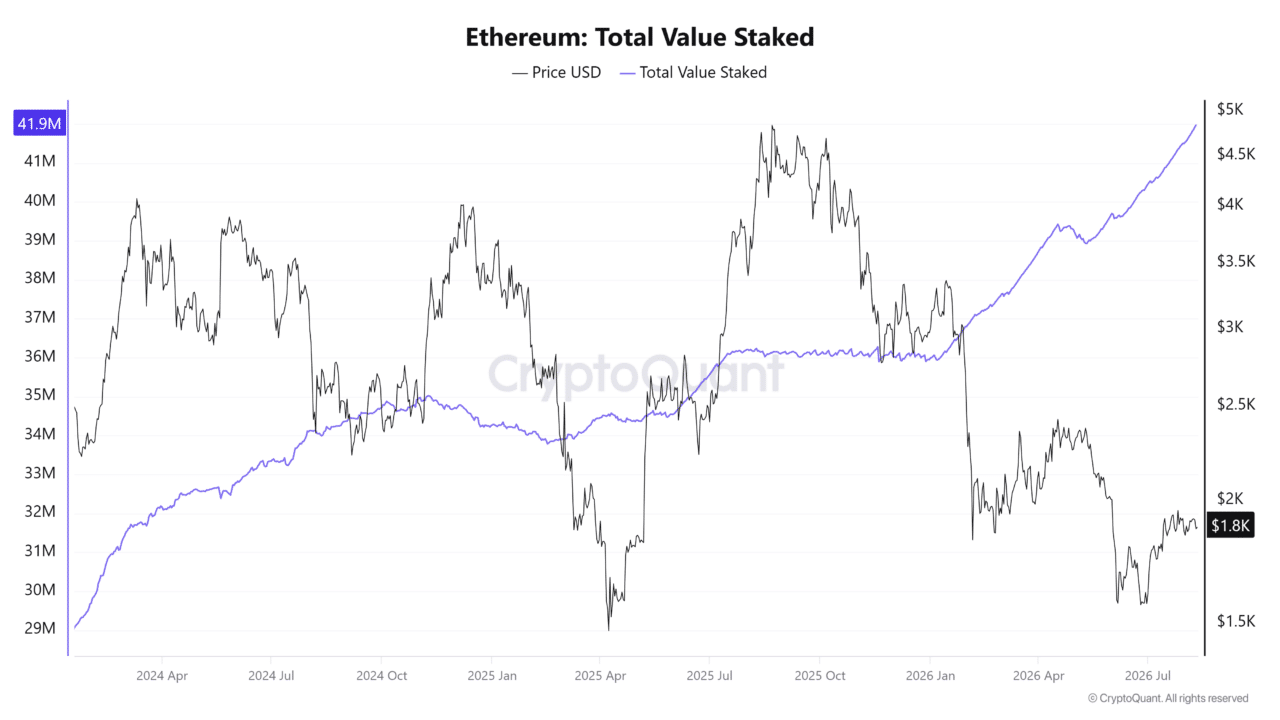
Despite Ethereum’s [$ETH] prolonged price weakness, holders have continued moving more supply into staking rather than withdrawing. Total staked $ETH rose from roughly 36 million in early 2026 to a record 41.9 million, even as the dominant altcoin fell toward $1,800.
Source: CryptoQuant
This steady increase suggests lower prices have not weakened the incentive to lock $ETH for yield. Since staking is absorbing additional Ethereum supply through this downtrend, it also reduces the immediate amount available for trading.
Source: CryptoQuant
Know when your coins move
Alerts, real-time prices, and market news — all in one app
4.8 based on 40K reviews in the App Store and Google Play
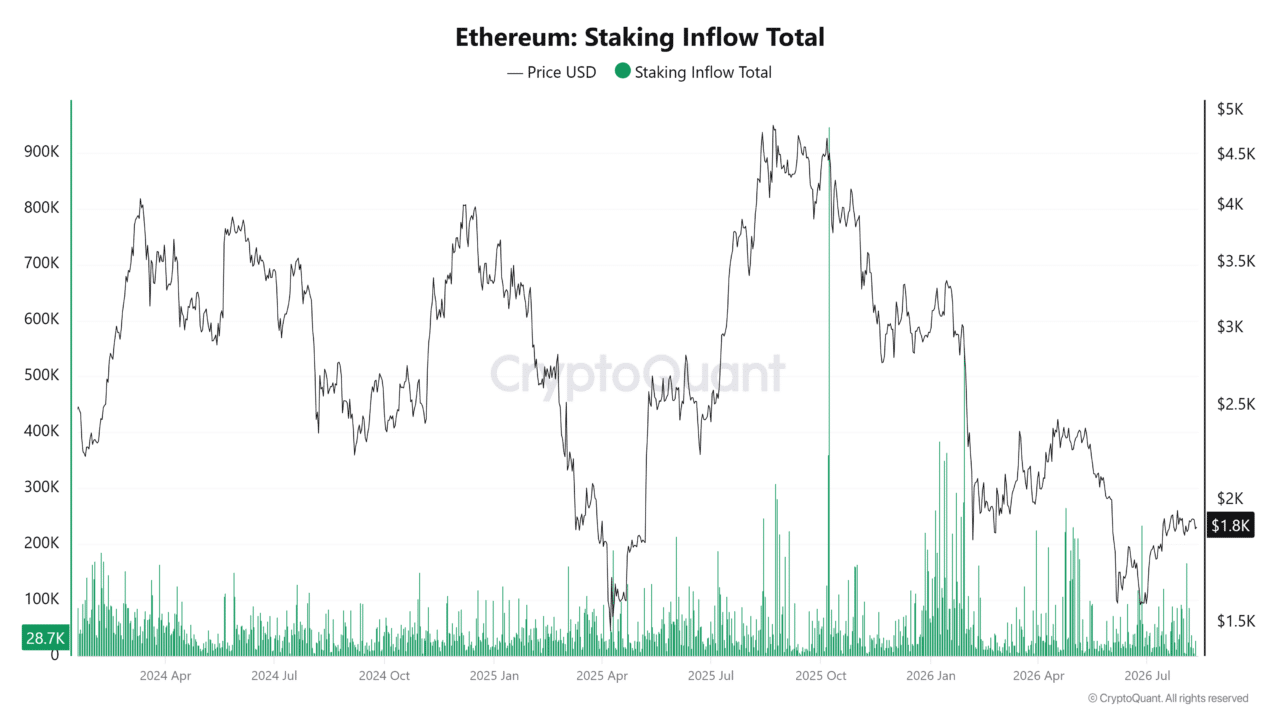
More importantly, recent inflows near 28,700 $ETH remain below earlier spikes above 200,000 $ETH, showing accumulation has become less aggressive. Notably, since roughly one-third of the supply is now staked, it will likely limit the $ETH liquidity, therefore strengthening scarcity if market demand eventually recovers.
EIP-8363 targets Ethereum’s staking rewards
That said, approximately one-third of $ETH is currently staked on the network. In light of this, EIP-8363, dubbed “Tapered Issuance Burn,” aims to alter the way new participation on Ethereum will be rewarded.
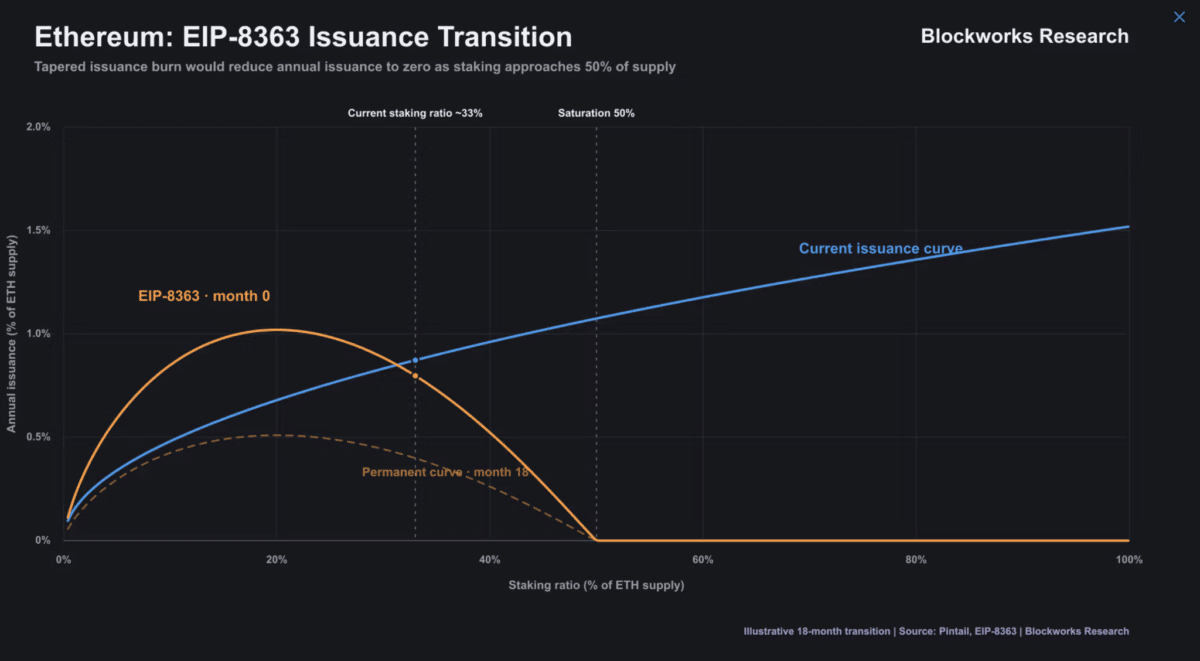
Under the proposal, validator rewards are set to decrease in proportion to increases in staking ratios. At approximately the current 33% staking ratio, annual issuance would begin to trend downward at a rate lower than the present reward structure, eventually approaching an issuance rate of less than .8%.
Near the current 33% staking ratio, annual issuance would drop toward 0.8%, below the existing reward curve. Later on, issuance would continue falling until reaching zero as staking approaches 50% of supply.
Source: Blockworks Research
As a result of this shift, this would reduce the incentive to keep locking additional $ETH while limiting dilution for unstaked holders. However, reduced yields may reduce interest from institutional investors in purchasing or utilizing liquid staking products. This would then contribute to weakened yield-based investment strategies.
EIP-8363 could therefore contain staking-driven issuance, but only by reducing an incentive supporting parts of Ethereum’s staking economy.
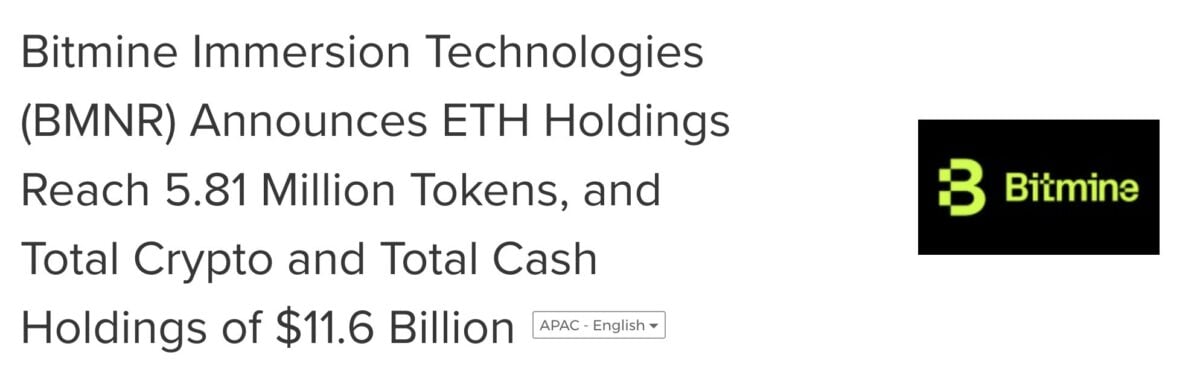
That proposed reward reduction will impact the institutions already earning substantial income from staking. For instance, Ethereum’s biggest DAT, BitMine, now holds 5.81 million $ETH after adding another 7,391 $ETH while staking 5.07 million $ETH of that position.
Source: prnewswire
Therefore, at least 87% of BitMine’s total holdings are locked in, and BitMine could potentially earn around $257 million annually off of the current rewards. Yet, with lower yields as a result of the increase in the staking ratio due to EIP-8363, this will also result in less annual recurring income for BitMine.
Still, this does not necessarily mean BitMine will have to sell off their $ETH holdings.
Nevertheless, that could weaken the reason for institutions to keep large positions staked. If alternative yields become more attractive, capital could shift toward DeFi or remain liquid, slowing institutional staking demand.
Final Summary
Ethereum [$ETH] staking hit 41.9 million $ETH, but EIP-8363 could slow growth by reducing validator rewards.
BitMine’s $257 million staking revenue highlights how lower yields could weaken institutional $ETH staking demand.

 ambcrypto.com