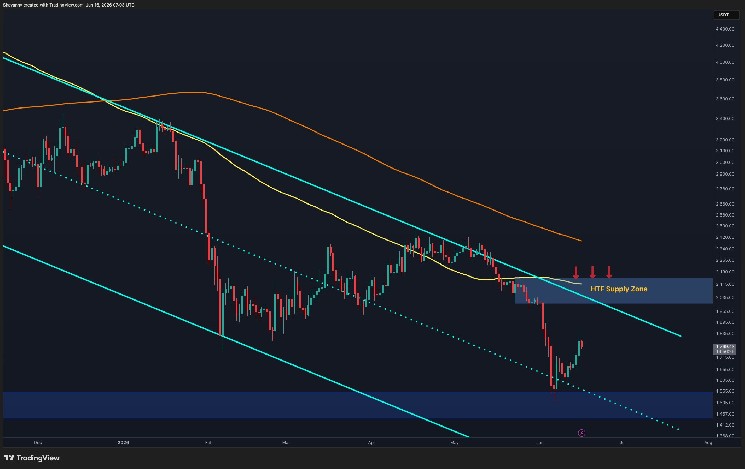
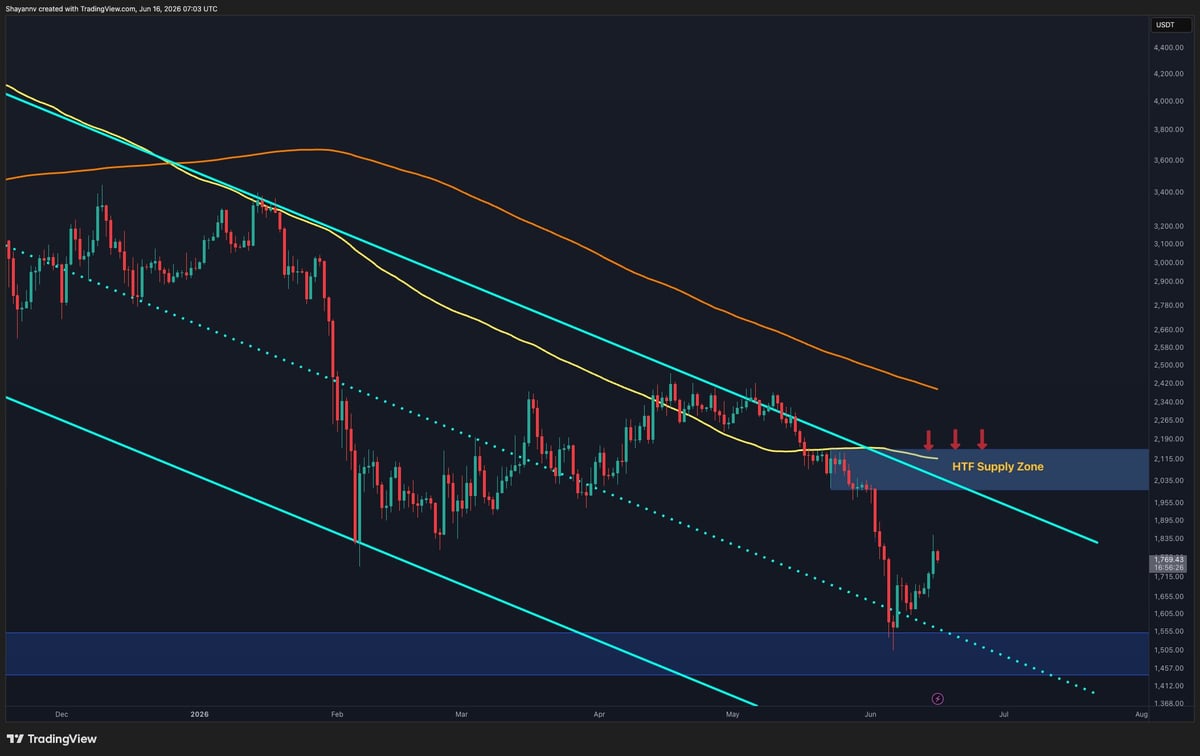
For now, the rebound remains intact as long as $ETH continues to hold above the $1.5K support region. The recent higher low also suggests that buyers are gradually regaining control after the prolonged corrective phase.
$ETH/USDT 4-Hour Chart
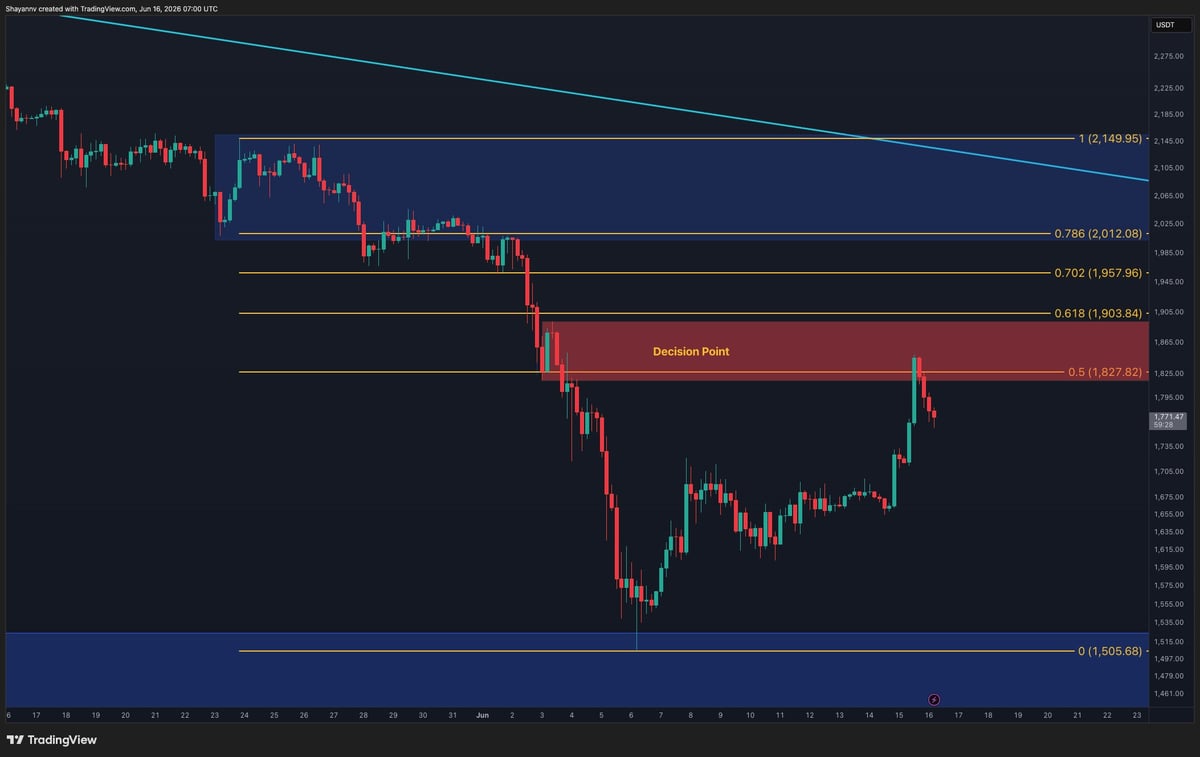
On the 4-hour timeframe, $ETH recently rallied into the $1.83K resistance region, which aligns with the 0.5 Fibonacci retracement level at $1.83K and the highlighted decision zone between roughly $1.82K and $1.88K.
This area has already produced a reaction, with price pulling back after tapping the lower boundary of the supply zone. The current correction is therefore a crucial test of demand. If buyers manage to defend the $1.75K to $1.8K area and establish a higher low, another attempt toward the 0.618 Fibonacci level at $1.9K becomes increasingly likely.
A breakout above $1.9K could then expose the 0.702 and 0.786 retracement levels at $1.96K and $2.01K, respectively. On the other hand, failure to hold the recent breakout structure would increase the probability of a deeper retracement before the uptrend can continue.
Sentiment Analysis
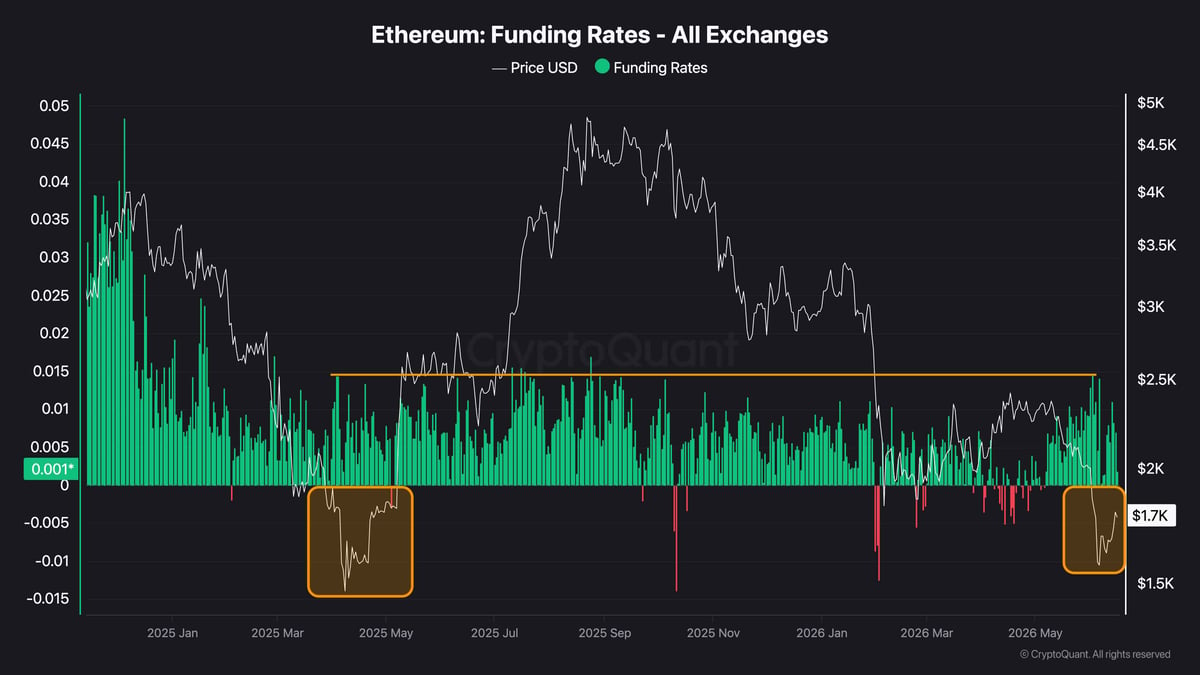
The funding rate chart provides an interesting perspective on market sentiment. Funding rates recently turned deeply negative as $ETH approached the $1.5K region, indicating that short positioning became crowded during the decline.
Historically, similar periods of strongly negative funding have coincided with local bottoms, as excessive bearish positioning often creates the conditions for short squeezes and relief rallies. The current setup appears to be following a comparable pattern, with $ETH recovering sharply after funding rates reached extreme negative territory.
More importantly, funding has now returned to positive levels while remaining far below the euphoric readings seen during previous major rallies. This suggests that leverage is gradually rebuilding, but speculative excess has not yet reached concerning levels.
As a result, the funding data continues to support the possibility of additional upside toward the $1.9K to $2K resistance region, although the market is now entering a key supply area where profit-taking and renewed selling pressure could emerge.

 cryptopotato.com