Is the market mispricing Ethereum? What ETH’s fee compression tells us
ambcrypto.com
24 May 2026 15:00, UTC
Lately, many L1s have been strategizing around fee reduction, but it comes at a cost.
The logic is simple: transaction fees are a core part of an L1’s revenue engine. Every network upgrade requires revenue to scale the chain and maintain the capacity needed to support growing demand. Ethereum’s [$ETH] Glamsterdam upgrade falls right into this trend, and the effects are already showing up on-chain.
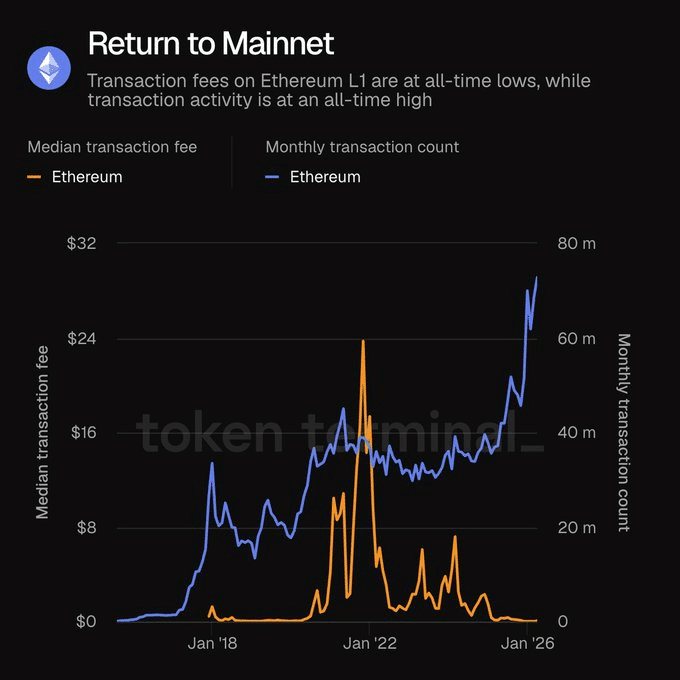
According to Token Terminal, transaction fees on Ethereum L1 have dropped to record lows. While cheaper transactions improve accessibility, consistently lower fees can put pressure on Ethereum’s long-term scaling economics. That impact becomes even clearer when looking at the network’s revenue data.
Know when your coins move
Alerts, real-time prices, and market news — all in one app
Point your phone camera to install
4.8 based on 40K reviews in the App Store and Google Play
Source: DeFiLlama
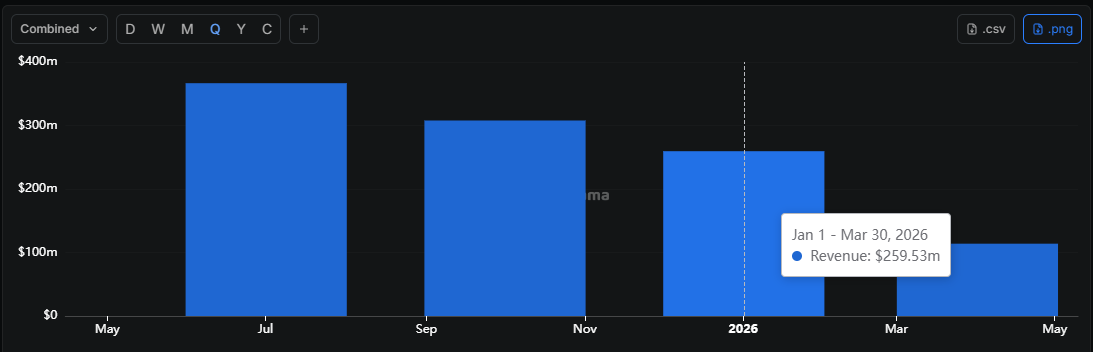
Data from DeFiLlama shows Ethereum’s revenue trending lower on a QoQ basis.
As the chart above highlights, network revenue has been declining steadily since peaking at $366.63 million in Q3 2025. By Q1 2026, Ethereum closed with $260 million in revenue. In simple terms, the Glamsterdam upgrade, which cut network fees by 78%, is now clearly reshaping Ethereum’s revenue structure on-chain.
That naturally shifts the focus toward Ethereum’s broader network growth. On the macro side, volatility is already weighing on $ETH’s price structure. But now, with Ethereum’s scalability economics also facing pressure, the bigger debate is becoming harder to ignore: Is $ETH genuinely undervalued here?
Ethereum’s revenue compression is colliding with strong demand
Undervaluation happens when the market fails to fully price in a network’s underlying strength.
On the surface, Ethereum’s falling fees and declining revenue make $ETH’s recent weakness look justified. Technically, $ETH is down around 6.2% in May and continues to underperform Bitcoin [BTC] across most major timeframes. In that context, lower fees can easily be interpreted as a sign of weaker on-chain demand.
But the on-chain data is starting to tell a different story. As the chart below shows, Ethereum’s monthly transaction count has climbed to a new all-time high, nearing 80 million transactions. Put simply, network activity remains strong even as fees and revenue continue trending lower.
Source: Token Terminal
In that setup, $ETH’s current technical structure starts looking increasingly mispriced.
From a network standpoint, lower fees are not translating into weaker usage. If anything, fee compression is pulling more users on-chain by making Ethereum cheaper to use. That dynamic is becoming a strong reflection of Ethereum’s underlying network fundamentals.
Against that backdrop, the decline in revenue looks more like a byproduct of Ethereum’s evolving fee model rather than a sign of fading demand. In that setup, $ETH’s current technical positioning appears increasingly undervalued relative to the network’s underlying on-chain strength.
Final Summary
Ethereum’s fees and revenue are falling, but on-chain activity continues hitting new highs.
Strong transaction growth suggests $ETH may be undervalued relative to its underlying network strength.

 ambcrypto.com