Ethereum Validators Confirm Block 25 Million After Nearly 11 Years of Runtime
news.bitcoin.com
02 May 2026 14:42, UTC
Ethereum finalized block 25,000,000 on May 1, 2026, marking nearly 11 years of operation since the network’s genesis block on July 30, 2015.
Key Takeaways:
Ethereum finalized block 25 million on May 1, 2026, nearly 11 years after its July 2015 genesis with no prolonged global network shutdown.
The milestone reflects Ethereum’s decade-long operation through major upgrades, including the 2022 Merge to proof-of- stake, despite some historical hiccups.
Bitcoin is tracking toward block 1,000,000, with roughly 52,509 blocks remaining at an estimated arrival in mid-2027.
More Than Just News Content, live market tracking, portfolio management, and price alerts — everything you need in the Crypto News app. Download now, stay on top of the crypto market, and take control of your information.
Validators Push Ethereum Past 25 Million Blocks While Bitcoin Closes In on Block 1,000,000
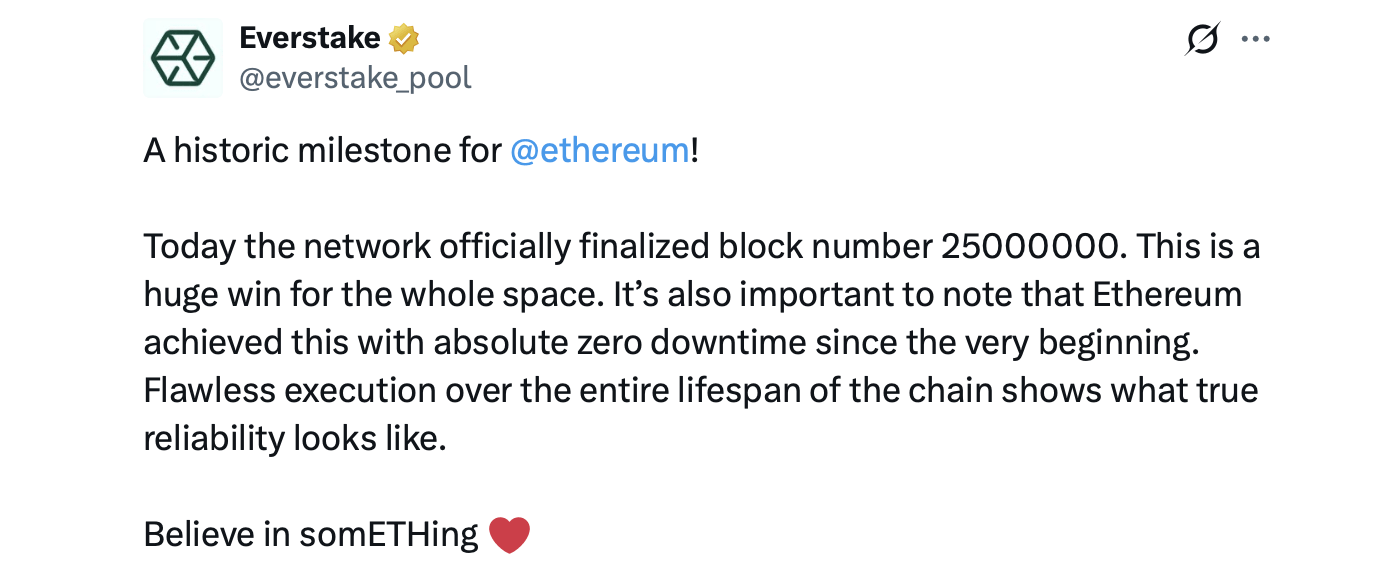
The milestone carries no protocol-level changes, but it draws attention from the Ethereum community as a measure of the network’s durability. Since block zero, Ethereum‘s base layer has never suffered a prolonged global halt, a record that sets it apart from several other large networks, though the chain has not been without incident.
In 2023, Ethereum stopped finalizing blocks twice within a 24-hour period, with each disruption lasting over an hour. Earlier incidents in 2016 and 2020 involved infrastructure issues that caused partial disruptions. A bug in the Prysm client once knocked roughly 23% of nodes offline, though the chain continued producing blocks. But for the most part, over the course of Ethereum’s life, it has kept on trucking.
Image source: X
The distinction matters: the base layer has never fully stopped globally for an extended stretch, but it has experienced some degraded performance, some client failures, and finalization gaps over its history.
Under proof-of-stake (PoS), which Ethereum adopted at the Merge in September 2022, the network targets one block every 12 seconds. Before the Merge, under proof-of-work ( PoW), average block times ran between 13 and 15 seconds. That pace has generated roughly 7,000 blocks per day in recent months, with each block bundling transactions, gas usage data, base fees, and validator rewards into a cryptographically linked record.
Each block proposed under PoS goes through a slot of approximately 12 seconds and reaches finality after two epochs, a process that takes about 15 minutes. Block 25,000,000 followed the same path, finalized by validator consensus without intervention from any central authority.
The network’s blockchain size now runs into hundreds of gigabytes, with tens of millions of ETH locked in staking. Layer two ( L2) solutions continue to carry a growing share of Ethereum’s transaction volume, though some L2 networks built on Ethereum have experienced their own clear outages. The development roadmap includes plans for single-slot finality, which would compress the current 15-minute finalization window to a single 12-second slot.
Ethereum has processed through several major protocol upgrades over its history, including London, which introduced EIP-1559 and base fee burning; Shanghai, which enabled staking withdrawals; and Dencun, which added blob-carrying transactions to support L2 data availability. Each upgrade passed through the network while block production continued.
At current production rates, Etherscan and Beacon Chain explorers were already showing blocks in the range of 25,000,395 shortly after the milestone block was confirmed.
Bitcoin’s Ride to 1 Million Blocks
Meanwhile, Bitcoin is tracking its own round-number milestone. As of May 1, 2026, the Bitcoin blockchain sat at approximately block 947,491, leaving roughly 52,509 blocks before block 1,000,000.
Bitcoin averages about 144 blocks per day, one every 10 minutes or so, with averages at times running slightly faster at around nine minutes per block or slower than the 10-minute trajectory. At that pace, the network is on track to reach block 1,000,000 sometime in mid-to-late 2027, roughly 364 days out.
Block 1,000,000 carries no protocol significance for Bitcoin. It does not trigger a halving, an upgrade, or any change to consensus rules. Halvings occur at every 210,000-block interval; the next one, which will cut the block reward to 1.5625 BTC, is scheduled for block 1,050,000, placing it approximately two years away.
The Bitcoin genesis block was mined by Satoshi Nakamoto in January 2009. The network has maintained a strong uptime record across that span, similar to the resilience Ethereum has demonstrated over its own block history. Bitcoin stats show an uptime of around 99.99026572226% since launch.
Both milestones reflect how decentralized networks accumulate history block by block, without a central operator deciding when or whether they continue.

 news.bitcoin.com