
 sandmark.com
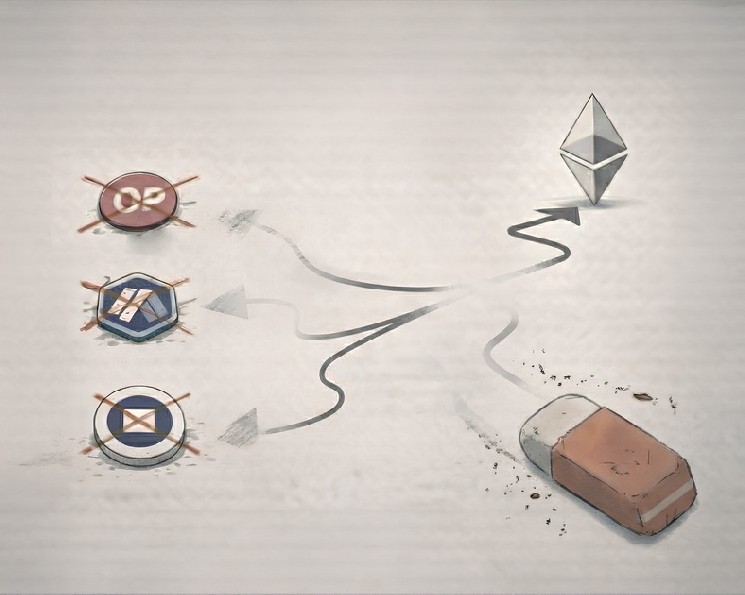
"The original vision of L2s and their role in Ethereum no longer makes sense."
That was Vitalik Buterin’s blunt assessment of early "child chain" approaches to solving Ethereum’s throughput bottlenecks.
Scaling has been a structural challenge since its earliest years, as every cycle of adoption - ICOs, DeFi, NFTs - exposed the same constraint: a surge in activity mechanically led to gas fee spikes, deteriorating accessibility for end-users.
During peak congestion cycles in 2021 and 2022, average transaction fees briefly pushed above $200. At those levels, Ethereum was not a global settlement network; it was a network for whales. Retail users were priced out. Simple token transfers became luxury transactions.
Ethereum could not scale execution on its base layer without eroding the very property it sought to preserve: decentralization. The network worked exactly as designed, but that design imposed a hard ceiling on throughput, which ultimately led to the shift toward today’s rollup-centric architecture.
Outsourcing execution to relieve congestion on Layer-1 (L1) was then a matter of survival. The only credible path forward was to separate concerns: preserve Ethereum as a secure settlement and data availability layer and move high-volume transaction processing elsewhere.
(Source: Token Terminal)
From that pivot, Layer-2s (L2) were born as Ethereum’s execution layer, pushed forward by Vitalik Buterin in late 2020, who argued for embracing rollups as the primary scaling path.
Even at that stage, the foundations were already in motion: Arbitrum and Optimism were deep in development, preparing the first production-grade optimistic rollups that would soon move from testnet to mainnet.
From Dencun in March 2024 to Pectra in May 2025 - and later Fusaka in December 2025 - Ethereum steadily advanced its rollup-centric roadmap, delivering one concrete milestone after another. EIP-4844 and the introduction of blobs sharply reduced data availability costs, materially improving rollup economics and embedding scaling into the protocol itself. Subsequent upgrades reinforced that direction, keeping the main venue lean and efficient, while rollups absorb execution growth.
Yet the narrative took an about turn coming from the top, as Ethereum’s main venue proved more resilient and more scalable than the past years implied.
A Structural Reversal
Two forces explain the emerging shift.
First, decentralization at the rollup layer remains incomplete from Vitalik's initial vision.
The vast majority of L2 networks have yet to achieve what Ethereum researchers describe as “Stage 2” maturity - the point at which fraud or validity proofs are fully decentralized, and users can withdraw their funds directly through the protocol even if the operators disappear or act maliciously, without relying on a centralized operator.
In practice, they remain reliant on centralized sequencers that control transaction ordering and batching, positioning them as centrally administered platforms operating within a blockchain wrapper.
Second, the L1 itself scaled.
Following Dencun’s cost compression for rollups in 2024, Pectra in May 2025 and the recent Fusaka upgrade – the cherry on top - gave the market a firsthand demonstration of L1’s scaling capacity.
Ethereum mainnet transaction fees dropped to their lowest ever level. Average Ethereum transaction costs fell materially - from roughly $5.66 in 2024 to $1.56 through the Pectra period in 2025, and to approximately $0.24 following Fusaka.
For the first time since the DeFi peak of 2021, Ethereum’s mainnet is competitive, and that shift had measurable consequences for user behaviour within the Ethereum ecosystem itself.
Value redistribution across Ethereum’s stack
Since Pectra, monthly active users on the L1 have increased by 128.4%, rising from 6.65mn to 15.79mn. Meanwhile, over the same period, dominant L2s venues saw a 62.3% contraction in active users, falling from 27.92mn in May 2025 to 10.54mn. Ethereum’s share of active users jumped from roughly 21% a year earlier to 59%.
(Source: Token Terminal)
While user-level migration cannot be observed directly, the simultaneous expansion of L1 activity and contraction across major L2s strongly suggests a “return to tradition”, with a meaningful re-concentration of usage on the base layer.
As scaling upgrades rolled out, transaction counts printed new all-time highs across L2s and the Ethereum mainnet in early February, while revenue counterintuitively fell to historical lows.
As gas costs fell sharply, so did the base fee component of Ethereum’s revenue. Under EIP-1559, the base fee is burned, permanently removing ETH from circulation. During periods of high activity and elevated fees, this mechanism pushed Ethereum into net deflation. Base fees consistently accounted for the vast majority of total fee revenue, often exceeding 80%, making fee burn a meaningful supply sink - until the L1 scaled.
With squeezed transaction costs, base fee revenue has compressed materially. Fee composition has tilted toward priority fees and MEV tips - components that flow directly to validators rather than being burned.
In other words, scaling improved usability, but weakened the burn mechanism that once underpinned Ethereum’s disinflationary narrative.
At the same time, a second compression unfolded. The data availability fees paid by rollups to the L1 also shrank materially, the latter reducing their own operating costs - the economic throughput flowing back to the base layer - while increasing their margins.
(Source: GrowThePie)
Dencun has been the inflexion point in the structural Ethereum rollup ecosystem break.
From 2022 through early 2024, L2s networks were effectively paying heavy "rent" to Ethereum. Data availability and settlement costs consumed the bulk of their fee revenue.
Between April 2023 and March 2024, Arbitrum, Optimism and Base paid on average roughly $9.44mn per month to Ethereum L1 on an aggregated basis.In that regime, margins were structurally tight. Rent regularly absorbed 70–80% of L2 fee revenue, and sometimes even exceeded protocol revenue, paying Ethereum more for data than it earned from users.
This was the pre-4844 reality, where L2 rent accounted for a rising share of Ethereum’s fee income, peaking above 5% during high activity windows. Rollups scaled execution, but they remained tethered to Ethereum’s calldata pricing dynamics.
Dencun, deployed in March 2024, changed that equation decisively. With the introduction of "blobs" - a cheap, temporary data storage mechanism - under EIP-4844, rollups moved to a cheaper, purpose-built data availability market.
From March 2024 until Pectra, average combined monthly rent across the three L2s collapsed from $9.44mn to roughly $717,851 - a 92% reduction – and margins expanded accordingly as share of paid rent on protocol revenues averaged only 6.69% across the three dominant venues.
Since Pectra, L2s rent paid to Ethereum has fallen another ~81%, now averaging roughly $135,985 per month. Rent represents just 2.64% of total L2s protocol revenues - even as L2 activity sits at all-time highs – Ethereum's base layer effectively capturing a shrinking share of the economic value generated on top of it.
Base, Arbitrum and the others
At the competitive level, the post-Dencun environment reshuffled shares.
Base now dominates across most observable metrics. Over the past year, it has accounted for roughly 60% of total transactions across Ethereum and major L2s combined. It leads in profitability, controls approximately 40% of blob space usage, and represents close to two-thirds of aggregate rent paid to Ethereum. Revenue concentration tells a similar story: Base captures roughly 70% of total rollup revenue.
(Source: Token Terminal)
Arbitrum - one of the earliest and most battle-tested optimistic rollups - remains structurally relevant. Together, Base and Arbitrum account for approximately 85% of rollup revenue and more than 80% of total transaction volume across major L2s, and close to half of the ecosystem trading volume – Ethereum concentrating the remaining half.
In trading activity, Arbitrum continues to lead in DeFi depth, derivatives, and tokenized assets - particularly in RWA exposure - while Base benefits from Coinbase’s customers and distribution moat, including native exchange integration, smart wallet onboarding, and ecosystem incentives that create persistent user inflows.
Outside Base, Arbitrum - and to a lesser extent Optimism - the broader rollup landscape has struggled to maintain traction. While the leading venues combine distribution advantages, liquidity depth, technical maturity, or distinct application focus, most of the long tail of L2 networks' user activity and revenue proved transient, driven more by incentive programs and airdrop speculative participation than durable demand.
Transaction activity and revenue across several newer rollups declined materially, in some cases falling from millions in monthly revenue back in early 2024 to (very) low five-figure.
The dispersion within the rollup field has widened - a handful of structurally embedded leaders, and a growing tail of low-traction networks struggling to sustain relevance.
Starknet, Scroll, Eclipse, Movement, Blast, among others - each a new tombstone in the vast and expanding L2 graveyard – at least for the ones that failed to carve out a distinct value proposition.
The Post-Scaling Order
L2s were indispensable during Ethereum’s congestion eras. They absorbed overflow demand when L1 blockspace was scarce and expensive. But in a regime where L1 transaction costs have normalized, the competitive equation changes. Rollups must now justify their existence beyond fee arbitrage.
The bar has moved.
If an L2 cannot provide something structurally distinct from what Ethereum itself offers, its value proposition weakens. The role of L2 shifts from mirroring Ethereum to extending it, the latter competing on purpose rather than on usage cost.
In this emerging phase, rollups are evolving from parallel replicas into functional modules - specialized execution environments optimized for specific use cases – where only the fittest will survive.