
 coinpaper.com

Ether extended its drop as a weekly chart highlighted lower support bands and fresh Fibonacci resistance overhead. Meanwhile, a four hour chart showed rebounds stalling at a reclaimed resistance zone, keeping the short term downtrend in place.
Ether drops to about $2,020 on weekly chart as Crypto Rover flags lower “buy zone” levels
Ethereum fell sharply on the weekly chart shown by Crypto Rover, with the candlestick ending near $2,021 after trading between about $2,391 and $1,739. The snapshot labeled the move as a weekly decline of roughly 10.8% and showed price sliding into a brown support band just under the $2,000 area.
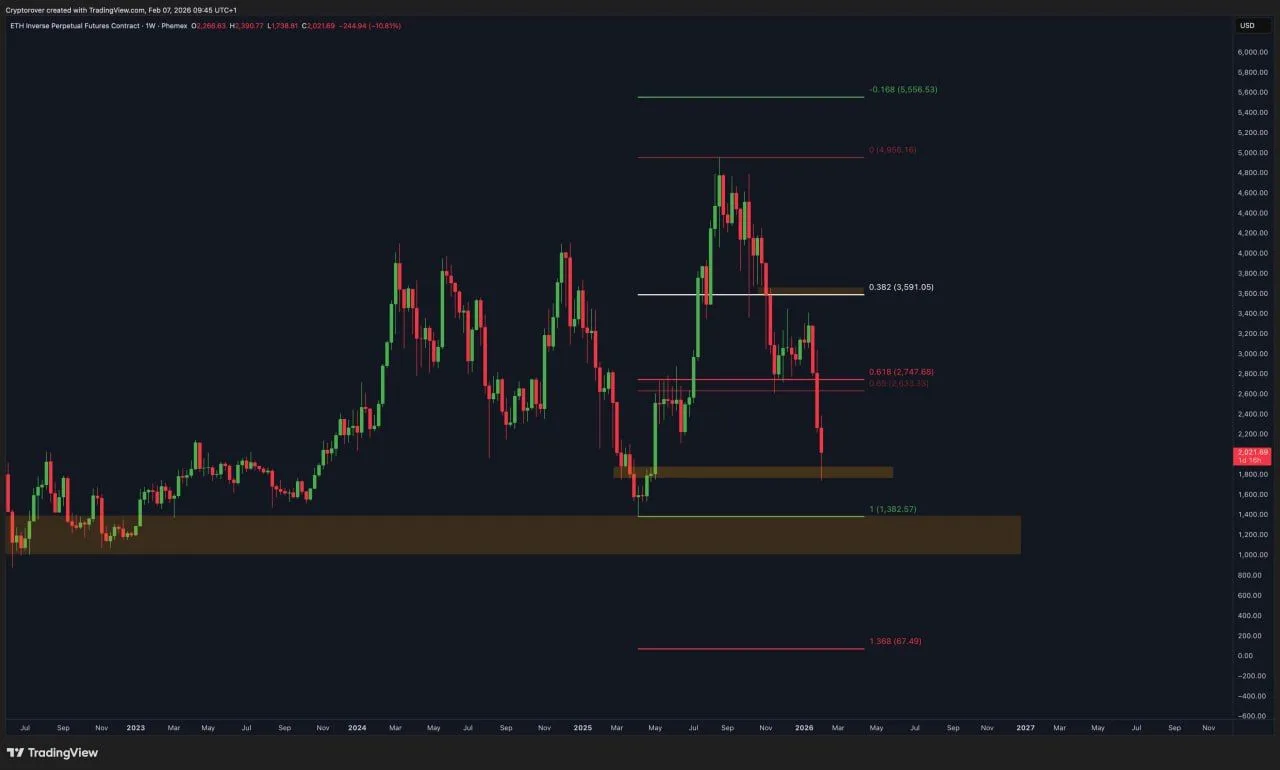
Ether Inverse Perpetual Weekly Chart. Source: Crypto Rover via X
The chart also mapped Fibonacci levels above current price. It marked the 0.65 line near $2,633 and the 0.618 line near $2,748 as overhead zones, while the 0.382 level sat higher around $3,591. Farther up, the graphic marked a reference line near $4,956 and another level around $5,557.
Below the market, the chart highlighted a deeper support level near $1,383 and a broader brown demand zone stretching across the low $1,000s. In his post on X, Crypto Rover said ETH was “not in the perfect buying zone (yet),” and added that patience mattered as price moved toward the lower marked areas.
Ether stalls at reclaimed resistance as four hour chart shows downtrend intact
Ether’s four-hour chart showed continued pressure after a steep downswing, with price failing to regain a prior support band that now acts as resistance. The TradingView snapshot marked repeated rejections along the boxed zone near the low-$2,100s, while a descending trendline capped rebounds, keeping the short-term structure tilted lower.
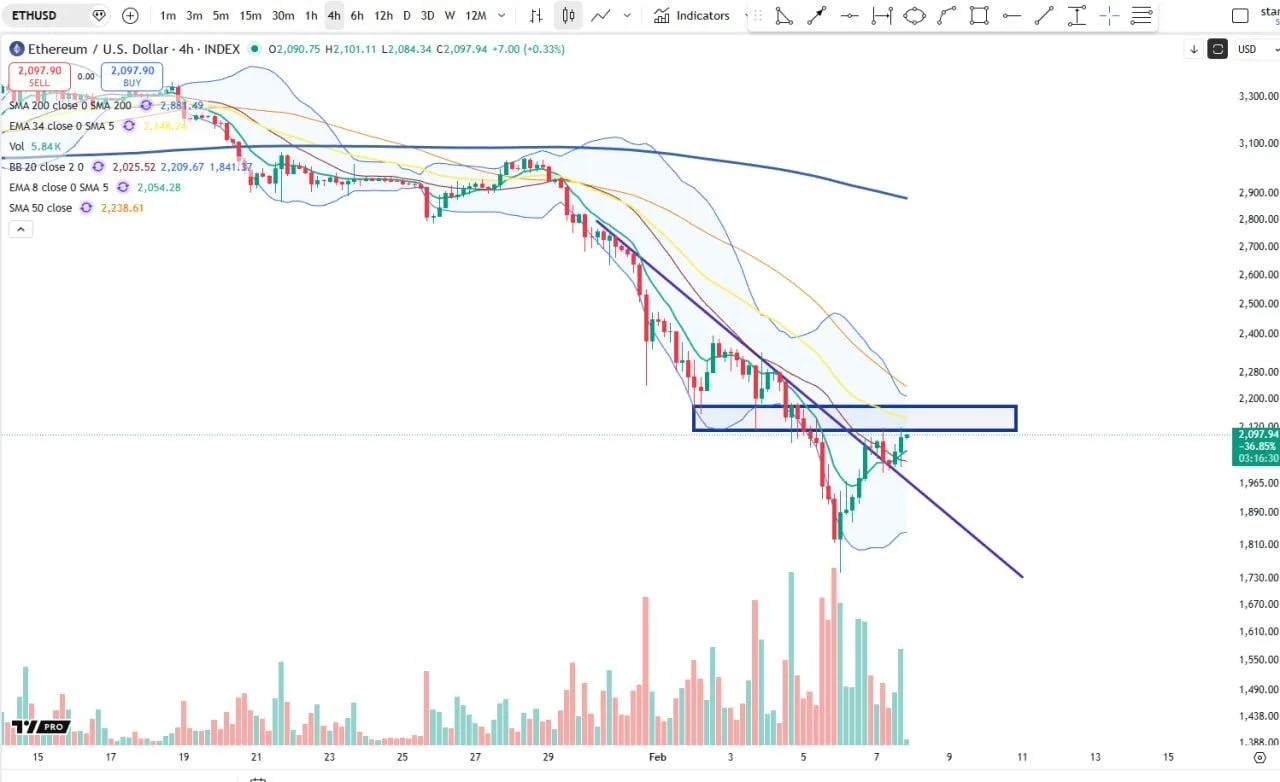
Ethereum U.S. Dollar Four Hour Chart. Source: TradingView / X
At the same time, short-term moving averages rolled over and tracked above price, reinforcing overhead supply. Bollinger Bands narrowed during brief pauses, then expanded as selling resumed, reflecting renewed volatility during the decline.
Volume expanded during the sharp selloff and then eased during the rebound attempt, a pattern that left follow-through limited near resistance. As a result, the chart framed the boxed zone and the falling trendline as the main technical barriers shaping near-term direction.