
 finbold.com

Ethereum (ETH) transaction fees have dropped to their lowest point in eight years, falling to levels last seen in 2017 only days after the Fusaka upgrade went live.
Data from CryptoRank shows that daily gas costs have collapsed toward the lower boundary of the historical range, marking one of the sharpest fee declines since Ethereum’s early phase of network growth.
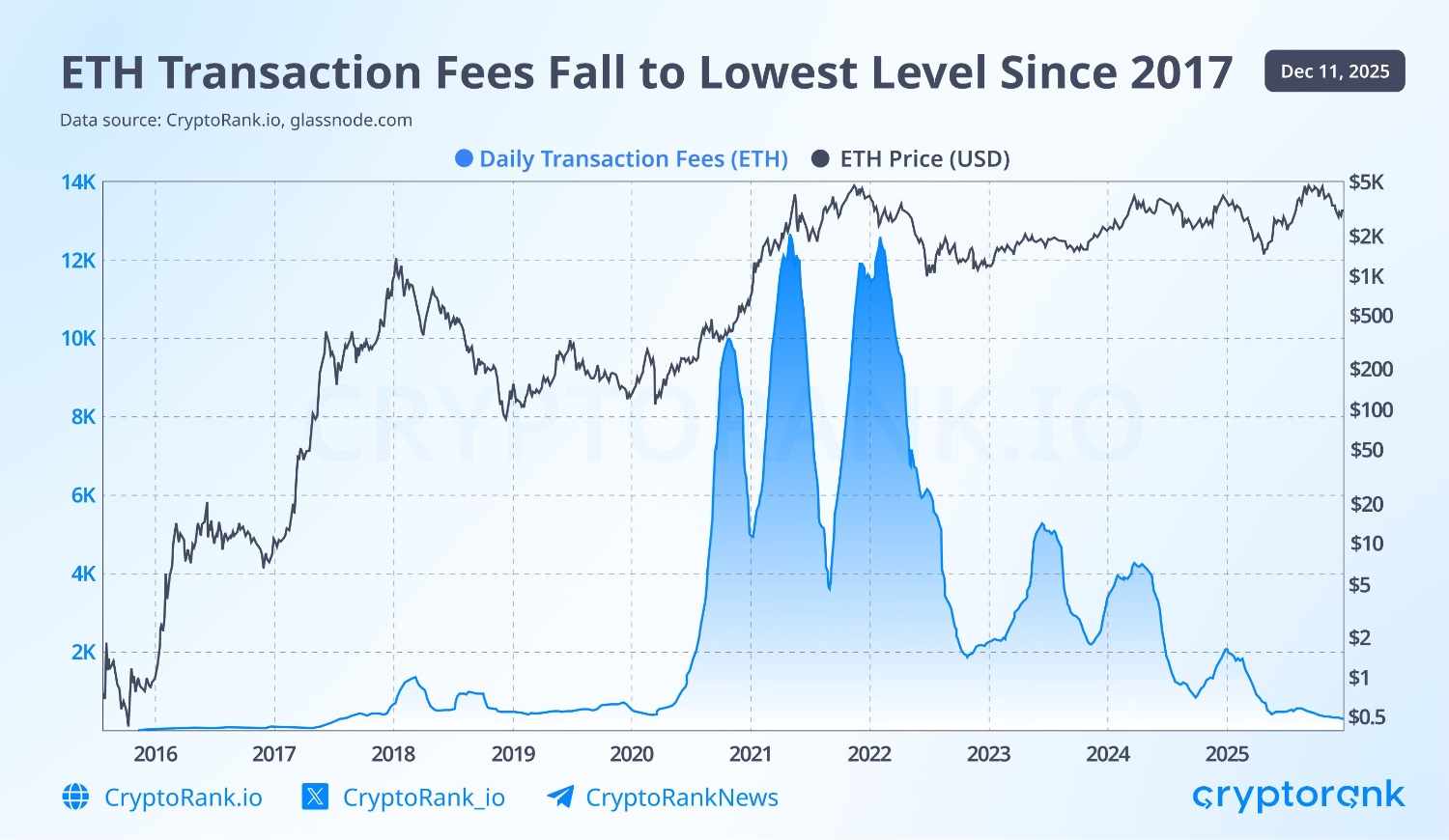
The Fusaka upgrade appears to be delivering its intended effect by improving execution efficiency and reducing congestion at the protocol level. Lower fees have long been one of Ethereum’s most persistent challenges, particularly during periods of heavy on-chain activity.
The Fusaka upgrade is today.
— Ethereum (@ethereum) December 3, 2025
Ethereum is securely scaling. pic.twitter.com/YaJ5WL4tSc
Notably, the latest decline suggests that the network is making measurable progress on scalability ahead of the broader roadmap milestones planned for 2026.
1/ Fusaka is coming December 3rd.
— Ethereum (@ethereum) November 28, 2025
Ethereum’s next major upgrade shows that the network can grow to meet global demand, without compromising on decentralization or permissionlessness.
Whether you’re a user, builder, institution, or operator, here’s how Fusaka will impact you. pic.twitter.com/FKsqdZiwMM
Elsewhere, Vitalik Buterin has also introduced a new proposal that could reshape how users interact with transaction costs. The concept outlines a trustless on-chain gas futures market that would allow developers and users to lock in or hedge future gas prices directly on Ethereum. Such a mechanism would create predictable transaction costs and reduce fee volatility during peak demand cycles.