
 thedefiant.io
Ethereum has rolled out its Fusaka upgrade, a major step that lets the network handle more transactions while prioritizing safety and decentralization.
Fusaka centers on EIP-7594: PeerDAS (Peer Data Availability Sampling), a system that enables Ethereum nodes to verify that block data is complete without downloading everything. This increases the network’s capacity while keeping it safe and decentralized.
Ethereum – the world’s largest smart contract blockchain with a total value locked (TVL) of over $73 billion in decentralized finance (DeFi) – processes 1.3 to 1.8 million transactions per day, according to Etherscan data.
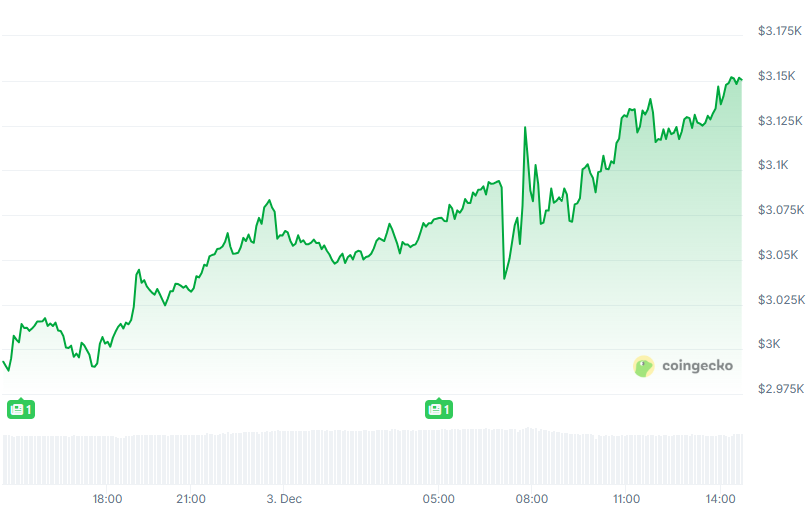
$ETH is up 5% over the past 24 hours.
“It makes Ethereum more scalable without compromising decentralization. That is the entire point,” Jason Chaskin, Ethereum Foundation Apps Relation Lead, explained to The Defiant. “The trade-off is that this path has taken almost a decade of research and engineering. It is the hard way to scale a blockchain, but it avoids the shortcut of forcing everyone into data centers.
He added that Fusaka also raises the Layer 1 (L1) gas limit from 45 million to 60 million units and introduces an R1 signature precompile, which makes it cheaper and easier for developers to use passkeys in Ethereum apps. For Layer 2 (L2) networks, which already have very low fees, Fusaka ensures they remain that way.
“PeerDAS gives rollups more blob space, and that space is only going to increase over time,” Chaskin said. “On speed, L2s are already extremely fast. Arbitrum is about 250 ms, and Base is around 200 ms, for example.”
The upgrade is an important step in Ethereum’s plan to handle more transactions and prepare for future improvements. Since most activity now happens on L2s like Base, Optimism, and Arbitrum, lowering data costs is key to keeping fees low and supporting more users.
“This is the first step of L2 data scaling. Ethereum will increase blob capacity slowly and methodically once operators and researchers are confident it is safe,” Chaskin said. “The good news is these increases can happen through blob-only forks, so we do not need to wait for a giant hard fork every time.”
He emphasized that the main risk is that this is new software running live for the first time, so the rollout will be careful. Still, he added that for the first time, Ethereum will have reliably low fees over the long term.
“That changes what developers can build and what users can expect. When you know fees will stay under a penny, whole new categories of applications become viable,” Chaskin said. “It makes Ethereum the most predictable environment to build in.”
The upgrade comes just a few weeks after the Ethereum Foundation revealed new details about its upcoming Interop Layer, a system that aims to make the network’s growing Layer 2 (L2) ecosystem work like a single, unified chain.