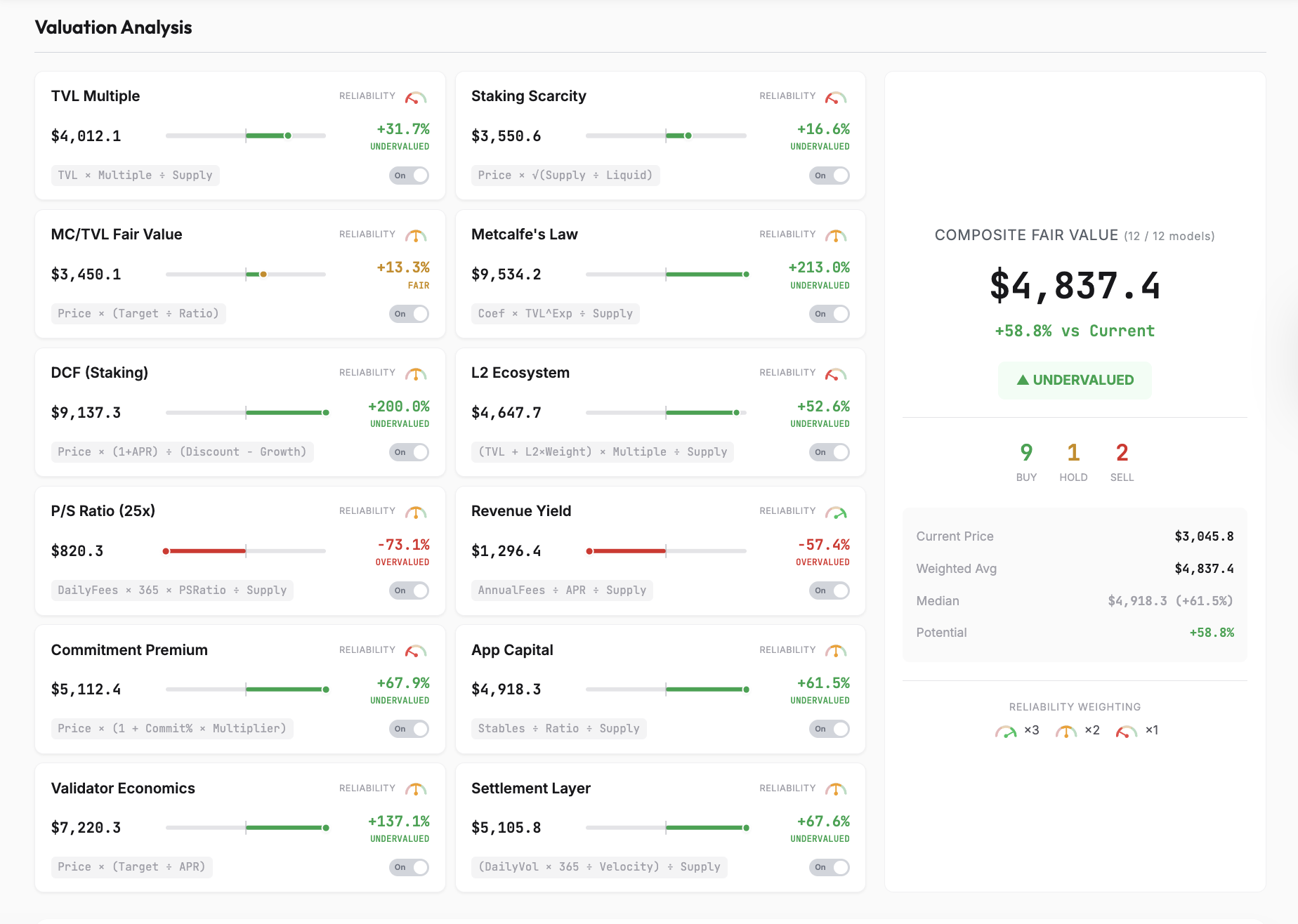
12 different $ETH valuation models signal that $ETH is undervalued at current market prices just north of $3,000. Source: ETHval
The App Capital valuation model, which accounts for total on-chain assets, including stablecoins, ERC-20 tokens, non-fungible tokens (NFTs), real-world tokenized assets (RWAs), and bridged assets, prices $ETH at a fair value of $4,918, according to ETHval.
Using Metcalfe’s Law, which states that the value of a network grows in proportion to the square of real active users or the number of nodes in the network, projects an $ETH price of $9,484, meaning the asset is over 211% undervalued, according to the model.
Valuing $ETH through the Layer-2 (L2) framework, which accounts for the total value locked (TVL) in Ethereum’s layer-2 scaling network ecosystem, projects a price of $4,633 per $ETH, meaning that $ETH is about 52% undervalued.

The composite fair value of $ETH over one year. Source: ETHval
The Ethereum community and analysts continue to debate how to value the world’s first smart contract platform properly, with many saying that traditional valuation models are not sufficient to value nascent digital assets and decentralized blockchain networks.
Related: Ethereum ICO whale cashes out $60M after 9,500x gain as top 1% keep buying $ETH
Despite the mostly rosy outlook, one valuation model says $ETH is grossly overvalued
The Revenue Yield valuation model, which values $ETH by the annual revenue generated by the network, divided by the staking yield on $ETH, says that $ETH at current prices of over $3,000 is overvalued by over 57%.

$ETH is overvalued, according to the Revenue Yield valuation model. Source: ETHval
Revenue Yield is the most reliable valuation model for accurately pricing $ETH, according to ETHval’s criteria and methodology.
$ETH should carry a price tag of about $1,296, according to the model, highlighting the Ethereum network’s dwindling revenue generation as fees reach record lows and competing networks absorb some of its market share.
Magazine: TradFi is building Ethereum L2s to tokenize trillions in RWAs: Inside story

 cointelegraph.com