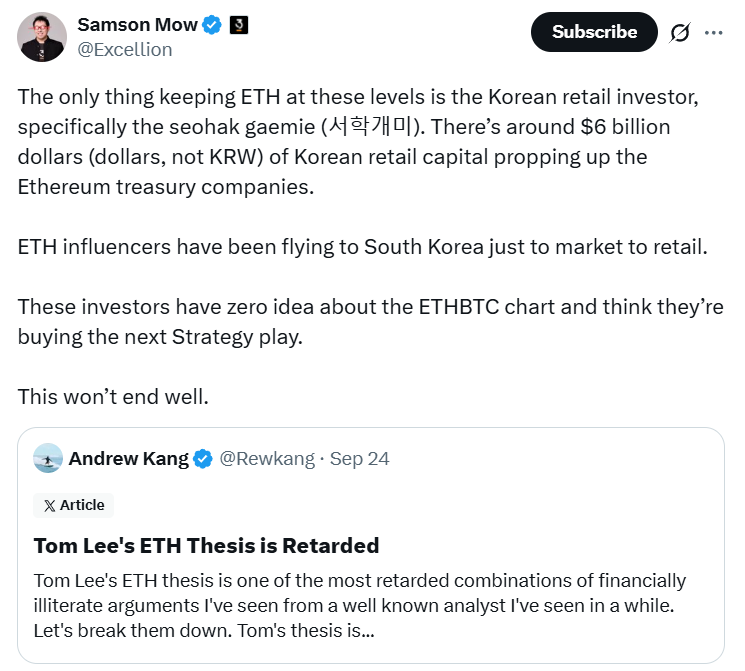
Source: Samson Mow
Upbit and Bithumb are the two main centralized exchanges (CEXs) used by South Korean retail traders.
Looking at futures data, Upbit ranked as the 10th largest CEX in terms of Ether futures trading, with $1.29 billion worth of trading volume over the past week, according to CoinGlass data.
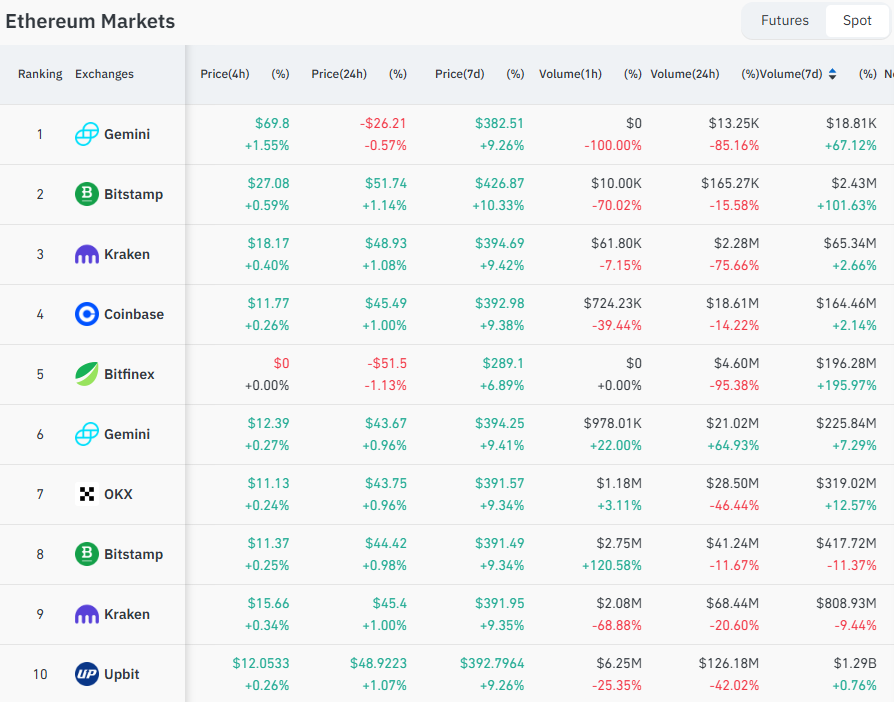
CEXs by Ethereum futures trading volume. Source: CoinGlass
Crypto futures trading usually exceeds the volume of spot trading and thus has a higher impact on the underlying asset’s price.
Related: Japan’s new PM may be a boon for risk assets, crypto markets
Ether’s “Kimchi premium” signals growing Korean retail investor engagement
Ether’s “Kimchi premium” also signals growing demand from Korean retail investors, which describes when the price of a cryptocurrency is higher on South Korean exchanges than on other exchanges.
Ether’s Kimchi premium rose to 1.93 on Sunday, up from -2.06 on July 16, when Ether traded below $2,959, according to blockchain data platform CryptoQuant.
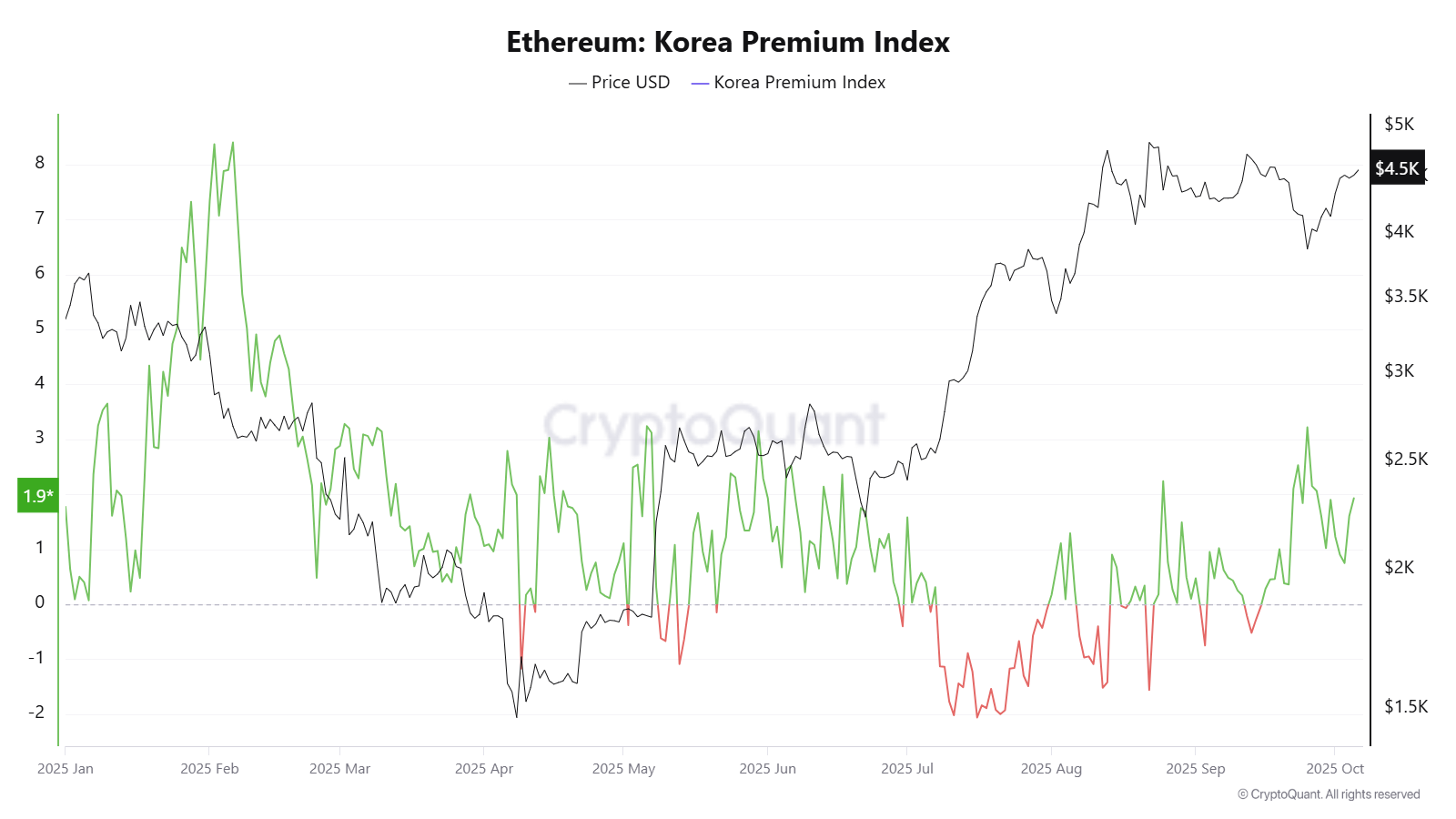
Ethereum: Korea Premium Index, year-to-date chart. Source: CryptoQuant
This indicator measures the price gap for Ether between South Korean exchanges and others.
Korean retail investors are significant participants in the crypto market, as reflected by Ether’s “kimchi premium,” according to Marcin Kazmierczak, co-founder of blockchain oracle firm RedStone.
However, Kazmierczak said this represents only a fraction of Ether’s overall momentum.
“Characterizing them as the primary support for Ethereum significantly understates the network’s diverse global capital base, which includes substantial US institutional investment through ETFs, corporate treasuries, and the vast DeFi ecosystem that relies on $ETH.”
Kazmierczak added that Ethereum’s strength lies in its “borderless nature,” combining Korean retail and global institutional participation.
Related: Aging boomers and global wealth seen boosting crypto until 2100
Mow’s insights come as many other industry watchers have questioned the sustainability of Ether treasury firms.
In September, Mechanism Capital founder Andrew Kang criticized BitMine founder Tom Lee’s Ether thesis, arguing that it overstated Ether’s value accrual from stablecoins and real-world asset (RWA) tokenization.
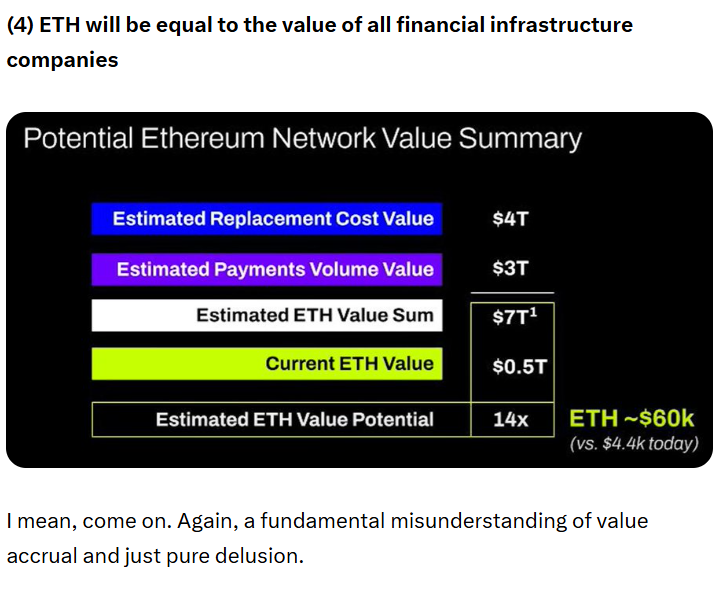
Source: Andrew Kang
“Ethereum’s valuation comes primarily from financial illiteracy. Which, to be fair, can create a decently large market cap,” said Kang in a Sept. 24 X post, adding that “the valuation that can be derived from financial illiteracy is not infinite.”
While “broader macro liquidity” has maintained Ether’s price momentum, it needs “major organizational change” to save it from “indefinite underperformance,” Kang said.
Magazine: Low users, sex predators kill Korean metaverses, 3AC sues Terra

 cointelegraph.com