“This disjointness created a lot of dissonance in the community,” Buterin said, before making his case for low-risk DeFi being Ethereum’s main fee generator. One example Buterin highlighted was deposit rates for stablecoin lending on DeFi protocol Aave, which hover around 5% for blue-chips like Tether (USDT) and $USDC ($USDC) and above 10% for higher risk stables.
Similarly, Buterin noted that Google does many “interesting and valuable things” — such as its Chromium family of browsers, Pixel phones, its open-source AI Gemini models, and more — but the revenue they make from those products is a fraction compared to what it makes through search and advertisements.
It comes as the total value locked on Ethereum DeFi recently surpassed $100 billion for the first time since early 2022. DeFi TVL tanked massively across the ecosystem during the 2022-2023 bear market, and TVL figures have largely trailed the performance of top layer 1 tokens this bull market.
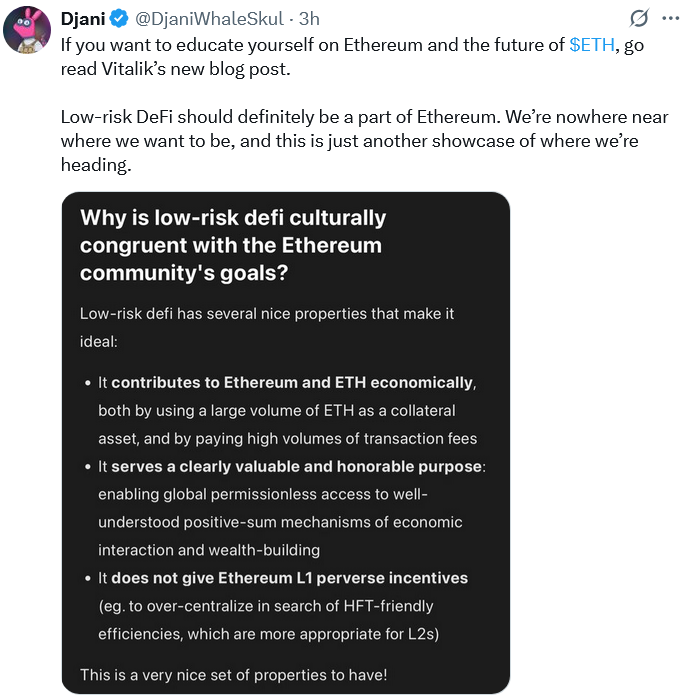
Source: Djani
However, DeFi has picked up lately amid an increase in regulatory momentum, particularly the Digital Asset Market Clarity Act, which is tipped to push DeFi adoption even further. A recent survey from the DeFi Education Fund found that over 40% of Americans are open to DeFi if stronger laws are put in place.
Ethereum has the potential to “do much better” than Google
Ethereum has the potential to “do much better” than Google due to its decentralization. Unlike Google, Ethereum’s decentralized structure better positions low-risk DeFi to align financial success with ethical outcomes, creating harmony between “doing well” and “being good.”
“The revenue generator does not have to be the most revolutionary or exciting application of Ethereum. But it does need to be something that is at least not actively unethical or not embarrassing.”
Buterin criticized Google’s incentive model, noting that advertising revenue pushes the company to hoard user data, conflicting with its original open-source and positive-sum ethos.
Vitalik advocates for basket currencies, flatcoins
While low-risk DeFi is often about enabling easier access to the US dollar — particularly those in low-income and high-inflation countries — Buterin would like to see other innovations that provide economic support to Ethereum.
Buterin pitched the idea of building cryptoassets that track a basket of currencies and flatcoins that are based directly on consumer price indices.

 cointelegraph.com