
 protos.com
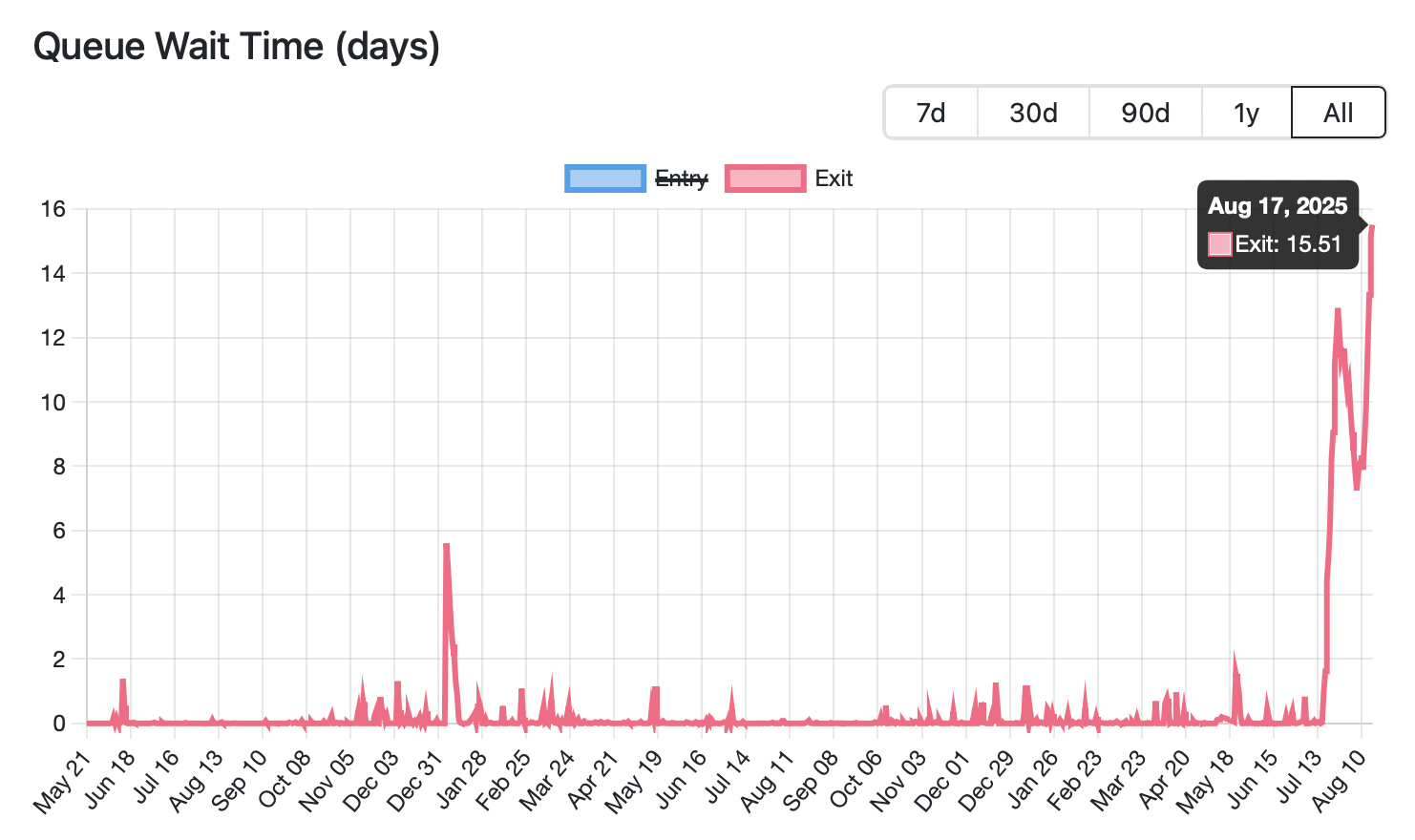
Over the weekend, there was a rush for the exits from the world’s largest Proof-of-Stake blockchain. As of 20:00 UTC Sunday evening, staters queued up 893,599 ether ($ETH) to unstake their $4 billion out of the Ethereum network.
Ethereum limits the quantity of $ETH that may unstake per 6.4 minute epoch. If more $ETH is being unstated than what can be processed in the upcoming epoch, extra $ETH must wait in queue.
As of 2:00 UTC Sunday morning, Ethereum’s unstaking wait time also lengthened to its worst validator queue in history: 15.5 days.
There was one leading explanation for the lengthy, multi-billion dollar queue.
$ETH staking within US ETFs
According to one observer, the SEC is imminently ready to approve $ETH staking within US spot ETFs. US residents who previously staked their $ETH via Coinbase or a staking pool like Lido would soon have the option of easily earning staking rewards within publicly-traded ETFs.
Someone else criticized this Paul Atkins-led SEC plan to approve staking income within ETFs, “I can’t wait to hold my centralized premined security in an ETF that I have no control over,” they said.
Another skeptic echoed that sentiment, “So more middlemen.”
Still, if the market is planning on a staking approval for ETFs, that news could explain some of this weekend’s record-setting level of unstaking requests.
Read more: Ethereum’s largest staking service finally regains stETH peg
Unwinding loops from higher borrow rates
Another explanation involves borrow rates for $ETH that have been increasing dramatically since July 16 and unwinding loops.
Loops, in the parlance of decentralized finance (DeFi), are risky trades that involve re-depositing the proceeds of loans as collateral for additional loans. Loops add leverage to Ethereum’s paltry 2.9% APR staking reward, offering double-digit or even triple-digit rates at the highest number of loops.
Galaxy Research blamed, in part, the Justin Sun-affiliated $HTX exchange for spiking $ETH borrow rates on Aave, a dominant lending protocol. They also noted knock-on effects from $HTX’s large unstaking, including a de-pegging of liquid staking and restaking tokens from the price of $ETH.