
 news.bitcoin.com

Ethereum co-founder Vitalik Buterin has suggested protocol adjustments to prioritize personal node operation, aiming to balance scalability with user privacy and censorship resistance as the network grows.
Ethereum Co-Founder Proposes “Local-Node-Favoring” Scaling Adjustments
In a recent Ethereum Research blog post, Ethereum co-founder Vitalik Buterin has outlined a series of technical adjustments to the blockchain’s scaling roadmap, emphasizing the importance of preserving users’ ability to run personal nodes as the network expands. The suggestion addresses concerns that rising hardware requirements could undermine decentralization, privacy, and censorship resistance.
Buterin acknowledged that while zero-knowledge proofs (ZK-EVMs) and private information retrieval (PIR) could theoretically enable trustless verification, these solutions alone are insufficient. He cited high costs, metadata privacy risks, and centralized RPC providers’ potential for censorship as critical flaws. “There is value in continuing to ensure greater ease of running a personal node,” he wrote.
Short-term priorities include finalizing EIP-4444, which would reduce node storage demands by limiting historical data retention to 36 days. A distributed storage network using erasure coding would safeguard older blockchain data without relying on centralized providers. Buterin also urged recalibrating gas fees to penalize excessive state growth, such as new storage slots or contract deployments.
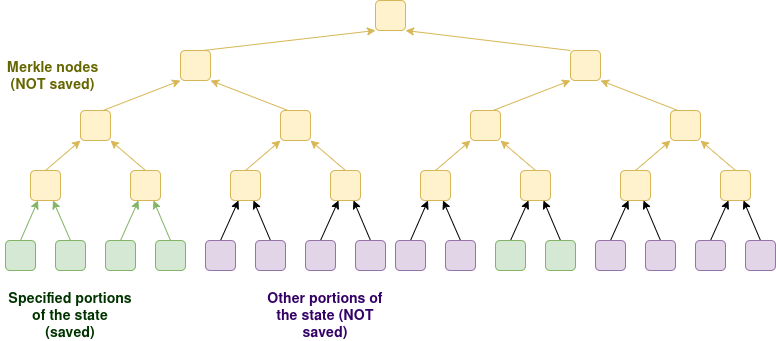
For the medium term, stateless verification—a method allowing nodes to validate blocks without storing entire state data—could halve storage needs. Buterin’s most novel proposal introduces “partially stateless nodes,” which maintain only user-specified portions of Ethereum’s state (e.g., frequently used tokens or active accounts). These nodes would handle most RPC requests locally, defaulting to external cryptographic solutions only for unsaved data.
Users could customize saved state segments via onchain contracts, balancing performance with personalized needs. Buterin argued this approach would retain privacy benefits and reduce reliance on centralized services, even if Ethereum’s gas limit grows “10-100x.”
The plan highlights Ethereum’s evolving tension between scalability and decentralization. By refining node operation viability, Buterin aims to ensure the network remains accessible to everyday users amid rapid technological advancement.