
 beincrypto.com

The leading altcoin, Ethereum, experienced a challenging month in March, marked by a series of bearish trends that reflected a broader market slowdown.
However, as the market begins to show signs of recovery, the key question for April remains: Can Ethereum regain its bullish momentum?
Ethereum’s March Woes: Price Crash, Activity Slump, and Growing Supply Pressure
On March 11, Ethereum plummeted to a two-year low of $1,759. This prompted traders to “buy the dip,” triggering a rally to $2,104 by March 24.
However, market participants resumed profit-taking, causing the coin’s price to fall sharply for the rest of the month. On March 31, $ETH closed below the critical $2,000 price level at $1,822.
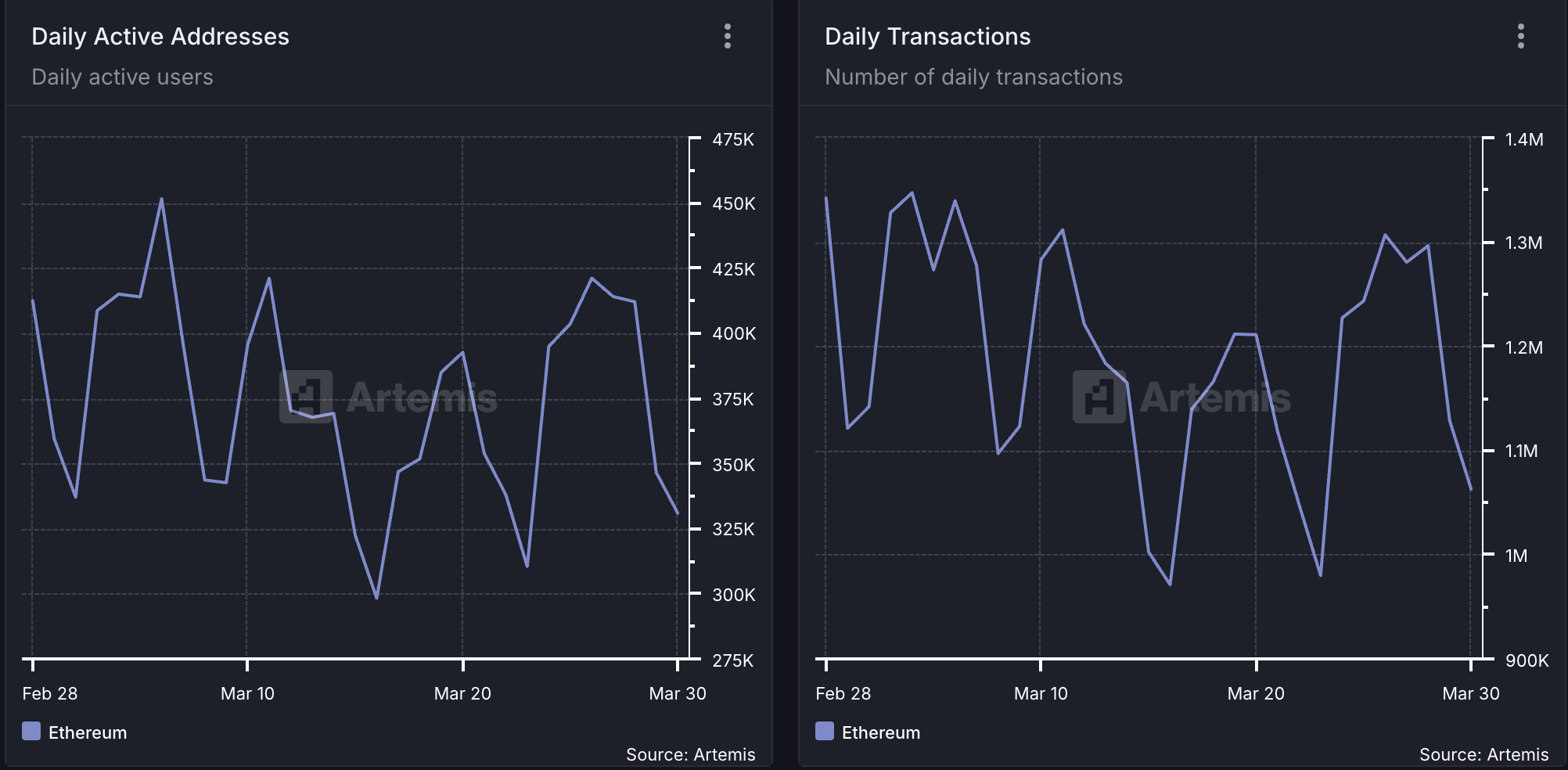
Amid $ETH’s price troubles, the Ethereum network also experienced a severe decline in activity in March. Per Artemis, the daily count of active addresses that completed at least one $ETH transaction fell by 20% in March.
As a result, the network’s monthly transaction count also plummeted. Totaling 1.06 million during the 31-day period in review, the number of transactions completed on Ethereum fell by 21% in March.
Generally, as more users transact and engage with Ethereum, the burn rate (a measure of $ETH tokens permanently removed from circulation) increases, contributing to Ether’s deflationary supply dynamic. However, when user activity drops, $ETH’s burn rate reduces, leaving many coins in circulation and adding to its circulating supply.
This was the case for $ETH in March when it saw a spike in its circulating supply. According to data from Ultrasound Money, 74,322.37 coins have been added to $ETH’s circulating supply in the past 30 days.
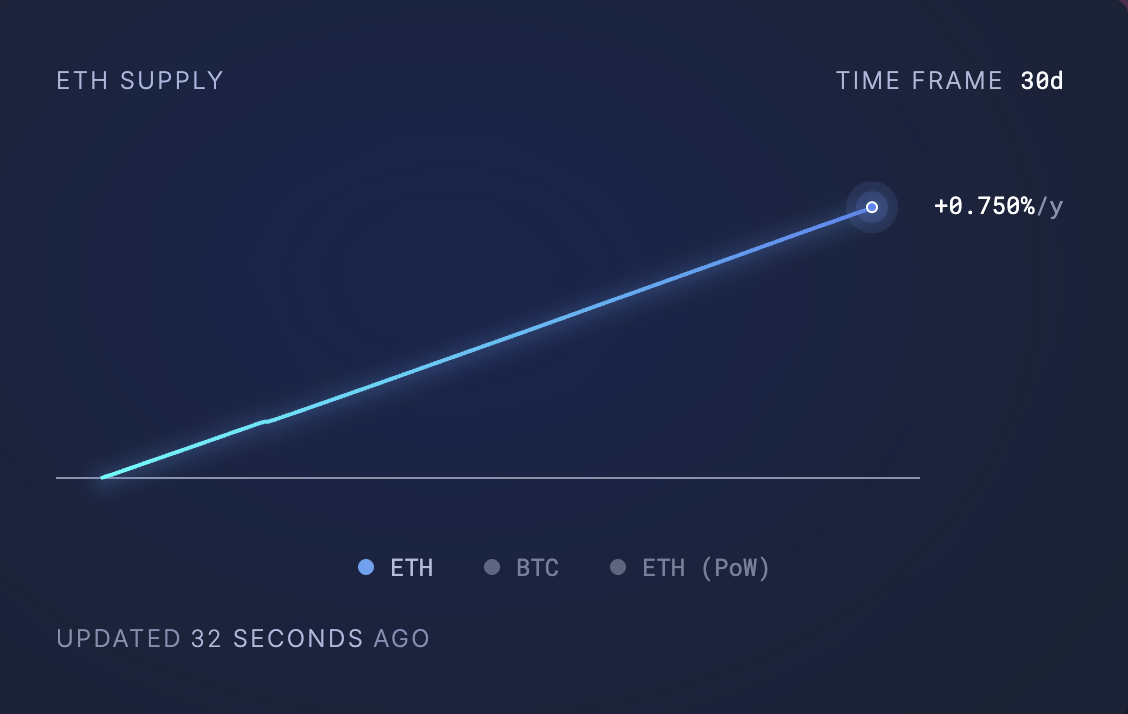
Usually, when an asset’s supply spikes like this without a corresponding demand to absorb it, it increases the downward pressure on its price. This puts $ETH at risk of extending its decline in April.
What’s Next for Ethereum? Expert Says Inflation May Not Be a Major Concern
In an exclusive interview with BeInCrypto, Gabriel Halm, a Research Analyst at IntoTheBlock, noted that $ETH’s current inflationary trends “may not be a major red flag” to watch out for in April.
Halm said:
“Even though Ethereum’s supply has recently stopped being deflationary, its annualized inflation rate is still only 0.73% over the last month, which is still dramatically lower than pre-Merge levels and lower than that of Bitcoin. For investors, this moderate level of inflation may not be a major red flag, provided that network usage, developer activity, and institutional adoption remain robust.”
Moreover, regarding whether Ethereum’s declining network activity has played a significant role in its recent price struggles, Halm suggested that its impact may be overstated.
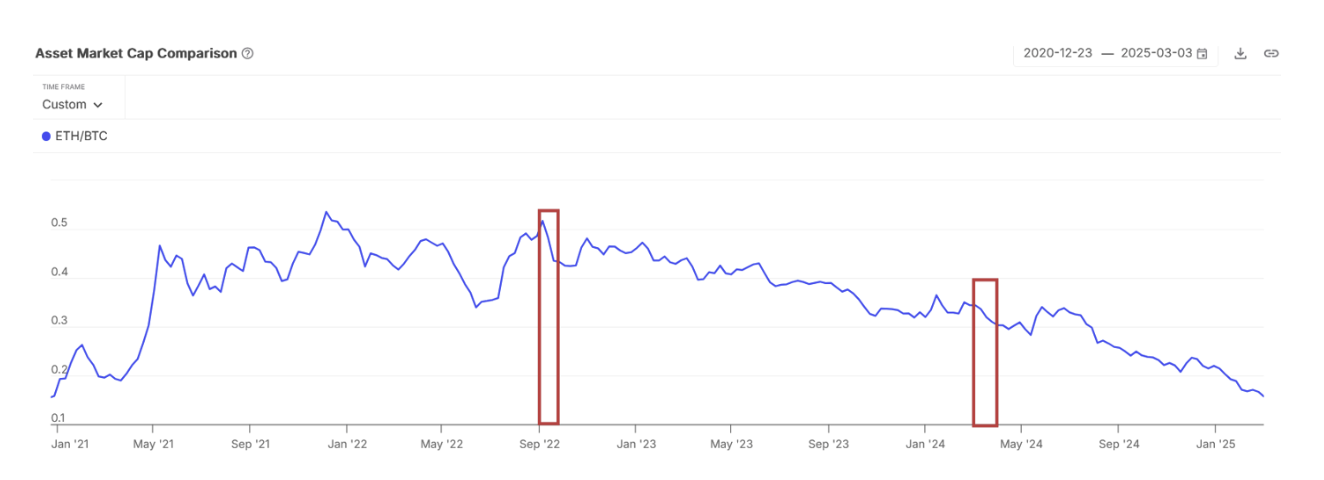
“Historically, from September 2022 to early 2024, Ethereum’s supply remained deflationary, yet the $ETH/$BTC pair still trended lower. This suggests that macroeconomic and broader market forces can play a far more significant role than token supply changes alone.”
On what $ETH holders should anticipate this month, Halm said:
“Ultimately, whether Ethereum dips or rallies in April will likely depend more on market sentiment and macro trends than on its short-term supply dynamics. Still, it’s essential to keep an eye on network developments that could spur renewed activity and reinforce $ETH’s leading position in the broader crypto landscape.”