
 beincrypto.com

Ethereum ($ETH), the world’s second-largest blockchain by market capitalization, has seen its quarterly transaction fee revenue drop dramatically by approximately 95% from its all-time high in Q4 2021.
This decline can be primarily attributed to a decrease in Layer 2 contributions, coupled with a significant dip in activity within the non-fungible token ($NFT) market.
What’s Driving the Drop in Ethereum’s Transaction Fee Revenue?
Token Terminal highlighted this shift in the latest X (formerly Twitter) post. Based on their estimate, Ethereum’s transaction fee revenue for Q1 2025 is projected to reach approximately $217 million.
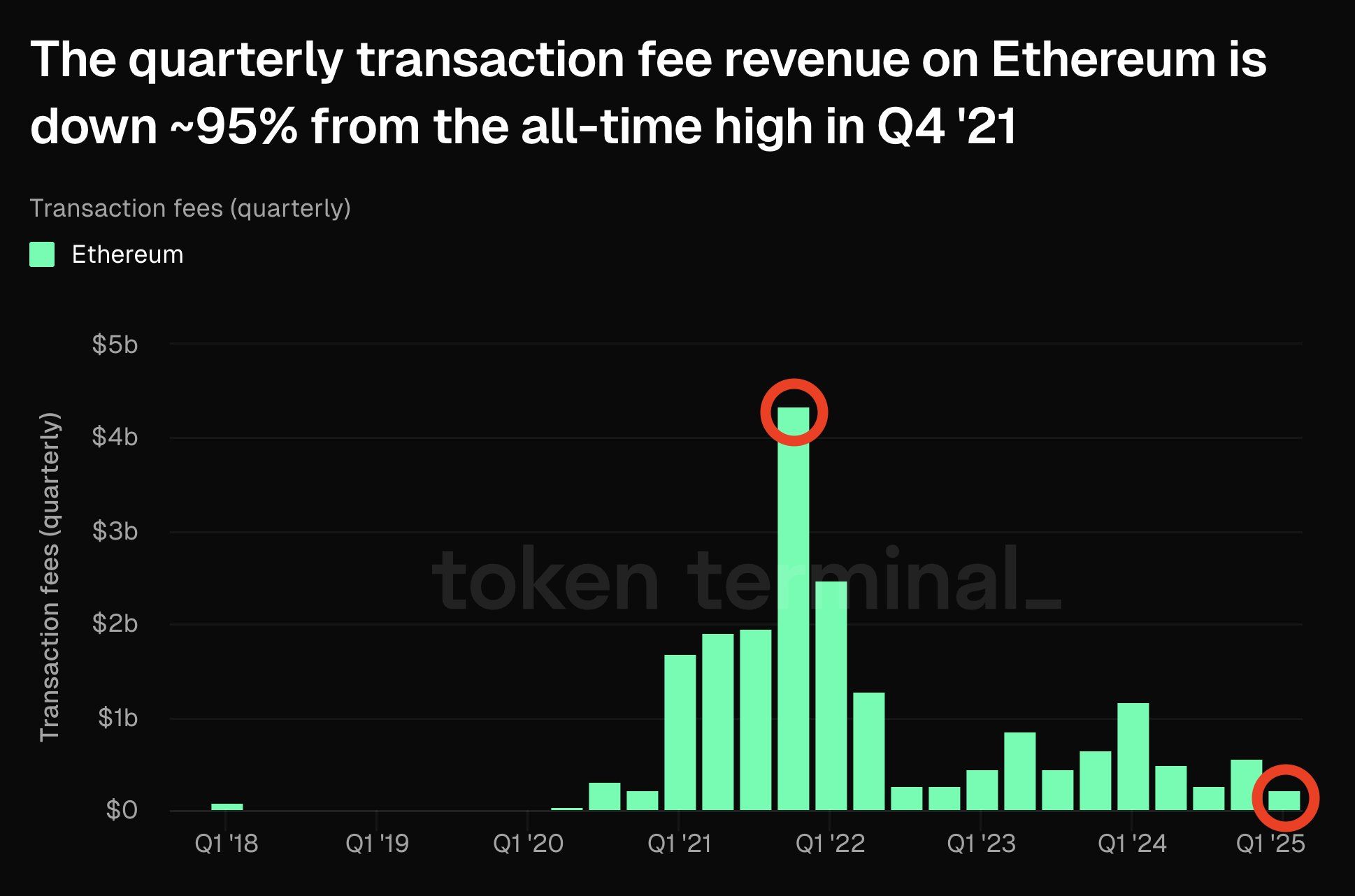
This figure represents a dramatic 95% reduction from the all-time high of $4.3 billion recorded in Q4 2021. At that time, Ethereum’s revenue surged by 1,777% year-over-year, according to Bankless. It climbed from $231.4 million in Q4 2020 to $4.3 billion by the last quarter of 2021.
Moreover, Ethereum’s DeFi ecosystem saw significant growth in Total Value Locked (TVL), decentralized exchange (DEX) volumes, $NFT sales, and Layer 2 TVL. However, the dynamics have changed since then.
This is evident from Ethereum’s recent performance. In 2025, monthly revenues sharply declined, with January recording $150.8 million and February only $47.5 million. Assuming the trend of declining transaction fees continues, March could also see similarly low figures.
Furthermore, in the fourth quarter of 2024, Ethereum generated only $551.8 million in transaction fee revenue, emphasizing the continued downward trend.
One of the major contributors to the decline is the shift to Layer 2 solutions. These have become increasingly popular for their ability to process transactions off-chain while settling on Ethereum’s mainnet.
In addition, the activation of EIP-4844 has significantly reduced the data cost of posting to Ethereum’s chain, further lowering L2 fee contributions. According to a CoinShares report, this upgrade has made transactions cheaper but has also diminished the revenue Ethereum’s mainnet collects from L2 activity.
“Layer 2-related fees, which were high in 2023 and early 2024, have since declined due to cost savings introduced by EIP-4844,” the CoinShares report read.
The decline in $NFT activity has also played a significant role. Q4 2021 marked the peak of the $NFT craze, with platforms like OpenSea recording billions of dollars in monthly trading volume. Nonetheless, now the interest has waned, leading to a sharp drop in transaction volume and, consequently, fee revenue.
$ETH Suffers its Worst Quarterly Decline Since 2018
This decline extends beyond transaction fee revenue. The price of Ethereum has followed a similar downward trend. After reaching an ATH in November 2021, $ETH has dropped substantially, now trading 58.8% below that peak.
Even during the election euphoria, when many cryptocurrencies, including Bitcoin (BTC), saw new highs, Ethereum failed to keep pace.
“$ETH has experienced the sharpest decline in Q1, dropping by -40%, marking its biggest quarterly loss since 2018,” an analyst wrote on X.
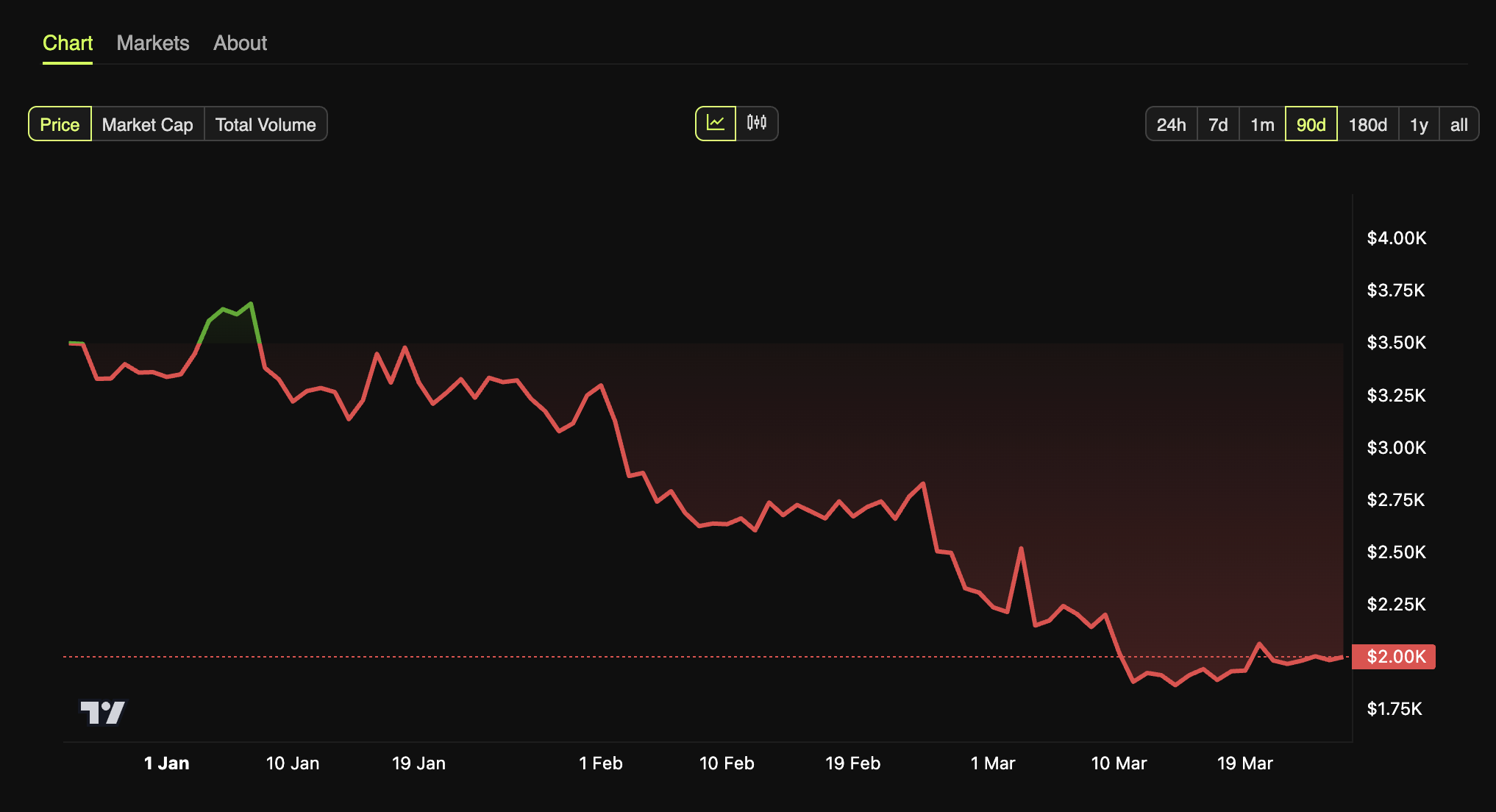
Over the past month alone, $ETH has fallen by 25.1%. As of press time, the altcoin was trading at $1,997, representing a slight gain of 0.45% over the past day.