
 protos.com

Ether’s ($ETH) market cap has shed approximately one-third of its value in bitcoin ($BTC) terms in just 12 months. Even worse, it’s been an embarrassing seven years since $ETH last rallied to a new high against the world’s leading crypto.
During the early months of Ethereum’s initial coin offering (ICO) in 2017, $ETH rallied to an all-time high of approximately 0.15 per bitcoin. It hasn’t surpassed that level since.
Even in 2021, amid several positive catalysts for $ETH investors, it only hit 0.088 per $BTC. That was a commendable comeback from its September 2019 low of 0.016 but still 42% below its 2017 high.
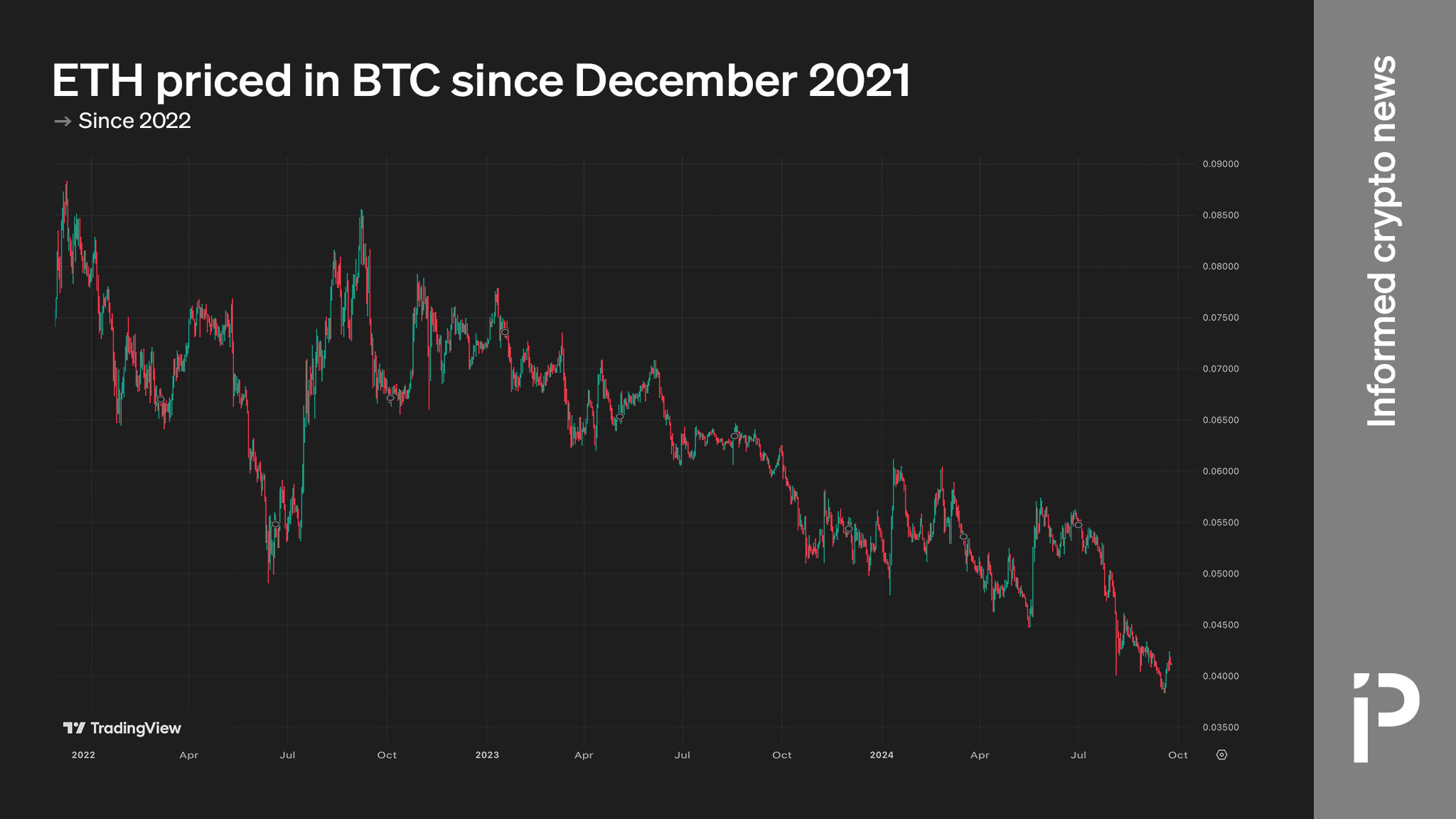
Understanding Ethereum’s failure to re-make a new high in $BTC terms in 2021 is instructive for understanding its current, 32-month-and-counting decline.
Ethereum’s failure to make a new high against bitcoin in 2021
Back in 2021, investors were excitedly listening to announcements about Ethereum’s switch to wealth-based block validation dubbed ‘The Merge,’ predictions of $ETH’s deflationary supply schedule called ‘ultrasound money,’ and most importantly, a network-wide transition to passive yield payouts of over 7% APR.
Indeed, just two months into 2022, predictions reached a feverish 9-12% from even Coinbase Institutional analysts. Today, $ETH’s actual yield is 3.5%.
In 2021, in addition to The Merge, buzzy new uses for $ETH around artwork speculation and supposedly passive income were also attracting mainstream attention.
Despite Ethereum-based NFTs gaining prominence, a resurgence of ultra-high DeFi yields like Olympus’ nose-bleeding 7,300% APY, and a cornucopia of other Ethereum DeFi protocols, investors were only willing to bid 58% as much $BTC per $ETH as they were four years prior.
All of those use cases weren’t enough. Investors have bid less and less $BTC for $ETH ever since.
Read more: All of Michael Saylor’s Ethereum predictions were wrong
Layer 2s, SEC approvals, and benchmark-setting performance
Nowadays, Ethereum’s most exciting and prominent use case seems to be layer 2s — chains of transaction data blocks that are periodically broadcast onto Ethereum’s blockchain. Yes, more blockchains seems to be Ethereum’s latest idea for how to make a comeback.
For 32 months, it hasn’t worked. $ETH has been declining in $BTC terms since December 2021.
This is in spite of many additional, substantial victories by Etherians.
- The famously skeptical Securities and Exchange Commission (SEC) has finally admitted publicly, “The Commission has not concluded that $ETH is a security.”
- The SEC also approved the listing of several spot $ETH ETFs on US securities markets.
- Ethereum has not suffered any major network outage in years, unique wallets are at highs, nodes still number in the thousands, validators exceed 1 million, and most metrics of network health are stable.
Nevertheless, the crypto market appears to remain — as it has since inception — a ‘winner take most’ market.
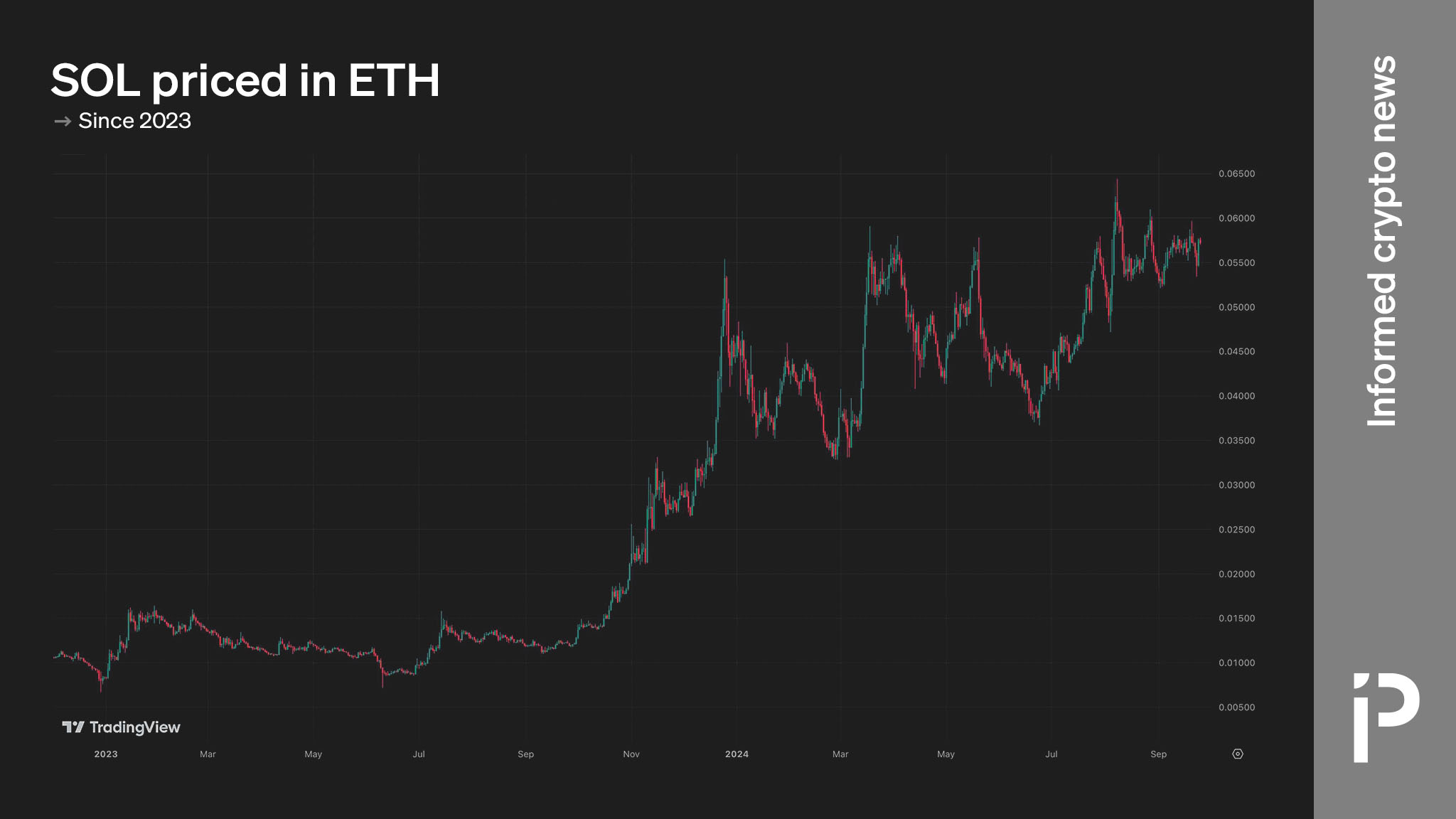
Although there are millions of altcoins, $ETH’s contention in second place has not been enough to convince investors to displace their confidence in $BTC as the most compelling investment in the sector. Indeed, Ethereum competitor Solana has septupled against $ETH since January 2023. Other altcoins are gaining prominence as well, such as Telegram, Binance, and Tron.
As it has for most years since 2009, $BTC alone has a larger market capitalization than the combined tally of all altcoins. Its 53% dominance dwarfs Ethereum’s 15% and it has gained ground for more than two years.